
Healthcare teams are not short on data. They’re short on time to use it well. Patient records, lab results, claims, and messages often sit across different systems, making it harder to catch risks early and act before problems escalate. That’s where AI predictive analytics in healthcare helps. It gives you a better way to spot patterns sooner, focus attention where it matters most, and make more timely decisions.
At Aloa, we help healthcare teams turn fragmented data into more actionable insights. We build custom AI and machine learning systems, including predictive analytics models and internal tools, that help you spot patterns earlier, prioritize the right work, and make better decisions. We typically start with discovery and data assessment, validate the approach through a focused proof of concept, and then scale into a system built around your existing workflow.
In this guide, we’ll explain what predictive analytics is, where it can help most in healthcare, what can go wrong, and how to implement it so your staff can rely on it.
TL;DR
- Healthcare already has the data. The problem is using it before the chance to act passes.
- Predictive analytics helps your team spot risk earlier, support proactive care, and make better day-to-day decisions.
- It works best when tied to a clear workflow, like discharge planning, no-show outreach, staffing, or claim review.
- Good outputs depend on clean healthcare data, a well-fitting workflow, compliance, and trust.
- Common use cases include deterioration risk, readmissions, disease progression, no-shows, capacity planning, and denial prevention.
- The safest path is to start with one narrow use case and test it with a focused proof of concept before scaling.
What Is AI Predictive Analytics in Healthcare in Practice?
AI predictive analytics in healthcare uses current and historical data to catch disease earlier, guide treatment plans, and help you manage resources. It helps clinicians move faster on diagnosis, estimate how a condition may change, and decide what to do next.
Put simply, it answers: What's likely to happen next, and who needs attention first?
Let's say you run care operations at a hospital. A patient may look stable, but their vitals, labs, meds, and notes may already point to decline. A predictive system pulls those signals together and flags risk before it turns into an emergency.
The same applies across operations.
A clinic can score upcoming visits for no-show risk and adjust reminders.
A billing team can flag claims likely to be denied before submission.
A staffing lead can forecast busy hours and adjust coverage ahead of time.
In each case, the value comes from connecting the prediction to a clear next step.
Predictive Analytics vs. Predictive Modeling in Healthcare
Predictive modeling is one part of the process. It's where you build and train the machine learning model.
Predictive analytics is the full healthcare analytics system. It includes the data, the model, the output, and the action that follows. A risk score on its own does nothing. It becomes useful when it changes who gets reviewed first, called first, or scheduled differently.
Common Data Sources
Most systems pull from electronic health records like diagnoses, vitals, and labs. Claims data shows patterns in cost and utilization. Clinical notes add context. Medical imaging supports early detection.
You can also use data from wearable devices or remote monitoring. For example, a home monitoring program can flag early signs of decline before a patient needs to return for care.
The key is not just having the data, but using the right mix to support a specific decision.
How AI Predictive Analytics Works in Healthcare
AI predictive analytics in healthcare usually follows a four-step process:
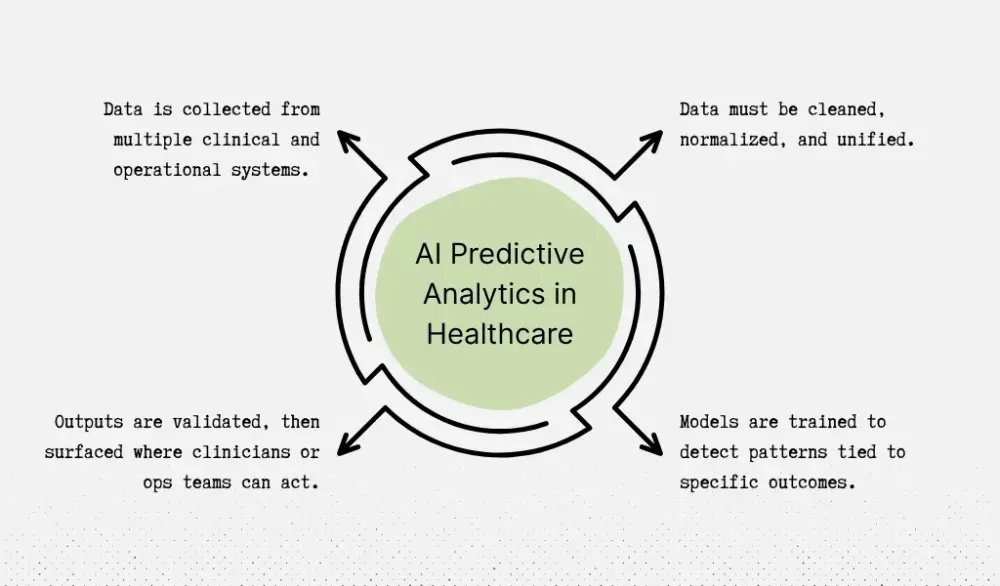
Step 1: Gather the right data
Using AI in healthcare starts with the data you already have. That may include EHR data like diagnoses, vitals, labs, meds, and visit history, plus claims, clinical notes, imaging, and data from wearables or remote monitoring.
The mix depends on the job. A readmission model may lean more on claims and prior use, while a deterioration model may rely more on vitals, labs, and notes.
Step 2: Clean and align the data
In healthcare, the same patient data often lives in different systems, uses different labels, or shows up with gaps and duplicates.
Before a model can do useful work, the data has to be standardized, matched, and pulled into one usable view. Otherwise, the output will be unreliable from the start.
Step 3: Train the model on a specific outcome
Next, the model looks for patterns tied to a clear outcome.
For example, it may learn which combinations of labs, vitals, meds, and prior visits are often followed by a readmission, a no-show, a staffing crunch, or a denied claim.
But the output still has to be tested in your setting. A model that looks good on paper may miss the mark in your clinic, hospital, or billing workflow.
Step 4: Put the prediction into the workflow
This is where the value shows up or falls apart.
The prediction has to reach the person who can act on it. A nurse may need a risk flag in the chart. A scheduler may need a no-show score before sending reminders. A billing lead may need a denial alert before submitting a claim.
Even a strong model fails when no workflow exists around it.
Predictive analytics only works when the forecast changes what someone does next.
Key Use Cases of AI Predictive Analytics in Healthcare
The best use cases start with a choice someone on your staff has to make today. Which patients need outreach first? Who's most likely to decline? Which appointments may fall through? Which claims need review before they go out?
Predictive analytics helps you answer those questions earlier, while there's still time to act.
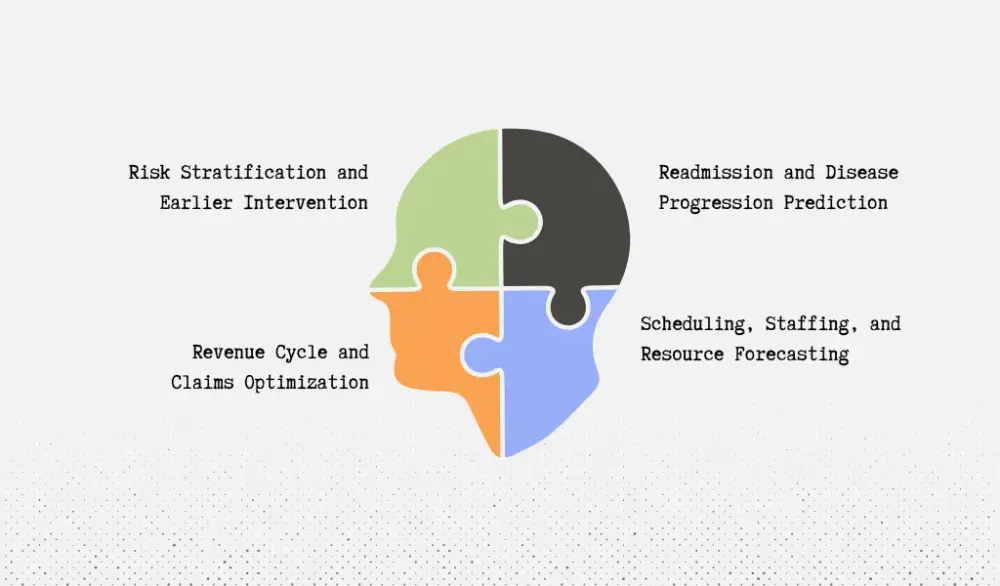
1. Risk Stratification and Earlier Intervention
Risk stratification helps you sort patients by who needs attention first.
Let's say you manage chronic disease patients with heart failure, COPD, or diabetes. You may have 500 patients on your list, but your nurses can only reach 40 today.
A predictive model helps rank that list based on recent risk factors like lab changes, missed visits, medication updates, prior admissions, and ED use.
That changes the workflow.
Instead of calling people in a random order, your staff starts with the patients most likely to need help now. One patient may need a quick check-in. Another may need a same-day call, med review, or urgent follow-up.
2. Readmission and Disease Progression Prediction
Readmission prediction matters most at discharge.
Two patients may leave with the same diagnosis, but their risk of coming back is not the same.
One may have stable housing, family support, and a clear follow-up plan. The other may have multiple chronic conditions, new medications, no ride to the clinic, and a history of missed visits.
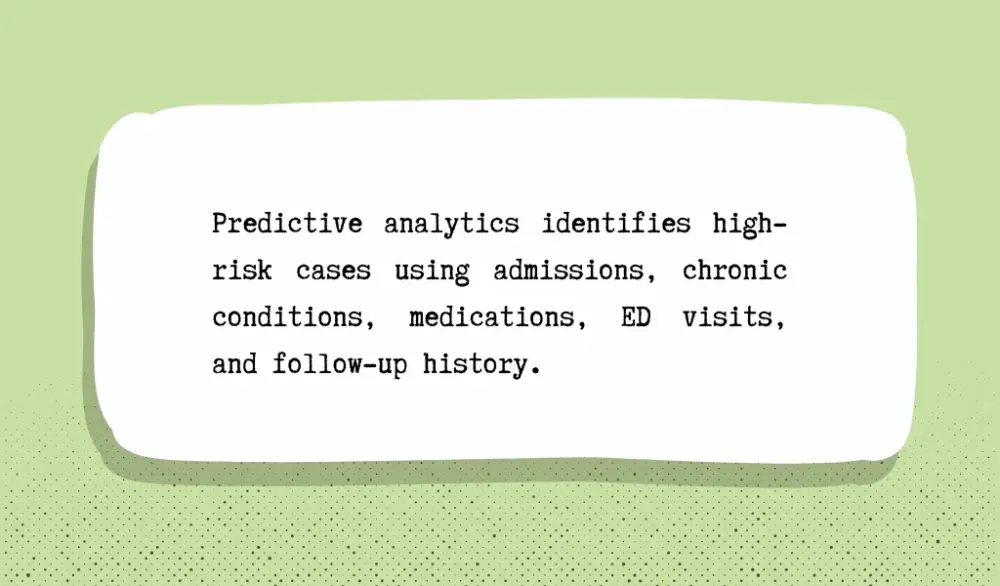
Predictive analytics helps you tell those cases apart. It looks at prior admissions, disease burden, medication load, recent ED use, and follow-up history to estimate who's more likely to return within 30 days.
That gives discharge and case management teams a clearer way to prioritize.
A lower-risk patient may need standard instructions. A higher-risk patient may need a confirmed follow-up appointment, transport help, a medication check, or a phone call within 48 hours.
Disease progression prediction is close to the same idea, but the question changes. Instead of asking who may come back, you are asking who may start getting worse.
For remote care programs or digital health teams, that often means tracking symptom logs, refill gaps, blood pressure, glucose levels, or oxygen readings.
The goal is to catch early signs of decline and step in before the patient ends up in urgent care or the hospital.
3. Scheduling, Staffing, and Resource Forecasting
Some of the clearest use cases show up on the operations side.
Start with no-shows. You may already know certain appointment slots are more likely to be missed, but predictive analytics helps you get more precise.
It can score upcoming visits based on appointment type, booking lead time, patient history, time of day, and past attendance.
That gives your scheduling team a clearer next step. One patient gets a reminder. Another gets a phone call.
If the risk is high, you can double-book the slot or pull in a waitlist patient to avoid lost time.
The same idea applies to staffing and capacity. You can look at scheduled procedures, discharge patterns, past census trends, and seasonal demand to see where pressure is building.
That gives you time to adjust staffing, free up beds, or shift resources before things start to back up.
4. Revenue Cycle and Claims Optimization
Revenue cycle is another area where timing matters.
A denied claim usually means the issue was caught too late. The claim goes out, gets rejected, and your team has to rework it.
That slows payment, adds unnecessary work, and increases cost.
Predictive analytics helps you catch those issues earlier. It can flag claims that are more likely to be denied before submission due to missing data, coding patterns, payer rules, or prior denial history.
That gives your billing team a clearer starting point. Instead of reviewing claims in order, they can focus first on the ones most likely to cause problems.
One claim may need a coding fix. Another may be missing authorization details. Another may need a documentation check before it goes out.
The same approach can also help you spot billing anomalies, underpayments, or patterns that point to revenue leakage.
Across all of these use cases in healthcare, the value is the same. Predictive analytics helps your staff focus first on what's most likely to go wrong, so they can step in with proactive care and make better decisions.
What Are the Benefits of AI Predictive Analytics in Healthcare?
The biggest benefit of predictive analytics is not just better visibility. It’s getting a useful signal early enough to act on it.
In healthcare, this can improve patient outcomes, help staff focus their time more effectively, and reduce avoidable operational and financial strain.
Here are some of the clearest benefits:
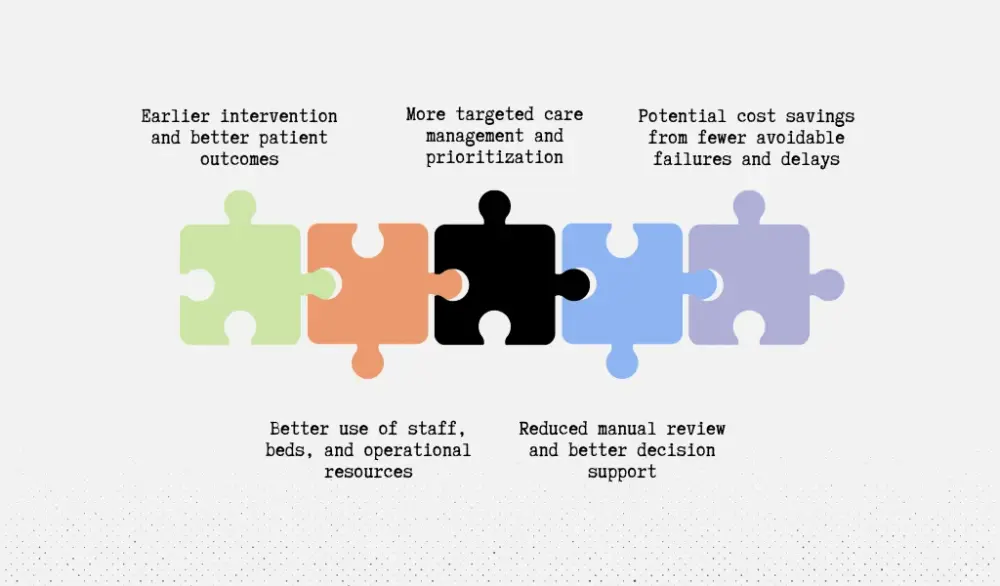
1. Earlier intervention when the risk starts to rise
In a hospital, an earlier warning can make the difference between a quiet chart review and a room full of people responding after a patient crashes.
Johns Hopkins reported that its sepsis warning system identified severe cases nearly six hours earlier than older methods and linked that earlier detection to a 20% drop in sepsis deaths.
For a care leader, that extra time can mean faster antibiotics, better patient outcomes, and fewer cases that spiral before anyone steps in.
2. Better use of staff time and follow-up capacity
Predictive analytics also changes how your staff spends the day. Instead of working through long lists in order, they can focus first on the patients or tasks most likely to need attention.
At the University of Kansas Health System, predictive analytics helped identify which patients were most likely to come back after discharge. The health system then tied that signal to follow-up work and cut 30-day readmissions.
In practice, that means a case manager can start with the patient who has new meds, a history of missed follow-ups, and the highest risk of readmission.
3. Fewer preventable denials and less rework
On the business side, the gain often looks like less cleanup. Predictive analytics helps teams catch likely problems before they turn into denials, delays, or extra manual work.
OhioHealth reported a 42% drop in registration- and eligibility-related denials after using AI-driven patient access tools.
That means fewer claims bouncing back, fewer staff hours spent fixing preventable mistakes, and less delay between care delivered and payment received.
4. More proactive care outside the hospital
The value also shows up beyond acute care settings. Earlier signals can help your teams step in before symptoms worsen enough to trigger an ED visit or admission.
A 2024 study of home digital monitoring found fewer hospitalizations, fewer emergency visits, and fewer total hospital days after the program started.
In everyday care, that can look like a nurse calling before symptoms worsen, a medication issue getting caught sooner, or a patient staying home instead of ending up back in the hospital.
In short, predictive analytics helps you intervene earlier, focus staff attention where it matters most, and avoid some of the failures that are most costly because they were preventable.
Challenges Faced in Predictive Analytics
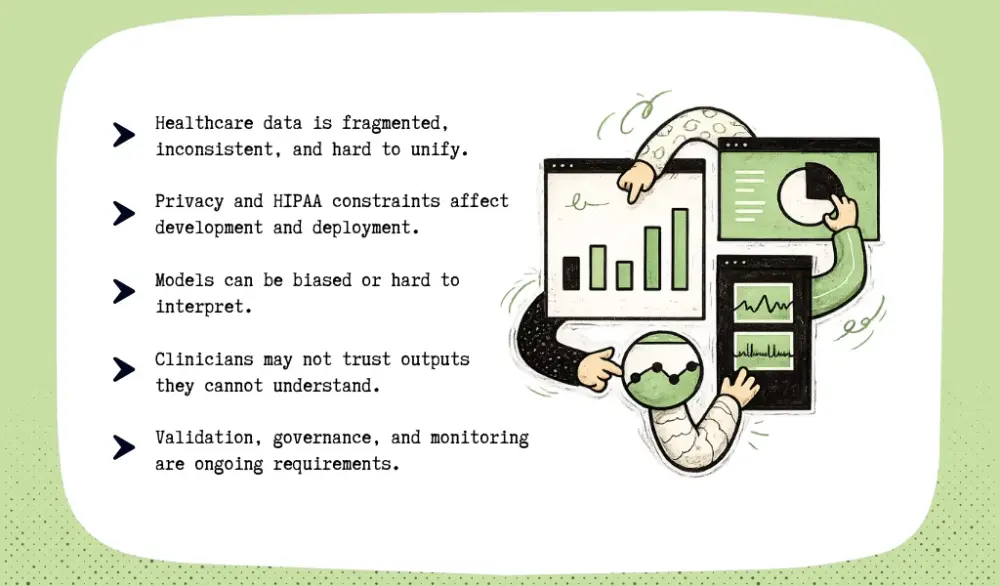
Most predictive analytics problems start before the model ever goes live. The issue is usually not the idea. It’s the data, the workflow, and the conditions around how the system is used.
Disconnected and Inconsistent Data
If you want to predict readmission risk, no-show risk, or who needs follow-up first, the model depends on clean, connected health data.
That’s where things often break. Visit history may sit in the EHR. Claims data may come through a payer feed. Scheduling may live in a separate system. Care notes may be buried in free text.
Now imagine a patient who missed a follow-up. The scheduler marks it as “rescheduled.” The EHR still shows it as “missed.” The care team logs outreach in a note no one else sees.
A model trained on that data may count the visit as missed, completed, or not counted at all. The model isn’t necessarily wrong. It just never saw a clean picture.
Data Privacy and Compliance Constraints
Data privacy makes everything more sensitive in healthcare.
If your team wants to combine EHR data with a third-party AI tool, you need clear answers on who can access the data, where it’s stored, whether anything leaves your system, and whether the process can be audited later.
A lot of projects slow down here because no one mapped the data flow clearly at the start or planned for healthcare AI compliance early enough.
Low Trust in Model Outputs
Trust is another challenge.
A care manager opens a dashboard and sees: “High risk: score 92.” That’s not enough to act on. They need to know why the patient is high-risk and what they should do next.
Something like “missed last two follow-ups, recent ED visit, no refill in 10 days” is much more useful. Without that context, the tool becomes something people glance at and then ignore.
Bias and Ongoing Validation Gaps
Bias can appear more quietly. A model trained mostly on insured patients in urban settings may not work as well for rural or underinsured populations.
The overall accuracy may still look fine, but some groups may get worse predictions. That’s why validation should not stop at launch.
You need to keep checking performance across different patient populations as your data, workflows, and care patterns change.
This is exactly where we focus our work. At Aloa, we’ve built HIPAA-compliant AI tools for healthcare teams, so we’ve seen these issues up close: disconnected systems, unclear data paths, and models that don’t fit real workflows.
At Aloa, we deal with that early. We map the data flow, lock down how PHI moves, and tie every prediction to a clear action your team can take. That’s how we avoid tools that look good in testing but fall apart in day-to-day use.
How to Implement Predictive Analytics for Healthcare Systems?
The best rollout plans usually look smaller and more practical than people expect.
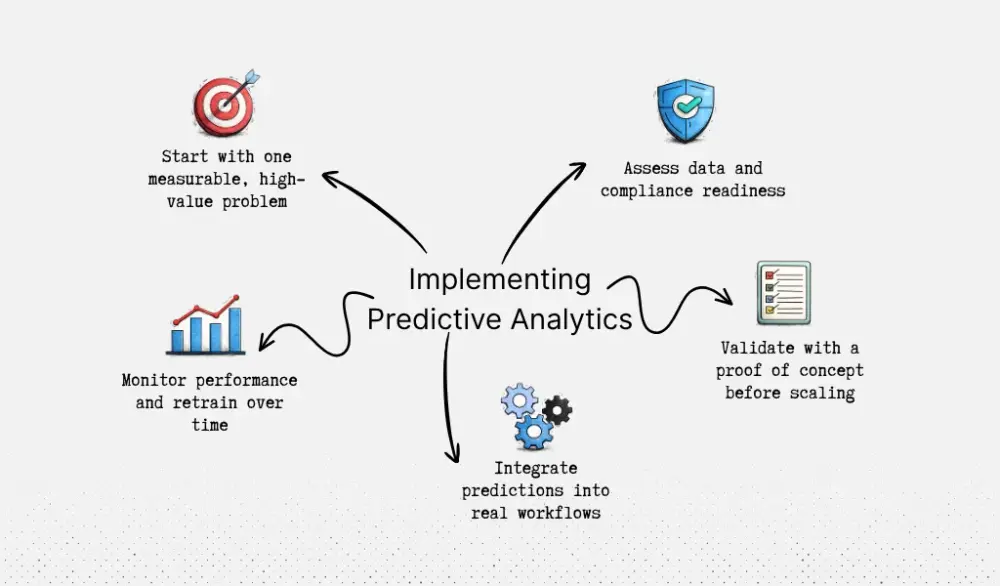
1. Start with one measurable problem
Start with one high-value problem in your care or operations workflow.
Not “we want AI across operations.” Something narrower. One cardiology team with high 30-day readmissions. One clinic with too many no-shows on new patient visits. One revenue cycle team dealing with repeated denials from one payer.
The best starting point is a problem where the pain is already obvious and the outcome is easy to track. When building AI-first products, ask what part of the workflow actually needs AI instead of assuming the whole system does.
2. Check whether your data and compliance setup can support it
Once the use case is clear, make sure your data can support it.
Let’s say you want to predict no-shows. You need to know where appointment history lives, whether cancellations and reschedules are labeled consistently, and whether reminder data sits in the scheduler, the CRM, or both.
You also need to trace where PHI moves. That matters even more when designing HIPAA-compliant AI workflows, where patient data can show up in prompts, outputs, logs, retry queues, and test environments, not just in the EHR.
3. Validate with a focused proof of concept
Before you go wider, test the idea in a smaller setting.
Don’t launch a readmission model across every hospital unit on day one. Start with one service line, one care team, and a limited set of recent data. Then see whether the output actually helps people make better decisions in the real workflow.
A proof of concept should test that early. Aloa’s process is built around that stage, with a working prototype, technical feasibility review, and risk assessment in a 6–8 week window before a larger build.
4. Put the prediction inside the real workflow
A useful prediction has to show up where decisions already happen.
A no-show score should help schedulers decide who gets a phone call instead of just a text. A readmission flag should support discharge planning inside the tools case managers already use. A denial-risk alert should appear before a claim goes out.
It shouldn’t live in a side dashboard no one checks. That’s one of the fastest ways to lose AI adoption in healthcare.
That's also how we think about implementation at Aloa. We're not just building a model. We're helping you design a custom tool around the workflow, compliance limits, and the operational goal you actually care about.
In our guide on AI integration, we recommend adding AI in small, controlled steps without breaking the systems your team already depends on.
5. Monitor performance after launch
Implementation doesn’t stop once the model is live.
Models drift. Data changes. Workflows change. What worked well a few months ago can weaken over time. That’s why someone on the team should own performance reviews, monitor whether the output is still useful, and retrain when needed.
That's also why we usually push healthcare teams toward a focused PoC first before production. It's the fastest way to test the workflow, pressure-test the data and HIPAA path, and see whether the tool earns its place before you invest in full production.
What Are the Trends in Healthcare AI Predictive Analytics?
Here are the trends shaping where healthcare predictive analytics is going next:
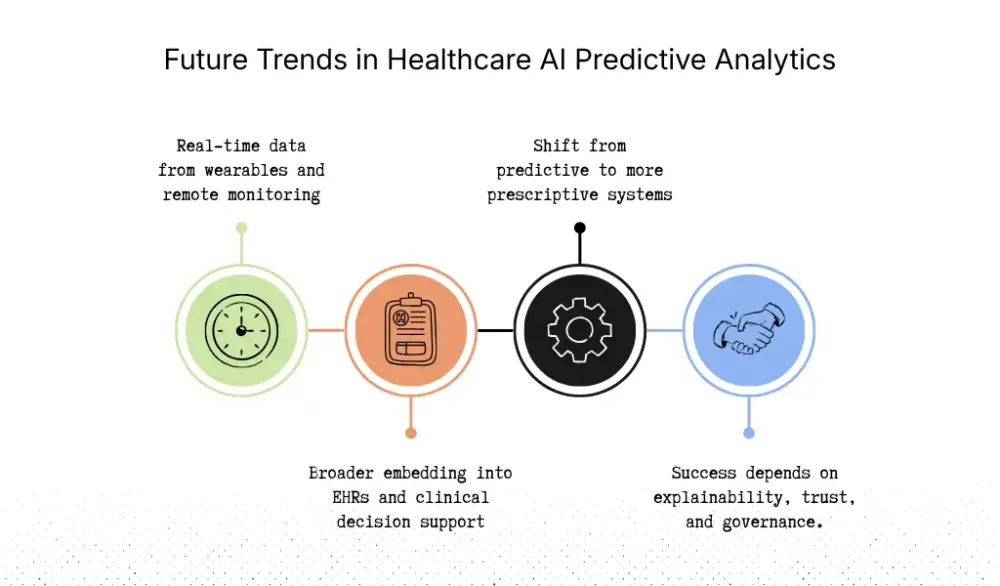
1. More real-time data from remote monitoring and connected devices
More useful signals are starting to show up before a patient ever walks through your door.
You can already see that in remote monitoring. In late 2024, Lee Health expanded its remote monitoring and hospital-at-home program with Biofourmis, tracking more than 700 patients a day and reporting a 50% drop in 30-day readmissions.
For a care team, that changes when action happens. Instead of waiting until the next visit, a nurse can see rising risk from home vitals, call the patient that day, review medications, and decide whether to move up follow-up or bring the patient in sooner.
2. More predictions embedded in clinical workflows
Those signals are also moving into the systems providers already use.
Mount Sinai said in 2025 that it has more than 20 AI-driven decision support tools live in clinical workflows, including models that flag fall risk, malnutrition, and patient deterioration.
That puts the prediction closer to the moment of care, when a nurse reviews a chart, updates a care plan, or decides who needs closer monitoring.
3. More actionable outputs, not just risk scores
Earlier tools often stopped at a risk score. Newer systems are starting to guide the next step.
That may mean showing not only who is high-risk, but why they’re high-risk and what action should happen next. In practice, a care manager may start the day with a short list of patients who need same-day outreach instead of working down a full panel in order.
4. More focus on validation, trust, and real-world performance
Even as the tools improve, the deciding factors stay the same. Health systems still need to test models in real settings, track how they perform, and adjust them over time.
That’s what builds trust. It’s also what determines whether your team actually uses the output once it’s live.
So while predictive analytics will keep improving, adoption still comes down to a simple question: can your team understand the signal, trust it, and act on it when it shows up?
Key Takeaways
Predictive analytics earns its place in healthcare when it helps someone make a better decision at the right time. A readmission score should change how you plan discharge. A no-show model should change how your team handles outreach. A deterioration flag should reach the clinician who can act on it.
That only happens when the data is usable, the workflow is clear, the system fits your stack, and your team trusts the output. Starting with one narrow problem and a focused proof of concept is still the smartest way to test all of that before you scale.
That’s how we work at Aloa. We build custom healthcare AI systems in-house and shape them around your actual workflow, compliance limits, and operating goals. Our team moves from discovery to rapid prototypes to production-ready builds, with the same senior group carrying the work forward. We care about craft, but we care even more about whether the tool holds up in day-to-day use.
If you're evaluating AI predictive analytics in healthcare, book a call with us and bring us the workflow that keeps breaking. We’ll help you pressure-test it, prototype it fast, and build something your team will actually use.
FAQs
How can our healthcare organization start using AI predictive analytics safely?
Start small and tie it to one decision your team already struggles with. For example, instead of “AI for care management,” start with: which 40 patients should our nurses call today? Then check your data (are missed visits labeled consistently?), map where PHI flows, and test it with a small group before rolling it out.
That’s how we approach it at Aloa. We start with a focused use case, build a working prototype in a few weeks, and test it inside your actual workflow. That helps you catch issues early, from data gaps to trust problems. If you want a second set of eyes on a use case, talk to us here.
What data do we need for AI predictive analytics in healthcare?
You usually don’t need new data. You need to use what you already have more clearly.
Most healthcare teams start with EHR data (labs, vitals, diagnoses, meds), then add claims, scheduling data, and notes. For example, a no-show model may rely on appointment history and past attendance, while a readmission model may lean more on prior admissions and medication changes.
The key is making sure the data lines up. If one system marks a visit as “rescheduled” and another marks it as “missed,” your model will break. Before building anything, step back and ask the right questions about AI-first products, your data, your workflow, and what decision you’re trying to support.
How long does it take to implement predictive analytics in healthcare?
It depends on the scope, but most teams can learn a lot in 6–8 weeks.
That’s usually enough time to build a proof of concept. For example, you might test a readmission model on one service line or a no-show model in one clinic. The goal is not full rollout. It’s to see if the prediction actually helps your team act differently.
Full production takes longer because you need integration, validation, and monitoring. But the early phase should move fast so you don’t spend months on something that never gets used.
Can predictive analytics work with our existing EHR and legacy systems?
Yes, but it has to be added carefully. The mistake most teams make is building a model first and figuring out integration of AI later. That’s how you end up with a dashboard no one checks. Instead, the prediction should show up where decisions already happen.
For example, a no-show score should appear in the scheduler before reminders go out. A readmission flag should support discharge planning inside your existing tools.
We usually layer AI into existing systems in small steps so nothing breaks and your team doesn’t have to change how they work overnight. That’s how you get adoption instead of another tool that sits unused.