
Generative AI and large language models come up in almost every artificial intelligence discussion. Leaders, builders, and vendors use the terms like they're the same thing, but they're not. Each type of model handles different tasks, data, and risks. When you blur the line between LLM vs generative AI during planning, your company can end up choosing the wrong tools.
At Aloa, we build custom AI systems for each client. We started years ago when a few of us were building apps for fun, and that builder energy never left. Before we write code, we help you name what you actually need, whether that’s a text copilot or a full multimodal engine. This helps us pick the right models, plan the right setup, and set honest expectations around data, cost, and tuning.
This guide explains what LLMs and generative AI do, how they differ, and where each one fits. With clear examples across several industries, you'll know how to choose the right approach for each use case in your company.
TL;DR
- Generative AI covers every type of content you might create. LLMs handle the language work inside that bigger group.
- If your work is mostly text (tickets, docs, search, reports, or code), start with an LLM and layer in retrieval, tools, and guardrails.
- If you deal with visuals (ads, product shots, training clips), use image, video, audio, or 3D generators, with an LLM helping plan and organize the output.
- Don’t lock into one model. Build a stack you can upgrade as better models drop.
- Aloa reviews your everyday workflows and spots where LLMs or generative models can actually help. We prototype the best ideas and scale the ones that deliver clear results.
How Generative AI and LLMs Work
Generative AI and large language models work in different ways, even though people mention them in the same breath. Generative AI creates new content across many formats, while LLMs focus on understanding and producing language. Once you get a feel for how each one processes information, it’s much easier to choose the right approach.
How Generative AI Works Across Modalities
Generative AI models learn patterns from large training data. After training, they use those patterns to make new content based on a prompt you give them. The kind of model you choose decides what types of content you get, from text generation to image generation and video generation.
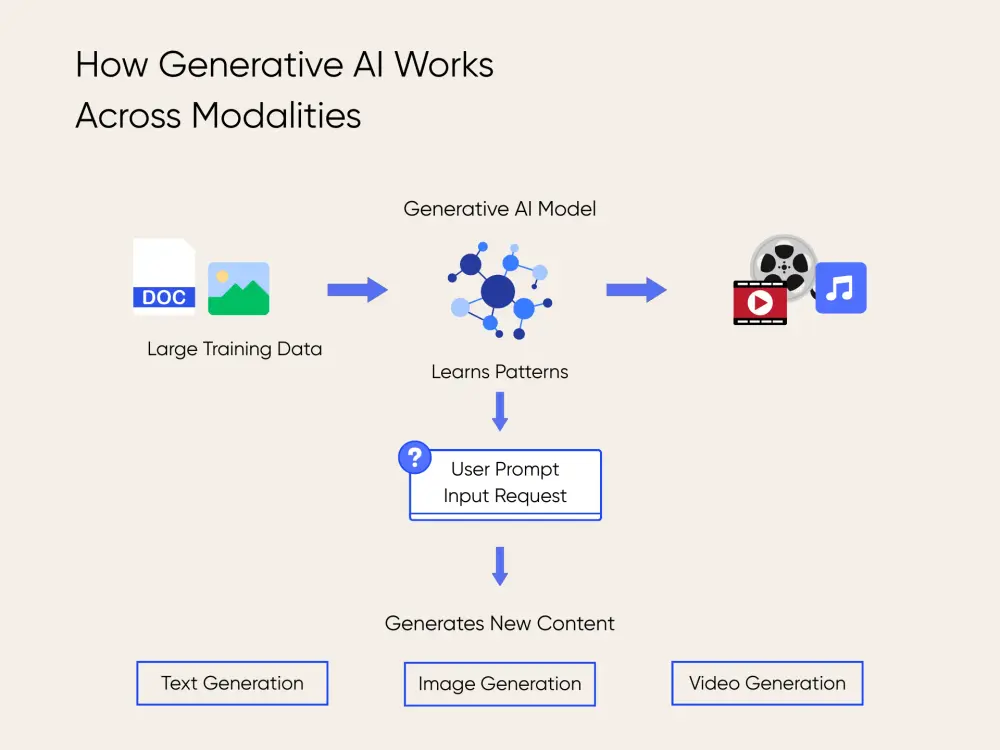
Here’s the quick version:
- Diffusion models start with random noise and turn it into clear, realistic images or video.
- Multimodal transformers take in two things at once, like text and images, and link them together.
- Generative adversarial networks (GANs) use two models that challenge each other to improve output quality.
You see these models in tools most companies already use:
- Midjourney: A Nike creative lead might type “fall running shoes, warm tones” to get visual ideas for creative content before designers begin.
- Sora: A Delta training lead might put a short script into Sora 2 and get onboarding clips back for new hires.
- Suno: A Spotify internal comms manager might use this model to generate background music for a feature update video.
- Meshy: A Target e-commerce team might upload front, side, and back product photos to generate 3D previews for product pages.
You can also see how other companies are using these tools in our insights on generative AI adoption. These tools don’t replace your creatives. They give them original content to react to so they can move faster.
At Aloa, we connect models like these into your existing systems. For example, you can generate product images with a diffusion model, route them through an internal review screen, and push only approved versions into your CMS. That keeps output organized and tied to workflows your teams already use.
How Large Language Models (LLMs) Work
LLMs work with human language and code. They train on huge amounts of text data so they learn how words, sentences, and ideas fit together. When you give an LLM a prompt, it predicts the next word (or token) over and over until it completes a reply. That one action lets it summarize, explain, plan, draft, and handle code generation across many programming languages.
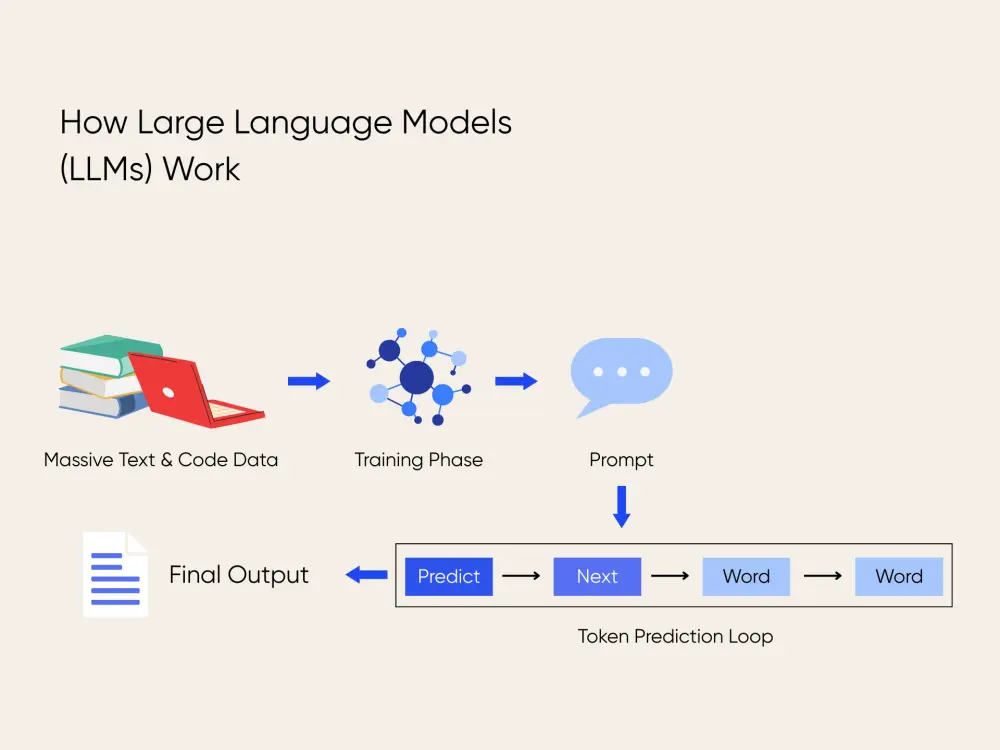
Here are some common LLMs you’ll hear about:
- GPT-5.2 for long prompts and deep answers
- Grok 3 when reasoning uses search and knowledge together
- Llama 4 when you want flexible hosting options
- Gemini 3 Pro for strong text and code support
They all use the same prediction method, but they differ in accuracy, speed, cost, and how well each AI model handles different tasks.
Here’s how LLMs work in actual workflows:
- At Verizon, for example, a support agent enters “customer can’t log in.” An internal bot pulls that customer’s Salesforce record and drafts a reply with next steps.
- At Walmart, an analyst types “sales by region last quarter” into a dashboard. The system builds and runs the Snowflake query for them.
- At UnitedHealth Group, a legal team uploads a contract and gets a short summary with deadlines and obligations.
This sharp difference explains why people mix up LLM vs NLP vs generative AI. Older NLP tools handled narrow tasks like labeling, sentiment analysis, or tagging text. A strong LLM can do many of those language jobs in one model. Generative AI is the broader category that includes LLMs and all the models that produce images, audio, and 3D content.
At Aloa, we test options like GPT, Grok, Llama, and Gemini on your real docs, tickets, and code. We look at accuracy, speed, and cost so we can recommend the mix that fits your privacy rules and workload.
End-to-End Pipeline
Seeing how these pieces fit into your workflows makes the choices clearer.
Here’s a common flow when text is the focus:
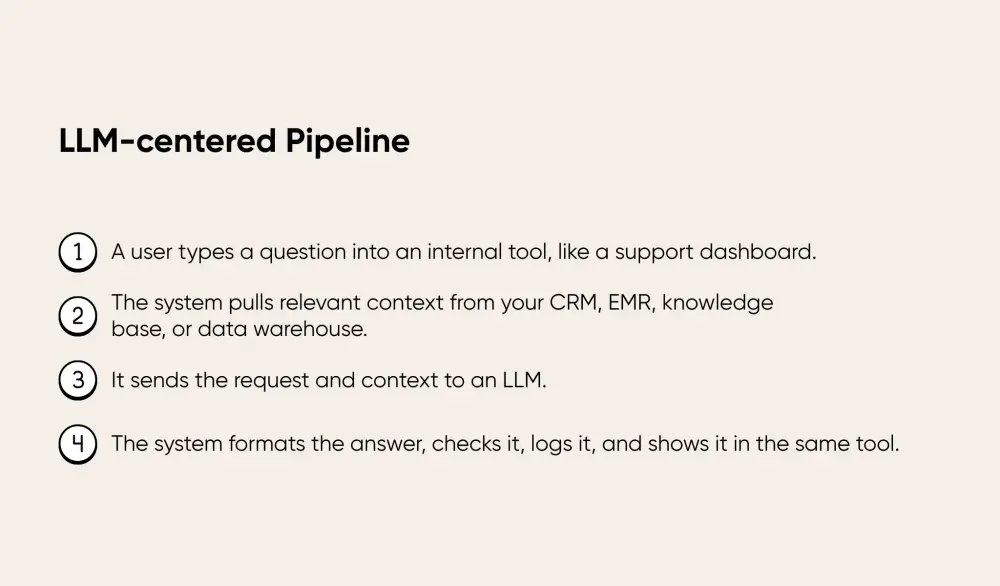
This setup powers internal support helpers, search assistants, contract review tools, and natural language dashboards.
Now compare it to a flow that generates media:
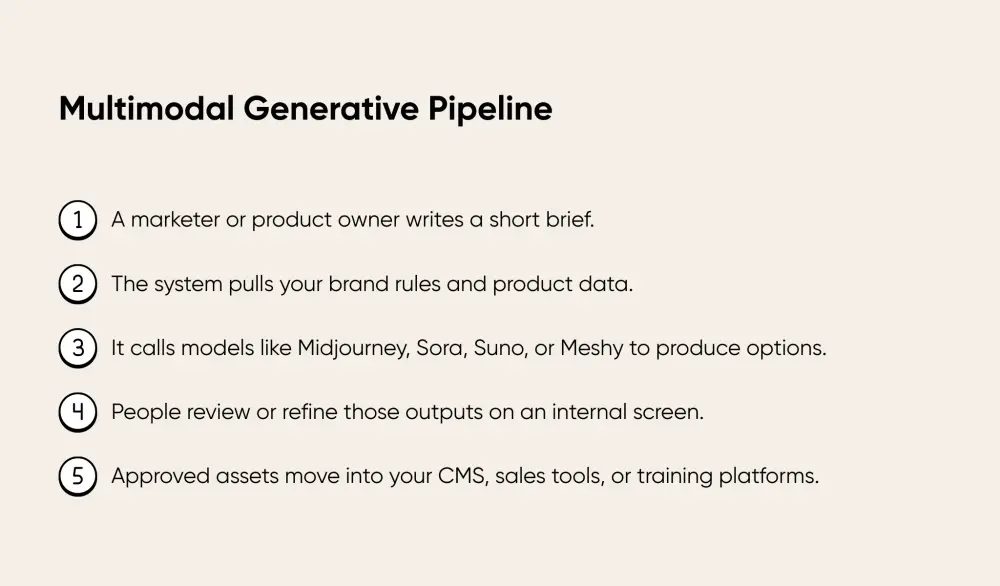
Side by side, you can see where language generation fits, where media generation fits, and where both support one gen AI workflow. Once you map your workflows to these patterns, you can point to specific roles, tasks, and metrics that will improve. Choosing the right tools stops being a guess and becomes a plan tied to measurable AI business impact.
LLM vs Generative AI: What’s the Difference?
In LLM vs generative AI, generative AI is the bigger category that creates new content of many kinds, like images, video, audio, 3D, and text. Large language models are one type inside that group, focused on understanding and generating natural language and code. All LLMs are generative AI, but not all generative tools are LLMs.
Here’s a quick side-by-side you can pull up in a planning meeting or vendor call:
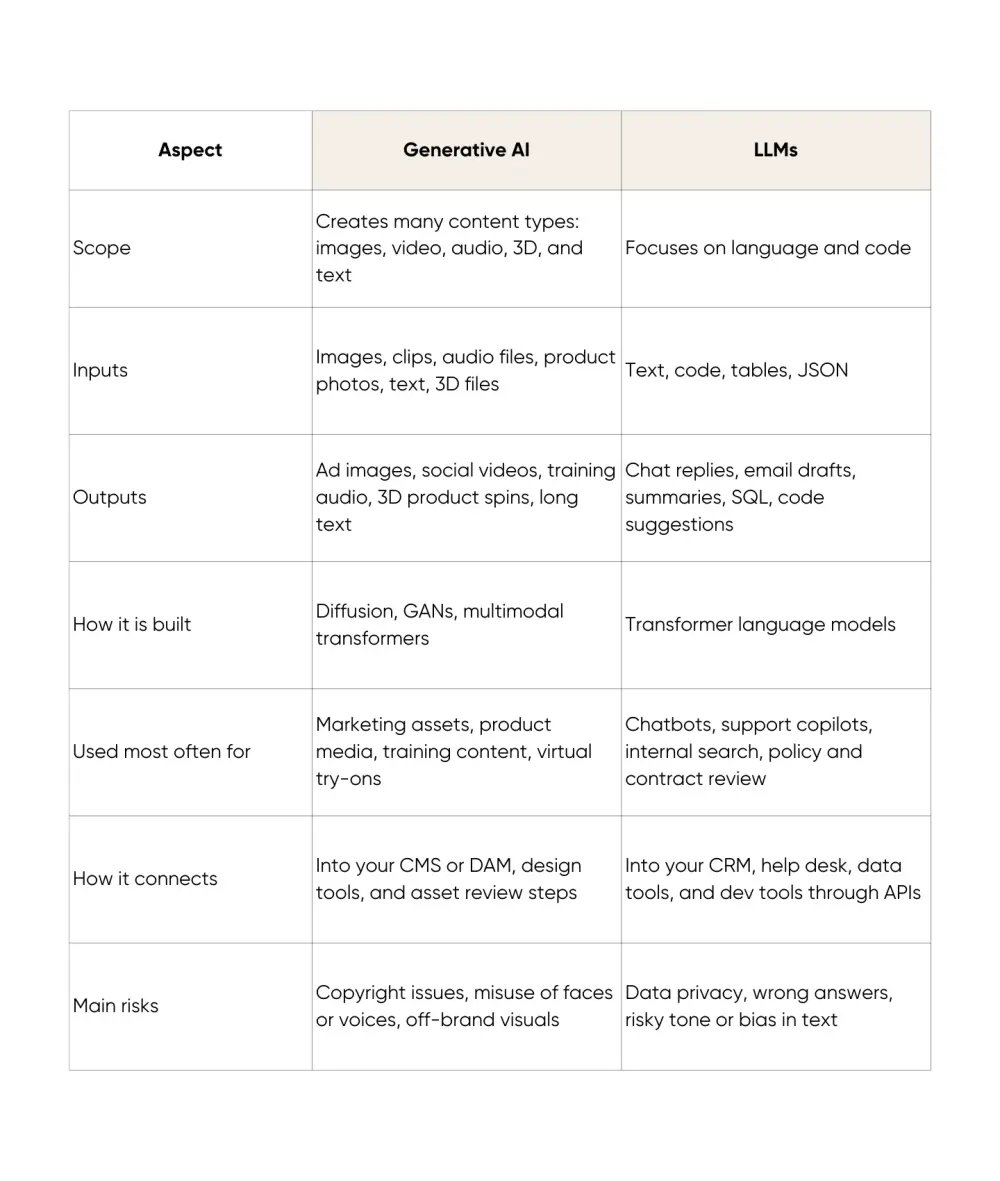
Say you run an e-commerce company. Your merchandising team might use a generative image model to create 3D spins of a new kitchen appliance for your product page. Your support team might use an LLM to draft a clear reply when a customer asks why that appliance shipped late. One set of models shapes visuals; the other shapes language.
Knowing the difference shows you where to invest. If a project is language-first, you put budget into LLMs, retrieval over your documents, and checks for answer quality. If it’s media-heavy, you focus on image or video models and build review steps so marketing or legal can approve assets before they go live.
LLM vs NLP vs Generative AI
These three terms sound close, but they solve different levels of problems:
- Traditional NLP (natural language processing) handles one small job at a time. For example, an airline might tag a tweet as “angry” or pull a flight number out of an email.
- LLMs handle many language jobs in one place. A bank could drop a long disclosure into an internal tool, get a summary, ask follow-up questions, and draft a message to customers using the same model.
- Generative AI is the full umbrella. It includes LLMs and also models that create things like ad images, training videos, synthetic voices, and 3D product previews.
You can map it like this:
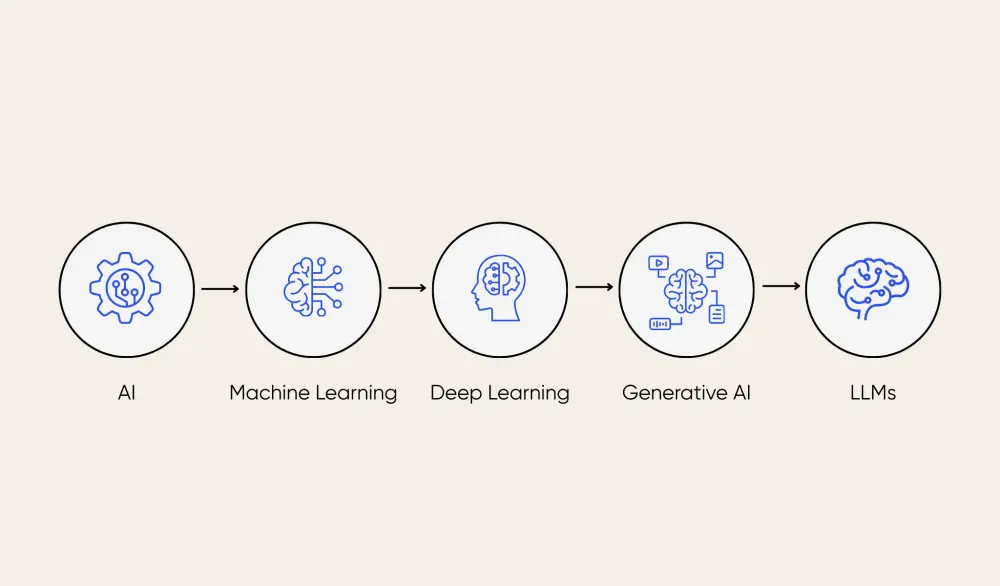
This view helps you decide what to use where. If your marketing team needs new promo images, look at generative image or video models. If your operations team wants a smart assistant that explains warranty rules in plain language, go for an LLM. That clarity keeps projects scoped clean and stops you from asking one model family to do the wrong job.
Real-World Use Cases and Examples
Planning AI gets easier when you can point to what other big brands already do. Here are examples of where LLMs shine, where generative AI leads, and when you use both:
Text-Heavy Workflows Where LLMs Shine
LLMs help the most when the work is mostly words, numbers, or code.
Take customer support. Verizon uses an AI assistant in the My Verizon app that runs on Google’s Gemini models. It helps customers with billing, upgrades, and line changes, and hands trickier issues to a human. Customers get faster answers, and agents step in only when needed.
Inside your company, an LLM can act like a smart internal search bar. Instead of opening ten folders, a product manager types “refund rules for enterprise contracts” into an internal chat. A RAG setup pulls the right pages from your SOPs, contracts, and product docs. The LLM then writes a clear answer with links to sources.
For engineering and data teams, LLMs act like extra teammates. UnitedHealth Group uses hundreds of AI apps, including tools that help about 20,000 engineers write code and help clinicians turn spoken notes into structured text. In your world, that might look like an analyst describing a question in plain language and getting a SQL query they can run right away.
These examples show that when the job is reading, writing, summarizing, or reasoning over text or code, an LLM handles the heavy lifting. Add retrieval for accuracy, add guardrails for tone or compliance, and you get a workflow that scales without slowing your team down.
Multimodal and Creative Workflows Where Generative AI Leads
Generative AI takes the lead when your output is visual, audio, or 3D.
Marketing teams use image and video models to create campaign visuals, landing page assets, or short product explainers. Walmart uses generative tools to help customers find curated product lists faster. Your team could use similar models to turn a short script into a polished product clip or create brand-aligned images for social channels.
Product teams also lean on 3D tools like Meshy to turn basic photos into interactive product models. A sportswear company, for example, can generate 3D spins of a new shoe so shoppers can view every angle in the app without a manual modeling process.
Training and education teams can use generative AI to convert dense manuals into quick video modules or short narrated lessons. Healthcare groups already use GenAI to transform clinical notes into summaries and then into training scenarios for staff.
In most of these flows, an LLM still plays a role behind the scenes. It writes prompts, names files, tags assets, and organizes metadata. The generative models create the visuals, audio, or 3D content. Together, they form a pipeline that moves ideas to production assets quickly.
Industry Examples
Different industries lean on different mixes of LLMs and generative models.
In healthcare, LLMs help with clinical and administrative text. AI scribes listen during visits and draft notes so clinicians focus on patients instead of keyboards. Generative models help with training through synthetic images or scenario videos that avoid using real patient data.
In finance, LLMs handle long, dense writing. A risk team can drop a memo into a tool and get a summary with deadlines and obligations. A compliance lead can ask “What do we say about insider trading?” and get an answer tied to the right policy section. Visual generative tools then support internal presentations by producing charts or scenario animations. (Check out our guide on AI in financial services for more examples.)
In operations and logistics, an LLM can act like an ops copilot. It reads tickets, forecasts, and inventory and suggests actions like shifting stock or adjusting staffing. Generative tools can turn those suggestions into quick visuals, such as route maps or warehouse layouts leadership can compare before making a call. You can see how similar ops workflows benefit from AI in our breakdown of high-impact AI operations practices.
Across these industries, the right mix depends on the job: language → LLMs; media → generative models. Most workflows use both.
At Aloa, we help teams pick the 2–3 use cases that matter most and prototype them fast using the right blend of LLMs and generative tools. We then turn the winners into stable systems that plug into your ERP, CRM, and internal tools.
Generative AI vs LLM: When to Choose Which?
When people talk about the difference between LLM and generative AI, the first question is often “Which model is best?” That skips the real work. A better place to start is, “What job do we need done, with what data, and under what limits?” Once you answer that, the right setup becomes obvious.
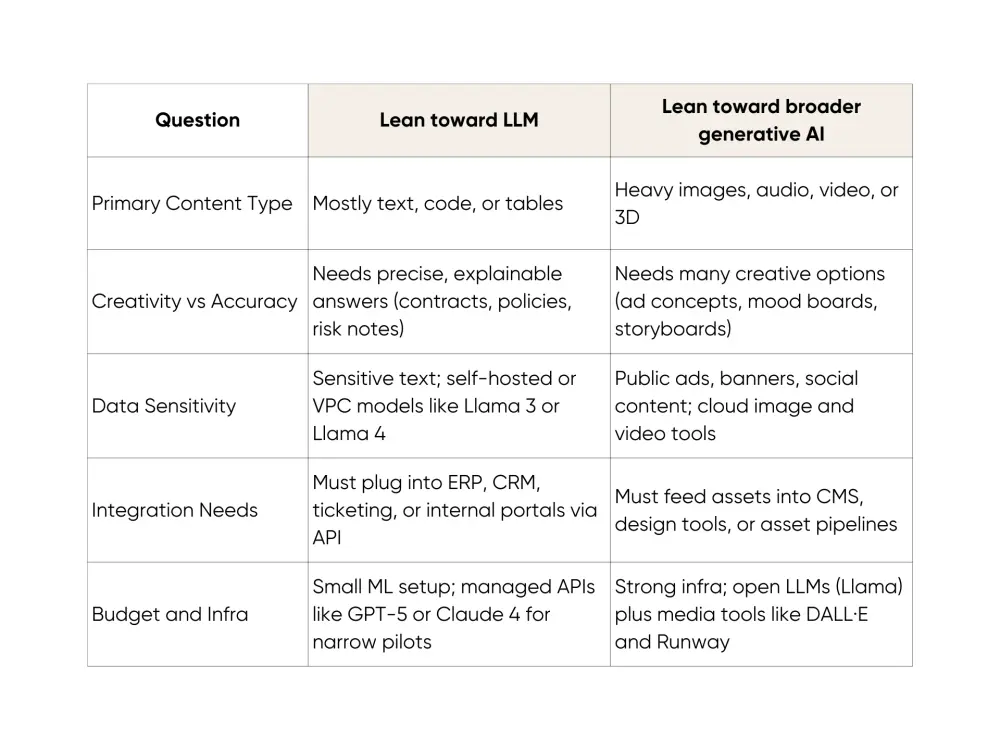
Start from the Problem, Not the Model
Before you touch any model, check the following with your teams:
1) What job are we trying to do?
Look at the exact tasks someone handles each day and match tools to the job. For example, your product team wants a search box that understands messy queries. An LLM such as GPT-5, Gemini 3, or Llama 4 can turn vague input like “blue shoes for flat feet under 80” into clean filters and then call your product API. Shoppers get results based on intent, not keywords, which lifts search accuracy and lowers the number of zero-result pages.
2) What data do we control?
- Mostly text, code, or tables: LLMs like GPT-5, Claude 4, Gemini 3, or Llama 4 work well because they understand and generate text. With retrieval, they answer questions and write drafts using the data you already trust.
- Mostly media such as product photos, videos, audio, or 3D: You lean toward tools like Midjourney or Stable Diffusion for images and Runway for video. An LLM can still help by naming files, tagging assets, and keeping everything organized.
3) What limits matter most?
- A clinic storing EMR notes needs strict privacy: It often uses self-hosted or VPC models like Llama 4 so patient text never leaves the secure environment.
- A retail brand working with public product photos has fewer limits: It can use cloud tools like DALL·E, Midjourney, or Runway to generate visuals quickly for campaigns.
Response time, budget, and your team’s skills shape the rest. A small group may rely on managed APIs. A group with stronger infrastructure may run open models on their own hardware and tune them over time.
At Aloa, we take these answers and your KPIs and turn them into a clear AI plan. These questions show exactly where AI can save time, reduce errors, or unlock new revenue. From there, we design a mix of LLMs and generative tools that fit how your teams already work.
How Aloa Helps Choose the Right Approach
Our goal at Aloa is to make this whole decision easier. We’ve spent years building custom AI systems, workflow automations, and healthcare-grade applications for teams across many industries. So we know how overwhelming it can feel to sort through LLMs and generative tools. Guessing your way through it usually burns time and budget. We give you a clear path so you can move with confidence.
We start with discovery to prevent costly detours. We sit with you, look at your workflows, peek at your data, and ask where things slow down. From there, we point out the use cases that actually move the needle for your team.
Then we narrow the list. Instead of chasing every idea, we pick two or three use cases that give you quick, low-risk wins. Maybe that’s an internal LLM copilot or a small generative video flow. Either way, you get early proof that the direction makes sense.
Next, we choose the right models and setup. We compare options like GPT-5, Grok 3, Llama 4, and Gemini 3 Pro and decide if you should integrate, fine-tune, or build custom. This keeps costs sane and keeps your data where it belongs. When tuning helps, we use our LLM fine-tuning services to match the model to your language and rules.
We build prototypes quickly so you see real results. We measure things like hours saved or ticket load reduced, then turn the winning pilot into a stable system with logging and access controls you can rely on.
And here’s the part people love: we keep your system fresh. New models drop constantly, and our engineers test them the hour they land. You can see examples of this in action in our interactive AI builds and case studies. Because we design systems in modular pieces, we can swap components without forcing a full rebuild. That way, your AI keeps improving while keeping your workflow intact.
Key Takeaways
Here’s what we covered regarding LLM vs generative AI: LLMs handle work made of words and code. Generative AI supports everything else you create or produce, like images, video, audio, and 3D. The nature of your work and your primary workflow will naturally point you toward a different AI stack.
But don’t ever pick a single model and call it done. Build an AI setup that can grow with you. New AI models have been landing every month, and a flexible stack lets you swap in something better without burning your old work.
If you want help figuring out a smart starting point, schedule a consultation with Aloa. We’ll look at what you’ve already tried, call out two or three use cases worth testing, and map a setup that fits your data, compliance rules, and daily workflow. Then we can prototype fast, measure what actually helps, and turn the winners into stable systems you can depend on.
Reach out to us, and we’ll sort out LLM vs generative AI together!
FAQs
Is generative AI the same as an LLM?
No. Generative AI is the big category. It includes tools that create images, video, audio, 3D assets, or text. LLMs are one slice of that category and focus only on language: writing, summarizing, searching, and coding. So GPT and Llama are LLMs. Midjourney, Runway, and DALL·E are generative models but not LLMs. If your work is mostly words, start with an LLM. If your work is mostly visuals, explore other types of generative AI instead.
LLM vs NLP vs generative AI: how do they relate?
NLP is the older toolbox built for narrow language tasks like pulling keywords, tagging sentiment, or extracting dates. LLMs can do those same tasks and also write new text. Generative AI is the wider family that includes LLMs plus tools for images, audio, and video. Many companies use all three layers depending on the job: NLP for structured tasks, LLMs for flexible writing and reasoning, and generative tools for visuals.
Do I need both LLMs and other types of generative AI?
Often, yes. If you run support, documentation, reporting, or engineering, an LLM might cover most of your needs. But if you own marketing, training content, or product visuals, you usually pair an LLM with image or video models. They work well together. The LLM plans prompts, tags files, or writes captions, and the visual model handles the creative output. This is how we design many generative AI systems for clients.
Which is better for my internal tools: generative AI or LLMs?
LLMs almost always carry the load for internal tools. They read your docs, logs, messages, and dashboards, then help with search, writing, planning, or code suggestions. You can add retrieval and guardrails to keep answers grounded in your data. If you want the model to match your tone or rules, our LLM fine-tuning services train it on your own workflows so it behaves the way your team expects.
How do I vet AI vendors who mention LLMs or generative AI?
Ask them to talk about your problems, not their models. A good partner should explain how they’ll plug into your data, protect it, measure quality, and keep the system flexible as new models launch. They should show examples that match your workflow, not generic demos. At Aloa, we lead with use cases and constraints first, because the model choice only makes sense once the actual job is clear.