
Banks now see annual gains of around $340 billion from generative AI in banking. That number grabs attention, but it also raises concern. You work in an industry that moves quickly on new tech and where every decision touches someone’s balance, loan, or credit score. Mistakes can cost money and trust right away.
At Aloa, we build custom AI systems for banks that want GenAI tools that work in the real world. Our team treats compliance, data controls, and audit needs as core elements from day one. We guide you toward workflows that benefit from automation and test your ideas with prototypes that use your data. Then we shape those wins into generative systems that support your daily operations.
In this guide, we'll cover practical use cases, real banking examples, the risks you should plan for, and a simple path to bring generative AI into your operations.
TL;DR
- Generative AI helps banks handle heavy reading and writing. It summarizes fraud cases, checks onboarding packs, drafts underwriting notes, and answers routine customer and staff questions.
- The strongest use cases fit existing workflows. Internal copilots, document intelligence, and fraud review tools deliver quick wins because the data is structured and the risk is manageable.
- Human oversight remains central. Banks use guardrails, retrieval over approved documents, logging, and review steps for anything tied to customer outcomes or credit decisions.
- Adoption works best in phases. Pick 2–3 workflows, run short pilots, then harden security and governance before scaling.
- Aloa supports the full journey. We map workflows, prototype on your data, and ship production systems that plug into your cores.
What Is Generative AI in Banking?
Generative AI in banking can create text, summaries, recommendations, documents, or structured outputs from your own banking data and context. These artificial intelligence systems use models that understand natural language. They can turn raw data and long documents into clear answers, drafted reports, or next-step suggestions for your staff.
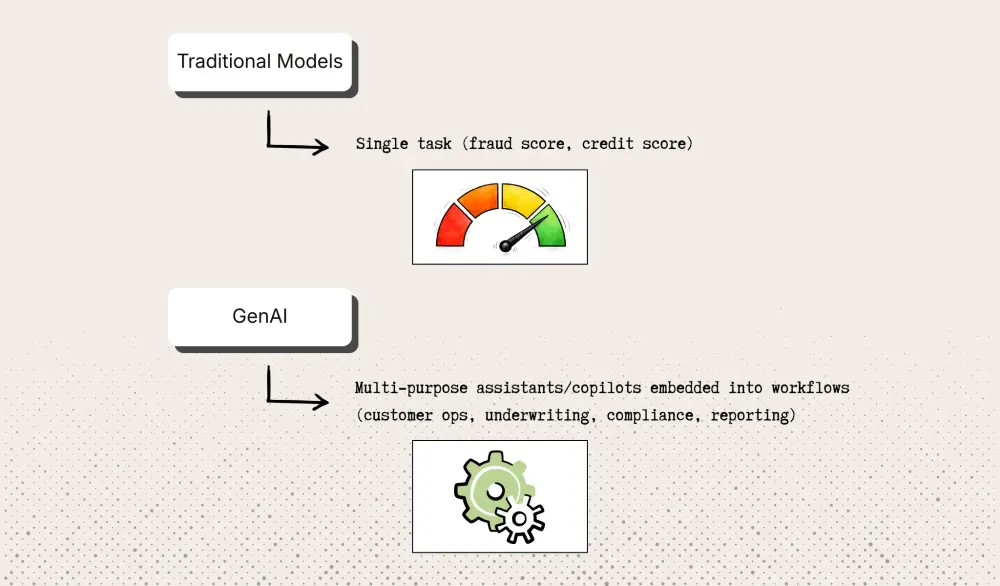
Traditional AI in banking usually did one job. It scored a card transaction for fraud or produced a credit score. Generative AI acts more like a helpful coworker inside the workflow. It can read a 40-page mortgage file, pull out key risks, draft the approval memo, and flag missing documents in one flow. It can also scan new regulatory text and highlight what changes for your current products.
Think about a large retail bank like Wells Fargo handling thousands of small business loan applications a week. A generative AI system can review uploaded financial statements, compare them with internal policy, draft a first pass risk summary, and hand that to an underwriter to edit and approve.
Banks usually run these generative artificial intelligence systems in secure private clouds or on-premise setups. Many connect them to internal knowledge bases using retrieval augmented generation, so the AI only answers from vetted documents. Others build agent-style flows, where the AI moves between systems to fetch data. But humans still approve key actions like final credit decisions or large payments.
How AI in Banking Has Evolved
Financial institutions didn’t jump straight to generative AI. The journey started small and built up over time. At first, banks used rule-based systems. These systems ran fixed checks, like “flag a transaction if it hits a list of bad accounts” or “decline a loan if income is below a set cutoff.” Those early systems worked, but they could only follow simple, hard-coded rules. They didn't adapt.
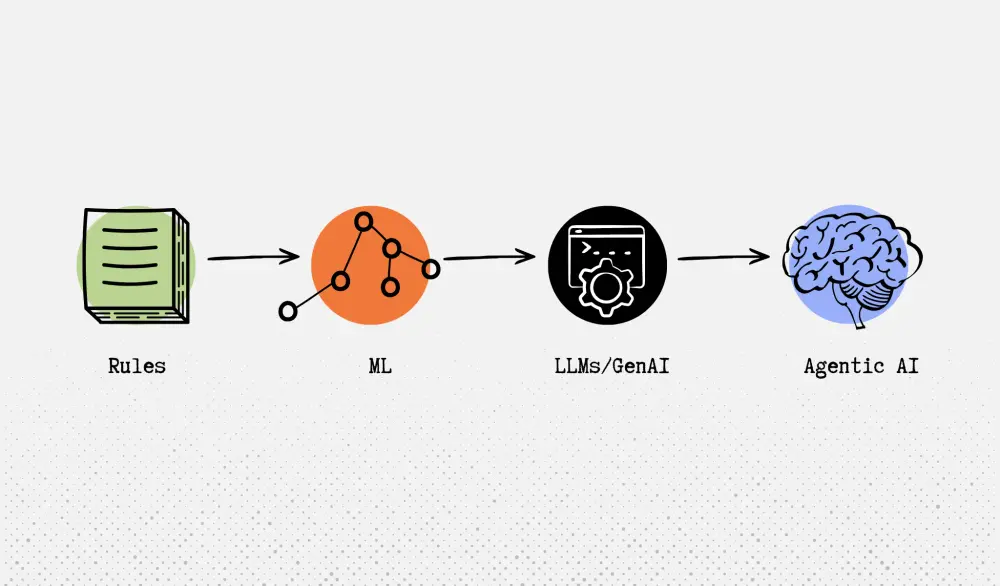
Next came machine learning (ML). Instead of fixed rules, ML models learned patterns from past historical data. For fraud detection, banks like Capital One and Danske Bank used ML to spot new fraud patterns that rules missed. ML also helped update credit risk estimates based on actual behavior, not just set cutoffs. ML models would give a score or probability to help a human make a decision.
Today, generative AI builds on those foundations but goes further. It can generate explanations, summaries, or next-step suggestions, not just a number. For example, a generative AI assistant can summarize a long KYC file and highlight missing documents for a loan officer, or generate a draft customer message from a complex policy.
Ongoing research and early pilots show large language model interfaces and agent-style tools that help staff move through tasks and pull info from multiple systems under human review. Our guide comparing LLMs and broader generative AI approaches breaks down how these models work and where they fit in banking.
This evolution from fixed rules to learning systems to language-native assistants reflects the banking industry’s steady modernization of technology.
Benefits of Generative AI in Banking
Generative AI in banking uses advanced models to analyze vast amounts of transaction and customer data, draft and summarize documents, and power natural-language assistants. It helps banks detect fraud, speed up onboarding and underwriting, and deliver more personalized customer service while reducing manual effort and human error.
Here are the most practical benefits and how they show up day to day:
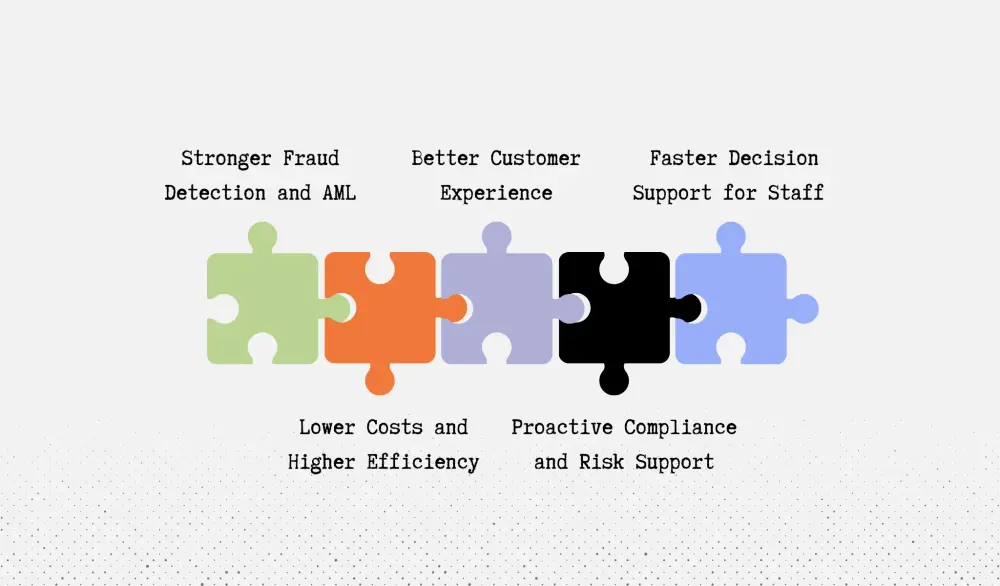
Stronger Fraud Detection and AML
Say your card portfolio looks like Wells Fargo’s. Generative AI reads real-time transaction streams, past fraud cases, and investigator notes. Then it groups related alerts and writes a short explanation for each case. Your fraud team sees why a pattern looks risky instead of spending hours clearing clean transactions.
Lower Costs and Higher Operational Efficiency
In a regional bank that handles hundreds of mortgage files a week, AI reads KYC packs, pay stubs, and collateral documents. Then it pulls key fields into your system and drafts a one-page summary for the underwriter. Your staff checks and edits instead of retyping details from PDFs all day.
Better Customer Experience
A retail bank like Chase can add an in-app assistant that answers balance questions, explains a strange fee, or helps lock a lost card in a short chat. When the issue gets tricky, the assistant passes the case to a human with a clean summary, so the agent doesn’t ask the customer to repeat everything.
Proactive Compliance and Risk Support
When your risk team receives a new 80-page guideline, generative AI reads it, highlights what affects your small-business loans, and drafts the first version of an impact memo. Your team edits and decides next steps instead of starting from a blank page.
Faster Decision Support for Staff
In a bank with many branches, an internal copilot can pull past cases that look similar, summarize what other bankers did, and suggest possible next steps. The banker still makes the call but has the key context in one place instead of clicking through several systems.
These gains only hold when you pair AI with strong data controls and clear human checkpoints. Built that way, generative AI becomes a practical helper across fraud, credit, service, and back-office work.
Top Generative AI Use Cases in Banking
Like us, you probably would value it the most when AI directly enhances the work your teams already do. Here are some interesting use cases of generative AI in banking institutions like yours:
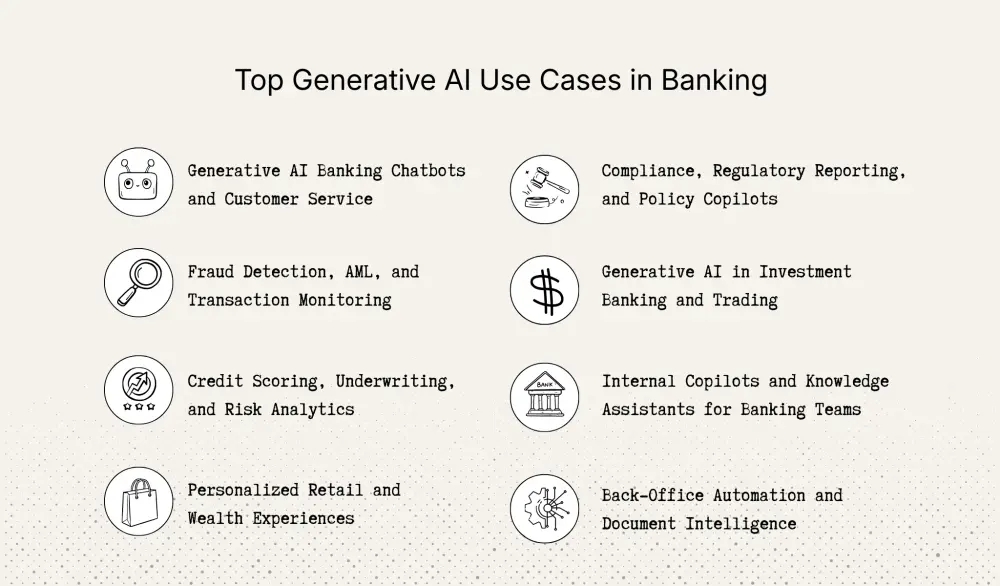
Generative AI Banking Chatbots and Customer Service
When your customer support team gets swamped with repeat questions every day, generative AI chat assistants help lighten the load 24/7. They answer common tasks like balance checks, card locks, address changes, onboarding steps, and basic disputes.
Imagine a customer who just lost their card after dinner. They open your app at 9:30 p.m., type “Can I lock my card?”, and receive a step-by-step guide that takes them to the functionality. Or a business owner asks, “Why did this ACH fail?” A generative AI assistant can interpret your actual ACH rules, look at the transaction context, and explain the specific reason the payment failed.
These assistants can search your approved documents (fee guides, product sheets, policy manuals) and build their replies from that content. That keeps the bot consistent with your rules. With the right prompts, you can also teach the assistant to watch for signals like repeated questions, negative sentiment, or a request to “talk to a person.” When those show up, it routes the conversation to a human queue and passes along a short summary so your agent spends less time backtracking.
Fraud Detection, AML, and Transaction Monitoring
You can use generative AI on top of your existing fraud engines to triage thousands of alerts your system receives every day. Instead of generating new signals, the assistant groups related alerts and drafts short explanations of the patterns it finds so analysts can focus on the higher-risk cases.
For example, you see a sudden spate of $1 test charges, followed by a large online purchase from a new device. The model clusters those events and summarizes them as one case explaining the behavior instead of having you click through multiple screens. You get the full picture in one view.
That leads to quicker investigations and more attention on alerts that really matter. You still control the rules and approvals; the AI just makes the workload easier to review and act on.
Credit Scoring, Underwriting, and Risk Analytics
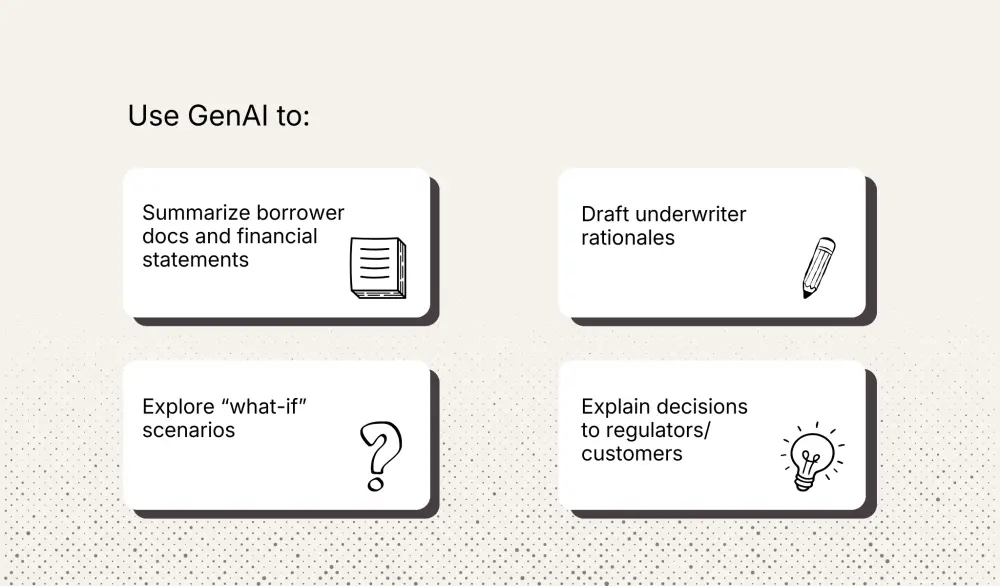
Underwriting involves hundreds of documents and data points like bank statements, tax returns, collateral reports, cash-flow schedules, and more. Reviewing all of that takes time. Generative AI scans those materials, extracts the relevant details, and produces a first-pass summary of cash-flow trends or risk drivers. Instead of starting from a blank page, you review, adjust, and make the final call.
You can ask simple questions like, “How did this borrower’s cash flow vary quarter to quarter?” and get a clear answer in a few sentences. You can also pose “what if” questions, like “What happens to coverage if revenue drops 15%?” The assistant returns a plain-language explanation so your team has context before making a decision.
Personalized Retail and Wealth Experiences
Customers expect financial advice that fits them, not generic messaging. Most banks already invest in making advice and offers feel personal. Generative AI builds on that work by quickly analyzing spending patterns, savings goals, and product use to tailor suggestions more efficiently and at a greater scale.
For example, a customer who pays overdraft fees every month might see a quick message in the app that shows how a low-balance alert could help. Someone who travels often might get card recommendations tied to hotels or airlines they actually use. That kind of relevance feels helpful, not spammy.
In wealth management, advisors use AI to draft short portfolio summaries before client meetings. Instead of building slides and text by hand, the model produces a clean first version that includes key moves, risk flags, and a short plain-language market note. The advisor tweaks it and spends meeting time talking strategy, not creating slides.
Compliance, Regulatory Reporting, and Policy Copilots
When you roll out generative AI in a bank, your compliance workload doesn’t shrink; it changes. You have to track where AI is used, document how models are governed, update disclosures, and show that humans stay in control of key decisions. A generative AI copilot can help you manage that extra work.
For example, when you launch a new AI-powered chatbot, the copilot can pull your internal policies, model documentation, and vendor contracts to draft a first pass of the AI use register entry. That includes what the tool does, which data it uses, which jurisdictions it affects, and the controls in place. It can also suggest plain-language disclosure text that legal and compliance teams review and approve before anything goes live.
These assistants also help with ongoing obligations, like periodic model reviews or regulatory reporting. They can summarize log data and prior findings into a draft monitoring memo, highlight changes since the last review, and assemble supporting evidence into a report format your regulators expect. You still decide what’s accurate and sign off. But you only edit and refine, while the copilot handles the repetitive drafting and document wrangling.
Generative AI in Investment Banking and Trading
Investment bankers spend a lot of time summarizing research and writing pitch materials. Generative AI helps by pulling structured data, analyst notes, and relevant news, then assembling a first draft that your team can edit.
A sector team, for example, could ask it to summarize recent deals and highlight how valuations react to market volatility and market conditions. In minutes, you get a short recap that sits in your preferred format, ready for refinement.
On trading desks, teams use AI to summarize daily market trends or outline scenario ideas tied to recent events. You control anything that touches actual trading decisions, but even simple summaries save hours each week.
Internal Copilots and Knowledge Assistants for Banking Teams
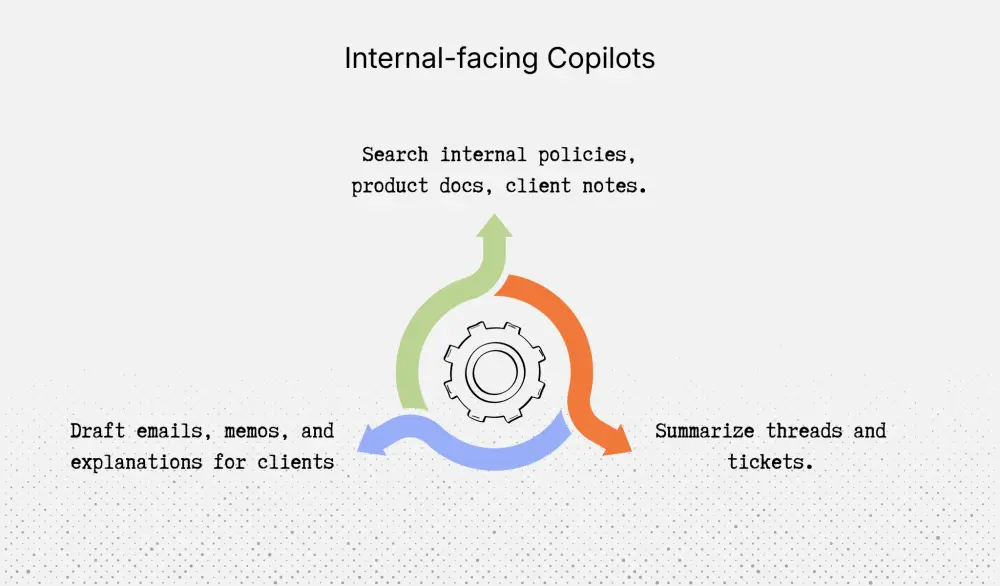
Your staff spends time hunting for answers across systems. Internal copilots let teams ask natural questions like “What is our policy for small business KYC?” or “Summarize key points from the last three emails with this client.” The tool pulls answers from policies, product docs, and notes and returns a clear, linked summary.
For example, a relationship manager can paste call notes into the assistant and ask for a follow-up email draft with next steps. A branch manager can ask, “What checks do I need before waiving this fee?” and get a short, accurate checklist.
These copilots often live right in your CRM or intranet, so teams get answers without switching systems.
Back-Office Automation and Document Intelligence
Back-office teams handle repetitive document tasks all day involving onboarding forms, KYC and KYB packs, loan files, and collateral reports. Generative AI can extract key fields, compare terms, highlight anomalies, and produce short summaries or checklists.
In a business onboarding scenario, the assistant might confirm all required documents are present, flag a missing owner ID, and point out mismatched addresses. In lending, it can highlight differences between a new and an old collateral report.
This turns long manual reviews into short checks. Humans stay in the loop, but their job shifts from searching for information to verifying it. That speeds onboarding, smooths lending workflows, and reduces errors from manual typing.
Across all of these areas, the pattern is: You pick a workflow, set clear guardrails, and let the system take on the heavy reading and writing so your people can focus on judgment and relationships.
Generative AI Examples in Banking
You just saw how the main use cases work day to day. Now let’s look at banks already using these tools so you can see the impact in real operations.
Goldman Sachs - GS AI Assistant and Anthropic Agents
Goldman Sachs rolled out its GS AI Assistant to help employees handle long documents, draft materials, and run quick analyses. About 10,000 people used it early on, and the bank now works with Anthropic on AI agents that support trade accounting, onboarding, and due diligence checks. These tools cut manual steps and shorten tasks that used to take hours.
Bank of America - AskGPS for Global Payments Solutions
Bank of America built AskGPS for its Global Payments Solutions group. It's trained on more than 3,200 internal documents, which helps their staff answer complex client questions in seconds. The bank expects this to save tens of thousands of hours each year and give more than 40,000 business clients faster, clearer responses.
TD Securities - Generative AI Virtual Assistant
TD Securities launched an AI assistant for front-office sales, trading, and research teams. It pulls insights from research notes, market data, and internal content so their teams can prep client calls or trade ideas without starting from scratch. This speeds daily prep work while keeping existing risk controls in place.
DBS - Joy GenAI Chatbot for Corporate Clients
DBS upgraded its Joy assistant with generative AI for corporate customers using the IDEAL platform. Joy answers common business banking questions around the clock and hands tougher issues to human staff with a clean summary. DBS reports quicker responses and smoother workflows for thousands of corporate clients.
These examples show how large banks already use generative AI to save time, improve service, and reduce manual work across their operations. If you’re exploring similar projects, Aloa can help you build internal tools for fintech and other regulated industries. We quickly prototype the right use cases for you and turn them into production systems that fit your architecture and compliance needs. Reach out to us today!
The Future of Generative AI in Banking
Your risk, compliance, and operations peers won’t ask about features first. They’ll ask what happens when a model gives the wrong rate, references the wrong policy, or pulls sensitive data into the wrong workflow. The use of generative AI can help you work faster, but only if you understand where the potential risks sit and how to manage them.
Key Challenges and Limitations
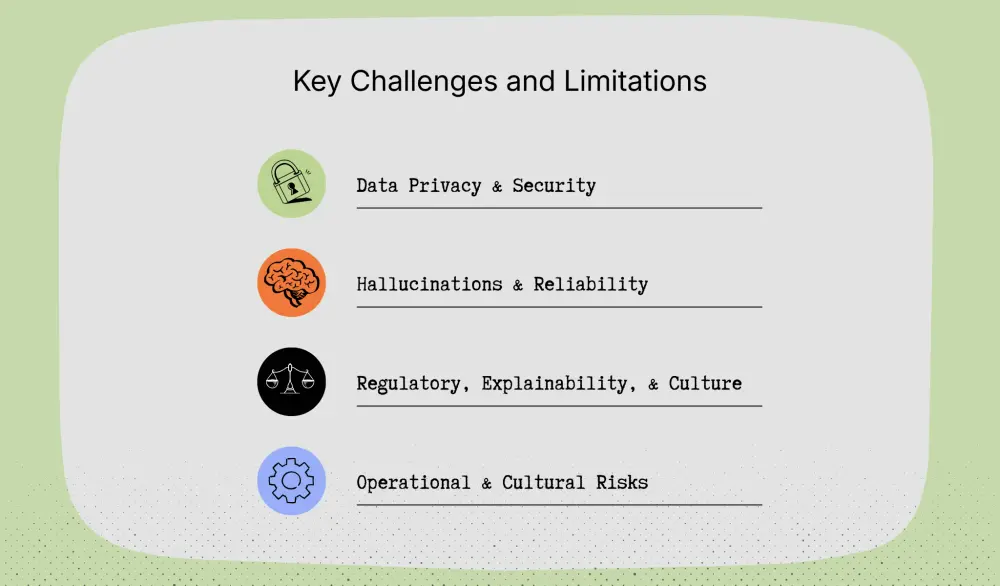
Data Privacy and Security
Banks hold information most industries never touch: full transaction histories, identity documents, income records, dispute notes, and internal messages. Imagine a model trained without strict controls pulling verbatim lines from a customer’s mortgage file into an internal draft. Even if it never leaves your network, it still exposes data in ways your policies don’t allow.
That’s why many banks keep their generative AI tools inside a secure private cloud or on-prem system. They don’t let the AI look at every database. Instead, they create a separate, safe “AI folder” with only the information the AI is allowed to use, and they remove or hide anything sensitive. This folder is also split into smaller sections so the AI only sees data for the right team or product. Every time the AI looks up information, the system checks whether the user has permission. And everything the AI does (every question, document, and answer) is recorded so compliance teams can review it if needed.
Hallucinations and Reliability
AI models can sound helpful and still be wrong, especially if you ask very open questions and don’t tell them where to look. If a chatbot isn’t told to pull from your actual card-dispute policy, it might guess and tell a customer, “Your dispute will be resolved in 24 hours,” when your real service-level agreement is 60 days. If an internal assistant isn’t anchored to your official monitoring standards, it might make up a threshold for when to escalate suspicious activity.
Banks lower this risk by using retrieval augmented generation, which forces the model to answer only from approved documents. Prompts tell the AI to search the right policies first and to say it can’t find an answer instead of guessing. Sensitive steps, like drafting adverse action notices or SAR language, still require a human to read every line and confirm it before anything is sent.
Regulatory, Explainability, and Culture
If a GenAI tool drafts part of a credit summary, you need a clear record of what data it used, how the draft changed during review, and who approved the final version.
Think of it like keeping “AI case notes.” Every time the AI helps with a file, the system saves the prompt, the documents the model pulled from, the draft it wrote, and the final version your team sent. A tool like GPT can also write a short note explaining what changed between versions and why. When an examiner asks why a loan was declined, you can show that full story in a few clicks. Having that trail is often the difference between a quick, smooth audit and a long, stressful one.
Operational and Cultural Risks
Many problems with AI come from how people use it, not from the tool by itself. A relationship manager might paste an AI-written email to a client without reading it carefully. Or a new analyst might treat an AI summary as fact just because “the system wrote it.”
To keep this in check, you can run short training sessions, set clear rules about where AI drafts are allowed, and require human review for anything customer-facing or risk-related. The goal is to help your staff see the model as a smart assistant that still needs checking, not a final authority.
These risks are often manageable and mirror what we see in high-stakes healthcare generative AI projects. They just require the same discipline you already use for credit models, payment systems, and fraud tools.
The Future of Generative AI in Banking
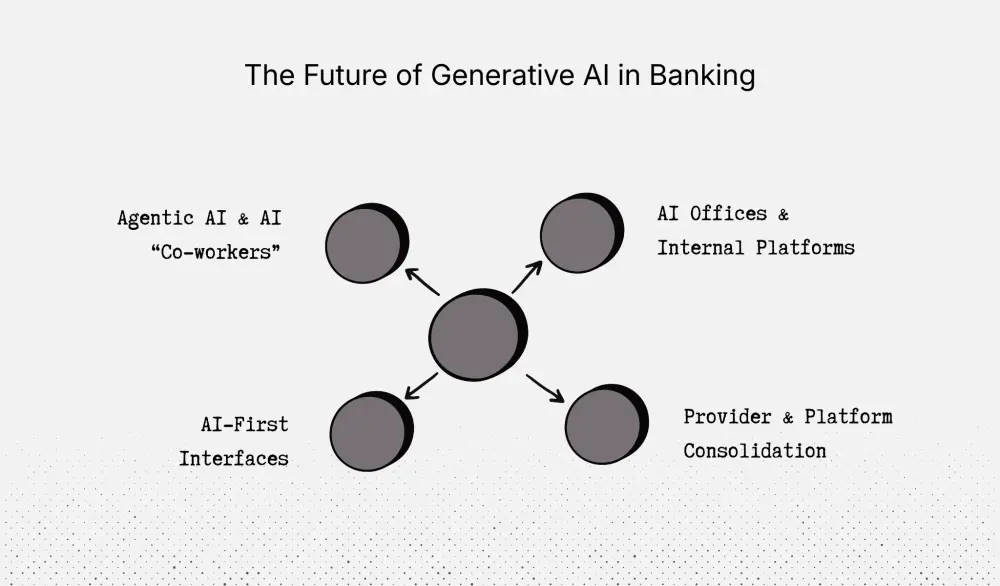
Agentic AI and AI “Co-workers”
Instead of single-step answers, banks will use AI that handles small sequences of work. Picture a wire-desk assistant that pulls recent activity, checks sanctions lists, drafts a review note, and hands everything to a human to approve. Or an onboarding assistant that checks KYC documents, flags missing pieces, and drafts a welcome email. Humans still make decisions; the AI just clears the clutter.
AI-First Interfaces
Many workflows will shift from screens and menus to natural conversations. A commercial banker might type, “Show me red flags for this borrower,” and get a clean summary pulled from statements, payment behavior, and policy guidelines. Customers will see similar improvements in mobile apps, moving from tapping through menus to asking direct questions about fees, transfers, or account rules.
AI Offices and Internal Platforms
Banks are centralizing oversight so AI doesn’t become a patchwork of random tools. CaixaBank’s AI Office is an example of this shift. These teams write the rules, approve projects, and make sure every build meets privacy, ethics, and regulatory expectations. It’s the same idea as enterprise risk management, just aimed at models instead of products.
Consolidation of Providers and Internal Platforms
Large banks are beginning to self-host models so they can control data flow and performance. HSBC’s partnership with Mistral is one example: they run the models on their own systems and use them for translation, analysis, and communication under existing governance. Expect more banks to bring models in-house so data never leaves their infrastructure.
Overall, the future looks less like AI replacing jobs. It's more like AI clearing the repetitive work so people can focus on judgment, context, and conversations, the parts of banking that actually build trust.
Implementing Generative AI in Banking
Rolling out generative AI in a bank feels big, but you can treat it like any other change to core processes. Set clear targets, test on a narrow slice of work, build guardrails, then widen the reach.
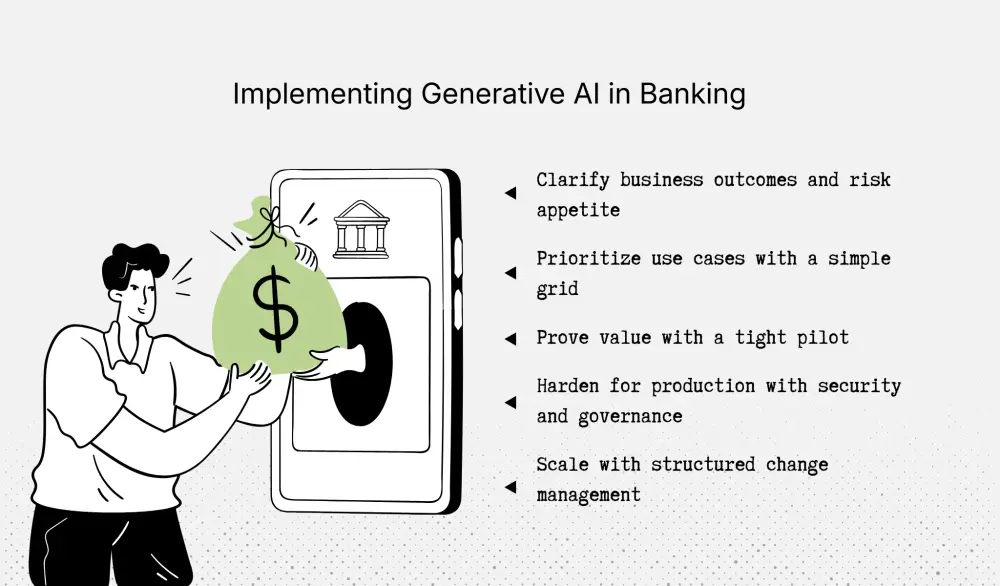
Step 1: Clarify business outcomes and risk appetite
Start with two or three hard numbers, the same type that show up in enterprise generative AI stats and adoption trends. For example, you may want to cut manual review time on fraud alerts by 25%, or reduce small business onboarding from 7 days to 3. Write those targets down.
Then write the limits next to them. You might say, “No customer-facing advice without human review” or “No training on raw customer chat logs.” Bring risk, compliance, legal, and security into that conversation early so everyone starts with the same map.
Step 2: Prioritize use cases with a simple grid
List concrete GenAI applications and score each one on impact, risk, and data readiness.
Imagine your list includes:
- An internal copilot that drafts credit memos
- A document assistant that checks KYC and KYB packs
- A savings coach inside the mobile app
The first two touch staff and documents you already control, so they usually land in a medium-risk band with strong upside. The savings coach shapes customer behavior and advice, so treat it as higher-risk and push it to a later wave.
Step 3: Prove value with a tight pilot
Pick one use case and give it a narrow scope. For example, run the onboarding document assistant for one region and one product line over 6 to 8 weeks.
Give the pilot a single owner and three or four clear metrics: minutes saved per application, reduction in back-and-forth emails, fewer missing documents, and user satisfaction. Meet each week, look at those numbers, read a few real cases, and adjust prompts or rules as you go.
Step 4: Harden for production with security and governance
Once the pilot hits its targets, move it into a more controlled setup. That usually means:
- Using retrieval over your approved policies and templates
- Enforcing single sign-on, role-based access, and full logging of prompts and responses
- Setting up quality checks, alerts, and a clear process for model versioning and retraining
Treat the assistant like any other important system: named owners, documented controls, and regular reviews.
Step 5: Scale with structured change management
When the tool proves itself, extend it to more teams and products. That requires attention to people, not only to models.
Run short, hands-on training sessions with real cases from your bank. Then ask each business unit to nominate an “AI sponsor” who will collect feedback and help coworkers adopt the tool. Update policies, playbooks, and process docs so auditors, new hires, and partners see consistent rules.
Over time, these steps turn a one-off pilot into part of normal banking operations.
Where Aloa Helps
You already juggle fraud queues, growth targets, and legacy systems that don't take change lightly. Our team at Aloa steps in as a build partner so you don't have to figure this out alone.
We sit with your subject matter experts, map messy workflows into concrete AI use cases, and rank them by impact, risk, and data readiness. Using our dedicated generative AI development services, we design and prototype copilots and document tools using your own data. When a pilot proves its value, we turn it into a custom finance-focused AI system that plugs into your core systems and other banking platforms.
If you're planning your next AI steps and want systems that ship and are maintainable, Aloa can help you shape the plan, deliver the first pilots, and scale the ones that earn their place in your daily operations.
Key Takeaways
GenAI already does useful work in banking. You can trim fraud alert review queues, shorten onboarding, speed up underwriting analysis, and give your staff copilots that answer questions in clear language. The strongest projects tie value to trustworthy data and a level of risk your compliance partners accept.
From here, we sit with you, pick two or three workflows, score them for impact and risk, and design focused pilots with clear owners and simple metrics. Then we add governance, logs, and human checks before anything shapes customer outcomes or credit decisions.
If you want help turning that plan into working software, our team at Aloa lives and breathes this work. We map workflows with your experts, prototype, and ship production systems for generative AI in banking that plug into your cores. You'll be working with passionate builders who try new models the hour they launch.
Schedule a consultation with Aloa to get started.
FAQs about Generative AI in Banking
Should I build custom AI solutions using generative AI in banking?
If your products, policies, and legacy systems feel very “bank-specific,” custom builds usually fit better than generic tools. For example, a mid-size bank that handles niche commercial loans often needs an assistant that understands its own covenants and templates, not a generic “loan bot.”
Custom solutions let you point the model at your policies, pricing rules, and credit playbooks, then design guardrails that match your risk appetite. Off-the-shelf tools can help you learn, but they rarely match your exact workflows or controls.
What are the biggest risks of generative AI in banking?
The big ones sit around bad answers, data misuse, and weak oversight. A model might give a confident but wrong explanation of a fee, misread a document, or suggest a step that conflicts with policy. That can trigger complaints and extra work for your staff.
You also need to control who sees what. If you let prompts and responses mix across lines of business without rules, sensitive details can land in the wrong place. Strong access controls, retrieval over approved content, and human review for anything tied to customers or credit help reduce that risk.
What are the most common generative AI applications in banking?
Right now, banks rely on a few use cases:
- Fraud and AML case summaries for analysts
- Document review for KYC, KYB, and lending
- Chat assistants for routine customer questions
- Internal copilots that answer policy questions or draft memos
For example, a branch team might use a copilot to draft follow-up emails after calls, while an operations group uses document intelligence to flag missing items in onboarding packs.
How long does it take to implement generative AI in banking use cases?
For one focused workflow, you can often reach a live pilot in 6 to 8 weeks. That covers scoping the use case, connecting the right data sources, building the first version, and letting a small group of users test it.
Turning that pilot into a bank-wide tool takes longer. You need to add monitoring, integrate with more systems, and train staff. Many banks treat that as a separate phase with its own plan and timeline.
Do banks need in-house AI teams to implement generative AI?
You need internal owners who understand your products, processes, and risk rules. You don't always need a large in-house AI lab on day one. Many banks pair a small internal group with a specialist build partner.
At Aloa, we are that partner. We bring engineers who work with new models the hour they launch, while your staff set direction and guardrails. Together, we design use cases, prototype quickly, and hand off systems your own tech group can run and extend.