

In 2026, fintech blockchain isn’t just speculation anymore. We’re now seeing real-world infrastructure making things like stablecoins, tokenized real-world assets, and blockchain-based settlement rails more available to everyday fintech users. This goes far beyond faster and more affordable transactions. Fintech blockchain is making financial services more transparent, feature-rich, and accessible than ever before.
At Aloa, we design innovative fintech blockchain systems tailored to your vision. Every build starts with understanding your day-to-day challenges and long-term vision. We also share what we learn through detailed case studies, so each innovation builds on the last.
In this blog, we’ll discuss some of the latest and most impactful industry insights on fintech blockchain. We’ll go over how the industry is evolving, from regulation changes to the strategic considerations that come from new developments. Let’s dive in!
TL;DR
- Blockchain’s transformation of fintech is already well underway, with real-time payments, transparent ledgers, and decentralized finance capabilities.
- Decentralized finance (DeFi) is disrupting traditional financial intermediaries with peer-to-peer lending and trading, among other financial innovations.
- Asset tokenization is increasing liquidity by making high-value trades more accessible. By turning real estate or stocks into digital tokens, they can be fractionally owned and traded on blockchain-based platforms without needing a middleman.
- Blockchain is bringing enhanced security, trust, and efficiency. Automated transactions make financial operations less costly, while transparency-by-design shields them from fraud.
What is Fintech Blockchain?
Fintech blockchain refers to the applications of decentralized blockchain ledgers in fintech. This enables things like real-time peer-to-peer payments, cross-border transfers, tokenized assets, and more.
At its core, blockchain functions as an accounting system and digital ledger for fintech companies, enabling transparent auditing and immutable record-keeping essential for seamless operation.
By distributing up-to-date ledger data to all devices on the network, blockchain ensures nearly impossible data tampering, enhancing security and trust in transactions. One of blockchain technology’s earliest and most notable applications is Bitcoin, a decentralized digital currency facilitating peer-to-peer money transfers without a central authority.
Fintech app development experts are recognizing the value of ledger technology, commonly known as blockchain technology, in revolutionizing financial operations. By leveraging blockchain, financial companies can streamline operations, reduce transaction costs, and bolster security against identity theft and digital fraud.
Blockchain in Fintech: Top 7 Trends
Blockchain in fintech is revolutionizing traditional financial processes and driving innovation across the industry. As fintech evolves, staying updated on blockchain trends is crucial for businesses aiming to stay competitive and capitalize on emerging opportunities. Here, we present the top 7 trends in blockchain for fintech, highlighting its transformative potential.
Trend #1: Market State Fluctuations
Market state fluctuations refer to the dynamic shifts in the value, size, and distribution of the fintech Blockchain Market. According to Acumen Research and Consulting, the fintech Blockchain Market Size accounted for USD 2.2 billion in 2022 and is projected to achieve a market size of USD 93.3 billion by 2032. This demonstrates a significant growth trajectory with a CAGR of 45.6% from 2023 to 2032.
North America led with more than 43% of the fintech Blockchain Market share in 2022, while the Asia-Pacific region is expected to record a remarkable CAGR of around 47% from 2023 to 2032.
The market for blockchain in fintech is influenced by various factors driving its fluctuations. Here are the drivers for the market fluctuations of blockchain in fintech:
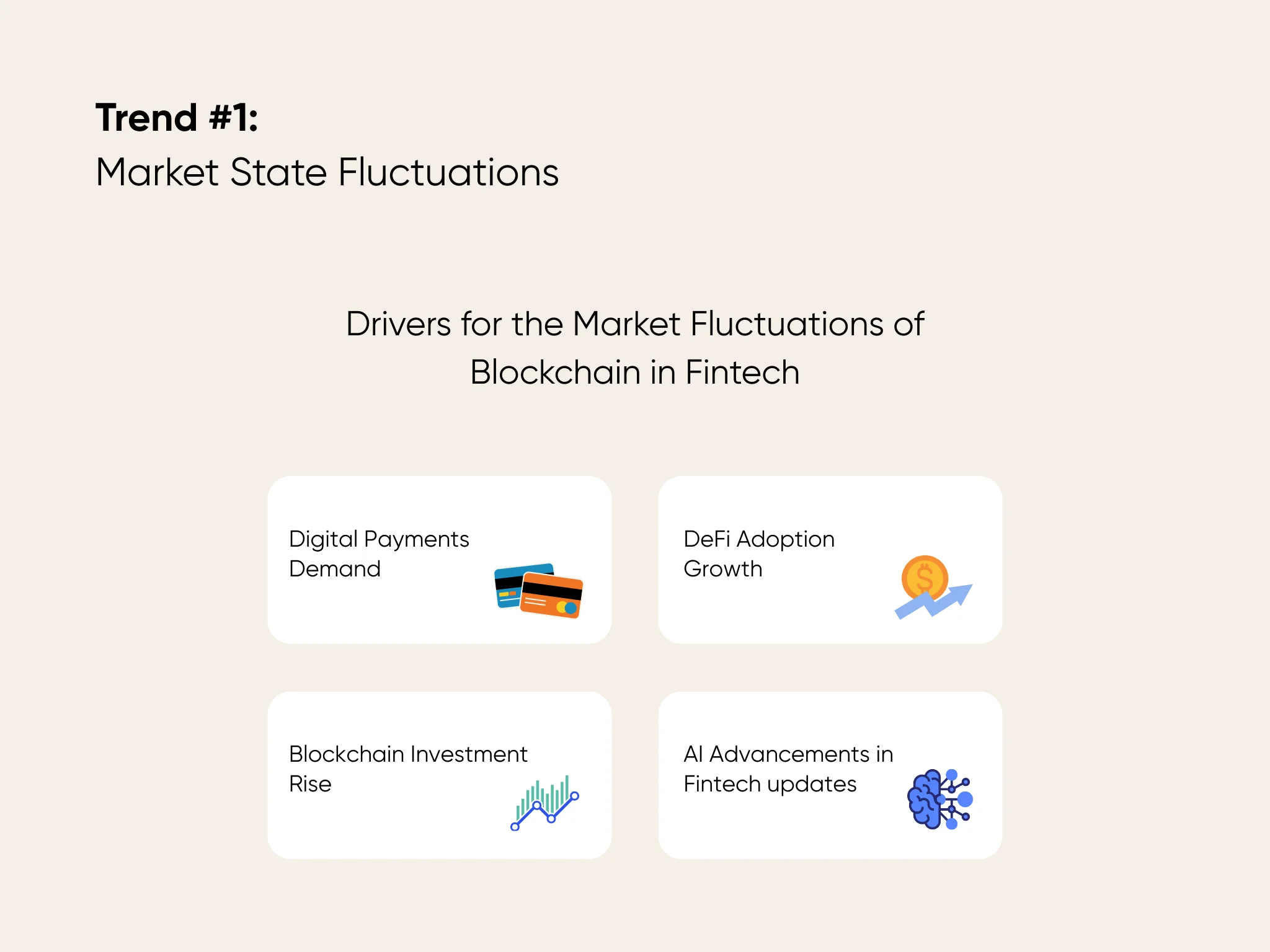
- Digital Payments Demand: The shift towards digital transactions has spurred the adoption of blockchain technology in fintech to ensure secure and efficient payment processing.
- DeFi Adoption Growth: Decentralized finance platforms leveraging blockchain technology offer alternative traditional financial services, driving increased adoption and investment.
- Blockchain Investment Rise: Financial institutions recognize the potential of blockchain to streamline operations and enhance security, leading to increased investments in blockchain solutions.
- AI Advancements in Fintech: Integrating AI and machine learning with blockchain technology enhances data analysis and decision-making capabilities in financial processes.
These market drivers collectively shape the future trajectory of blockchain in fintech, highlighting the pivotal role of technological advancements and evolving consumer demands in driving innovation within the financial sector.
Trend #2: Decentralized Finance (DeFi) Revolution
The Decentralized Finance (DeFi) revolution in blockchain in fintech signifies a transformative shift towards decentralized financial systems, disrupting traditional financial intermediaries and processes. According to InsightAce Analytic, the Decentralized Finance (DeFi) Market is expected to exceed USD 398.77 billion by 2031, with a significant growth trajectory from its estimated value of $20.22 billion in 2023.
This exponential growth underscores the substantial impact of DeFi on reshaping the financial industry, fueled by its broad adoption and integration with decentralized blockchain systems. As DeFi continues to gain traction, it paves the way for innovative market expansion opportunities, particularly with the introduction of blockchain-based prediction solutions.
Here are the drivers for the Decentralized Finance (DeFi) revolution:
%20Revolution.webp)
- Technological Advancement: Continuous advancements in blockchain technology drive the evolution and adoption of decentralized finance solutions within the fintech sector.
- Dominant Financial Organizations: Major financial institutions recognizing the potential of DeFi contribute to its revolution by investing in and integrating decentralized finance solutions into their operations.
- Popularity as Blockchain Genres: The rising popularity of DeFi and other blockchain genres influences the revolution by shaping market sentiment and trends, driving increased adoption and investment.
As DeFi continues to reshape traditional financial systems, it underscores the immense opportunities for innovation and market expansion within the fintech landscape.
Trend #3: Central Bank Digital Currencies (CBDCs) Exploration
Central Bank Digital Currencies (CBDCs) exploration in blockchain in fintech represents a global trend wherein central banks are exploring the issuance of digital currencies as legal tender. This global phenomenon extends far beyond these countries, with 105 out of 109 countries tracked by the Atlantic Council exploring CBDC in some form, indicating widespread interest and investment in this emerging financial technology.
Here are the drivers for the exploration of CBDC for blockchain in fintech:
%20Exploration.webp)
- Financial Inclusion: CBDC has the potential to enhance financial inclusion by providing access to digital financial services to unbanked and underbanked populations.
- Regulatory Support: Supportive regulatory frameworks facilitate the exploration of CBDCs by providing clarity and guidance to central banks.
- Economic Efficiency: CBDC offers opportunities for central banks to improve the efficiency of monetary policy implementation and financial transactions.
The exploration of CBDC in blockchain in fintech reflects a global shift towards digitization and innovation in the financial sector. As central banks continue to explore the possibilities of CBDC, the landscape of digital currencies and financial services is poised for transformation in the future.
Trend #4: Cross-Border Payments Innovation
Cross-border payments Innovation in blockchain in fintech refers to improving payment systems to facilitate seamless transactions across different countries and currencies. This innovation leverages blockchain technology to address challenges such as high fees, long processing times, and the need for more transparency commonly associated with traditional cross-border payment methods.
Here are the drivers for the Cross-Border Payments Innovation of blockchain in fintech:
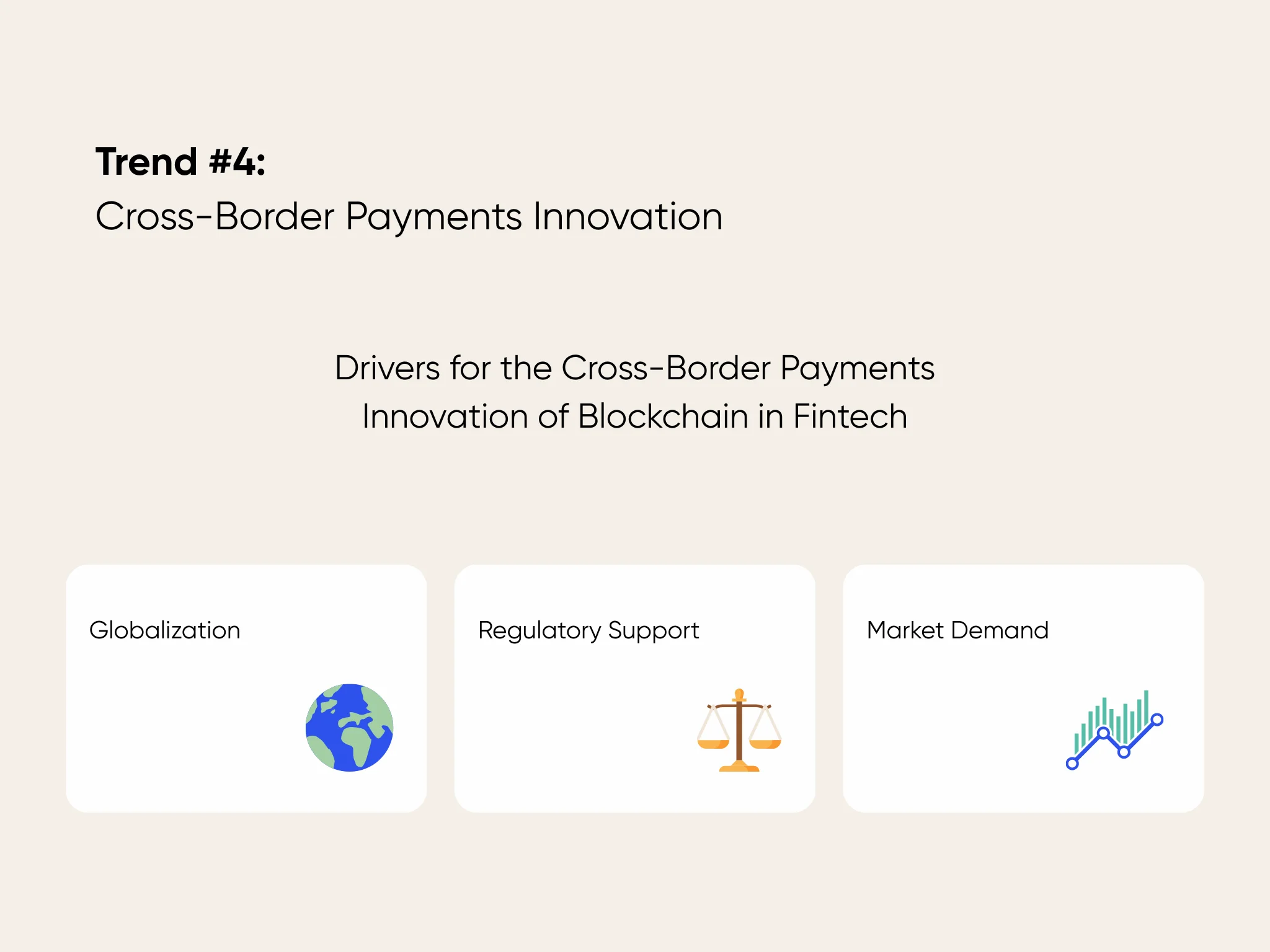
- Globalization: Increasing globalization and international trade drive the demand for efficient cross-border payment solutions, fostering innovation in this space.
- Regulatory Support: Supportive regulatory frameworks encourage the adoption of blockchain-based cross-border payment platforms by providing clarity and guidance to financial institutions.
- Market Demand: Growing demand from businesses and individuals for seamless cross-border payment solutions motivates the development and innovation of blockchain-based payment platforms in fintech.
Cross-border payments innovation in fintech blockchain represents a significant step towards addressing the inefficiencies in traditional cross-border payment systems.
Trend #5: Tokenization of Assets
Tokenization of assets in blockchain in fintech refers to representing traditional assets, such as real estate or stocks, as digital tokens on a blockchain. These tokens are programmable and divisible and can represent fractional ownership of the underlying asset, providing liquidity and accessibility to a broader range of investors. Many companies now offer specialized asset tokenization services to facilitate this process.
Since its emergence, the tokenized asset market has shown significant exponential growth. Given the innovativeness of the market, experts believe that such growth will continue. For instance, Europe is set to see an STO boom in the next five years, with a total market volume of more than €918 billion by 2026. Regarding the future growth of security tokens, its estimated growth rate will be roughly 81% each year from 2021 to 2026.
Here are the drivers for the tokenization of assets of blockchain in fintech:
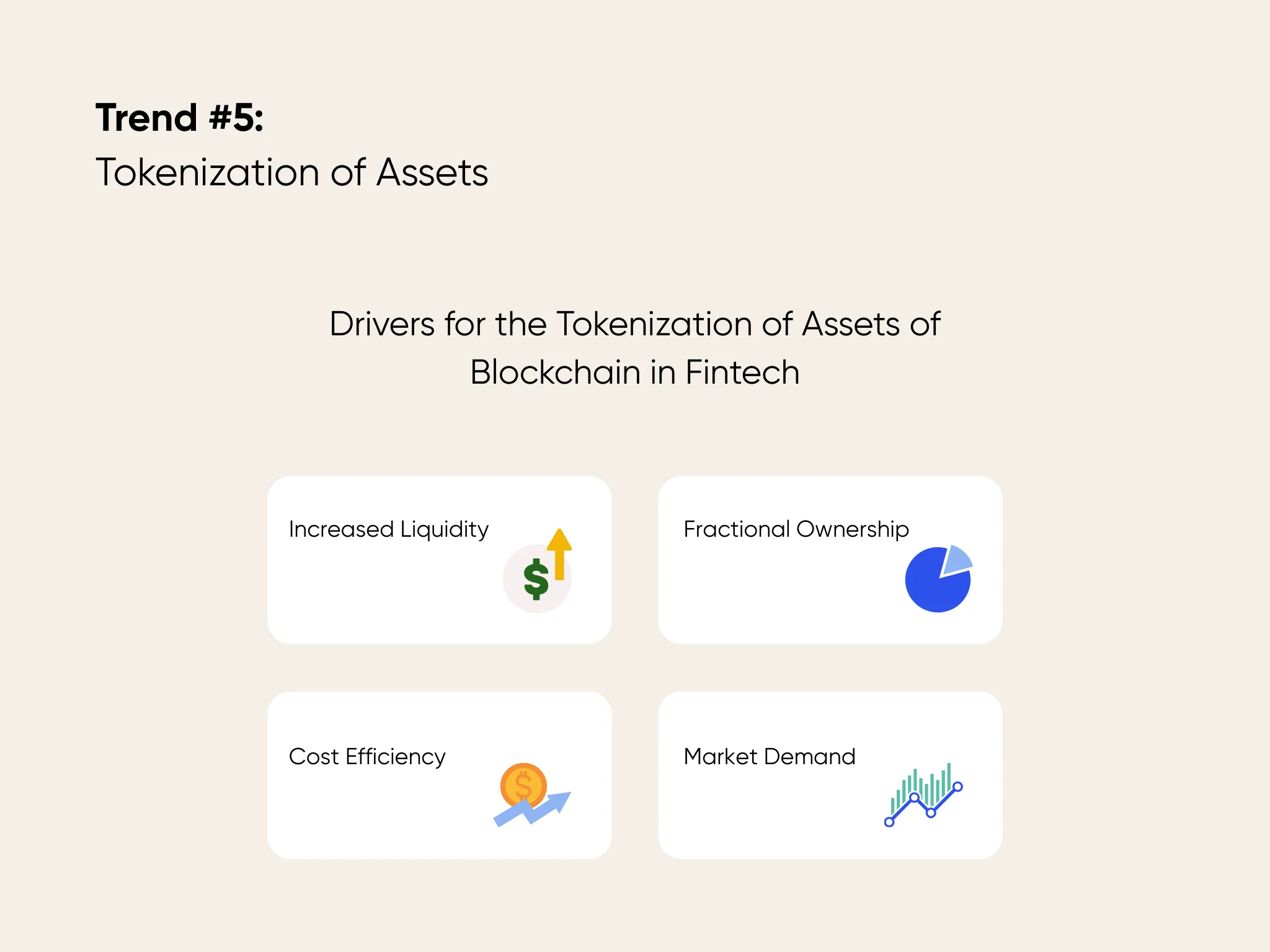
- Increased Liquidity: Tokenization allows assets traditionally illiquid, such as real estate, to be easily traded on digital exchanges, enhancing liquidity and accessibility for investors.
- Fractional Ownership: Tokenization enables fractional ownership of high-value assets, making them more affordable and accessible to a broader range of investors.
- Cost Efficiency: Tokenization reduces transaction costs associated with traditional asset trading, making it more cost-effective for investors and issuers.
- Market Demand: Growing demand from investors for alternative investment opportunities and increased interest in blockchain technology are driving the adoption of tokenization in fintech.
With the potential to enhance liquidity, accessibility, and efficiency in asset trading, tokenization is poised to reshape traditional financial markets in the years to come.
Trend #6: Smart Contract Adoption in Financial Services
Smart contract adoption in financial services within blockchain in fintech refers to integrating and utilizing digital programs known as smart contracts to automate and execute specific actions within financial transactions and processes. These smart contracts operate based on predetermined conditions, automatically executing actions when criteria are met, such as transferring funds or validating transactions.
The global smart contracts market is witnessing significant growth, with a market size valued at USD 684.3 million in 2022 and expected to grow at a compound annual growth rate (CAGR) of 82.2% from 2023 to 2030. By leveraging smart contracts, financial institutions can streamline operations, reduce manual intervention, and mitigate the risk of errors or disputes commonly associated with traditional contract execution methods.
Here are the drivers for the smart contract adoption in financial services blockchain in fintech:
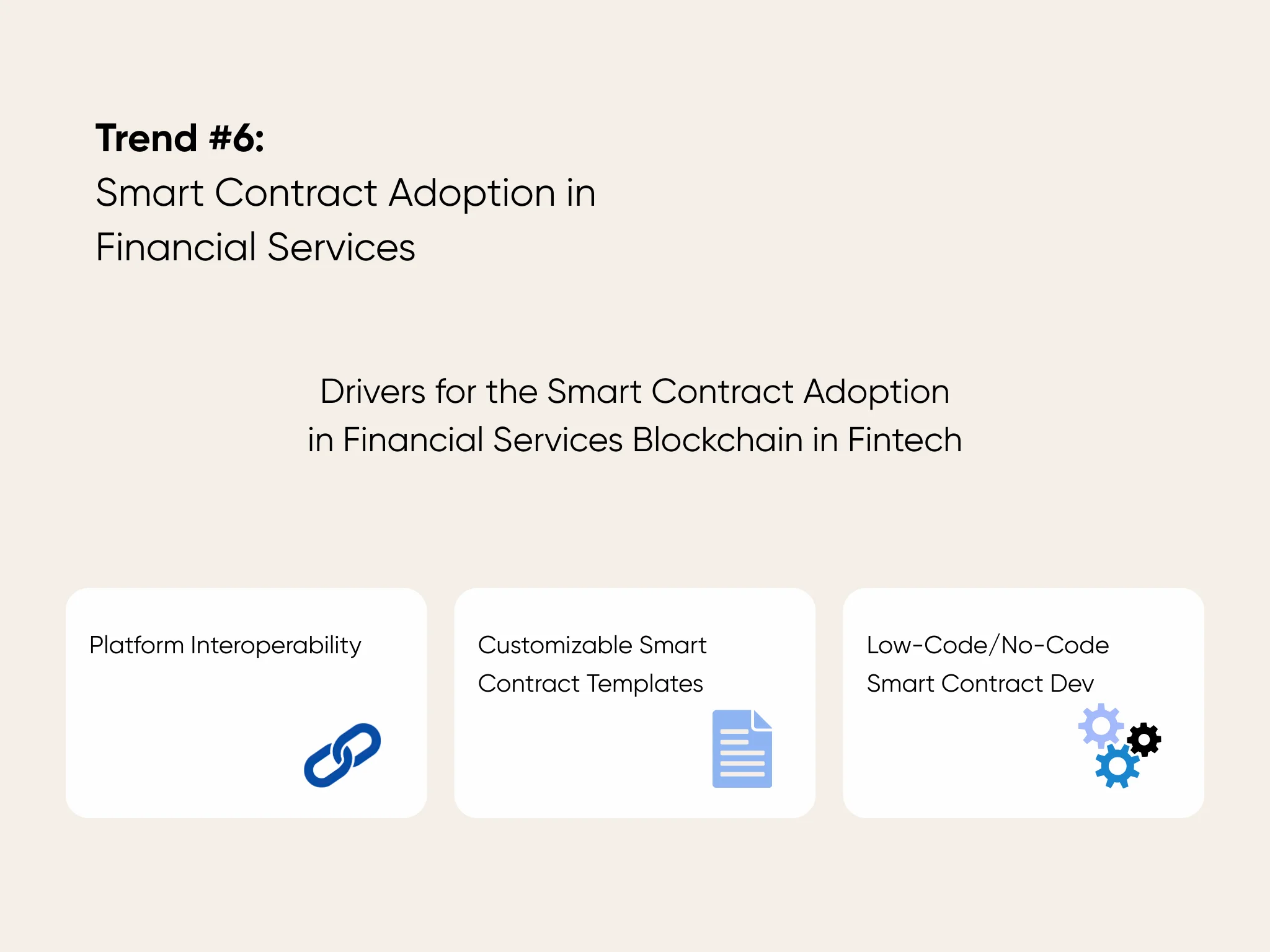
- Platform Interoperability: Smart contract providers focus on ensuring seamless communication and interaction between blockchain platforms, enabling broader adoption and integration across various ecosystems.
- Customizable Smart Contract Templates: Providers offer customizable smart contract templates, allowing users to tailor contracts to their specific needs and requirements without extensive coding knowledge, facilitating quicker deployment and adoption.
- Low-Code or No-Code Smart Contract Development: The trend of low-code or no-code smart contract development platforms is gaining traction, enabling non-technical users to create smart contracts easily.
The adoption of smart contracts in financial services continues to evolve, driven by technological advancements and innovative solutions offered by industry leaders. As smart contract adoption grows, it promises to revolutionize financial transactions and bring greater efficiency and transparency to the industry.
Trend #7: Supply Chain Finance
Supply chain finance in fintech blockchain refers to the use of blockchain technology to optimize and streamline financial processes within the supply chain ecosystem. It involves leveraging blockchain’s transparency, immutability, and efficiency to improve cash flow, reduce transaction costs, and mitigate risks for all participants involved in the supply chain.
According to a Facts and Factors research report, the Sustainable Supply Chain Finance market is projected to experience significant growth, with a forecasted market size of USD 2,926,758 million by 2027, representing a robust CAGR of 18.24%. Key players in this market include BNP Paribas, DBS Bank Ltd., First Abu Dhabi Bank, and TIER Sustainable Supply Chain Finance.
Here are the drivers for the supply chain finance blockchain in fintech:
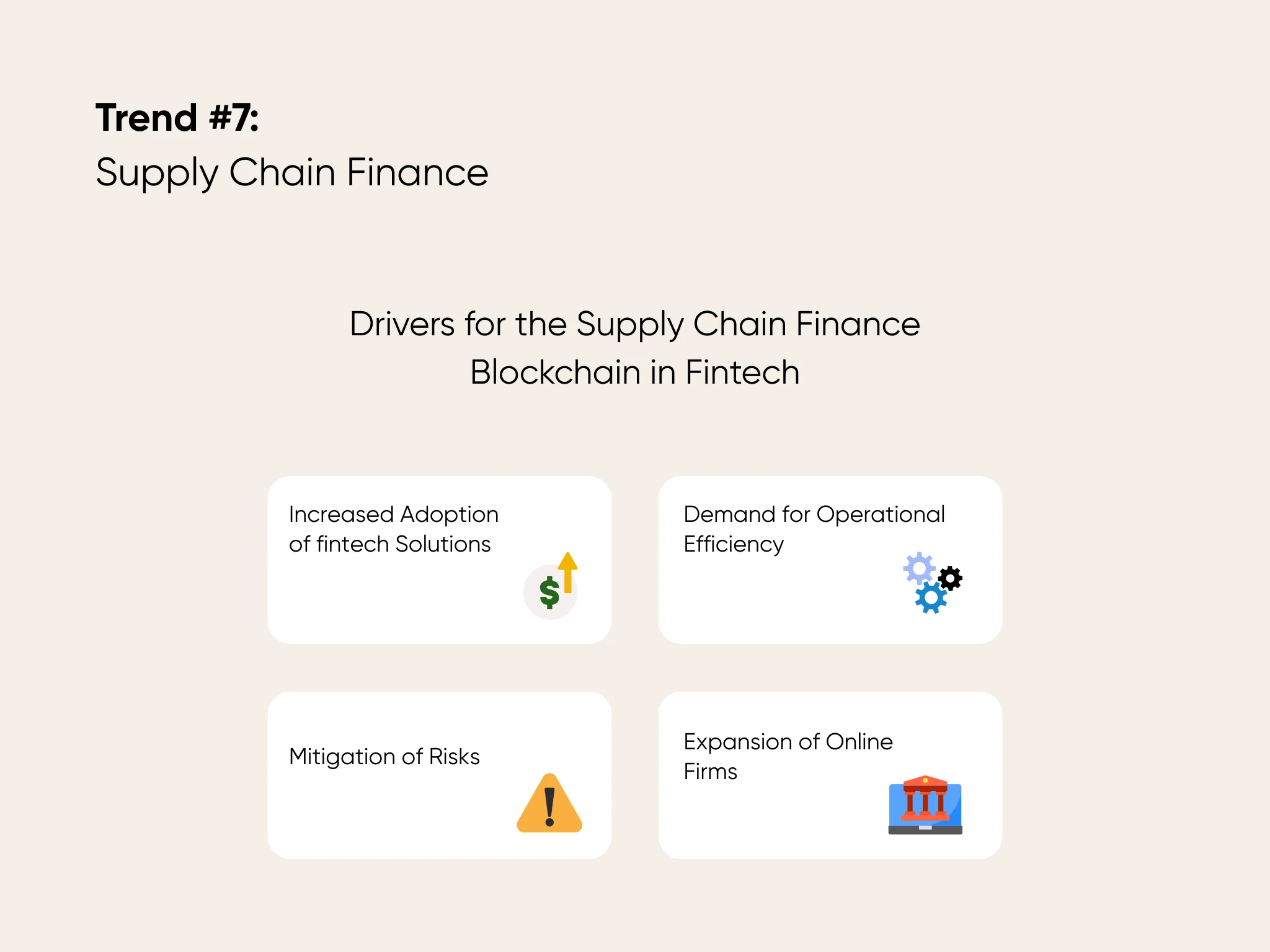
- Increased Adoption of FinTech Solutions: The growing adoption of fintech solutions in the supply chain finance ecosystem streamlines operations and reduces transaction costs.
- Demand for Operational Efficiency: Businesses seek to optimize their supply chain finance operations, driving the adoption of blockchain solutions for improved efficiency.
- Mitigation of Risks: Blockchain-based supply chain finance solutions offer enhanced security and risk mitigation capabilities, attracting businesses seeking to minimize operational risks.
- Expansion of Online Firms: The presence of many online firms enhances the functionality of traditional processes, driving market growth.
Despite potential complications and vulnerabilities, the sustainable supply chain finance industry is poised for significant growth, driven by technological advancements, increased adoption of financial tech solutions, and the demand for operational efficiency.
Benefits of Blockchain in Fintech
Within the financial technology sector, blockchain technology presents transformative advantages that benefit fintech developers and businesses. Here, we explore the advantages of blockchain in fintech, revolutionizing conventional financial processes and elevating industry efficiency and security.
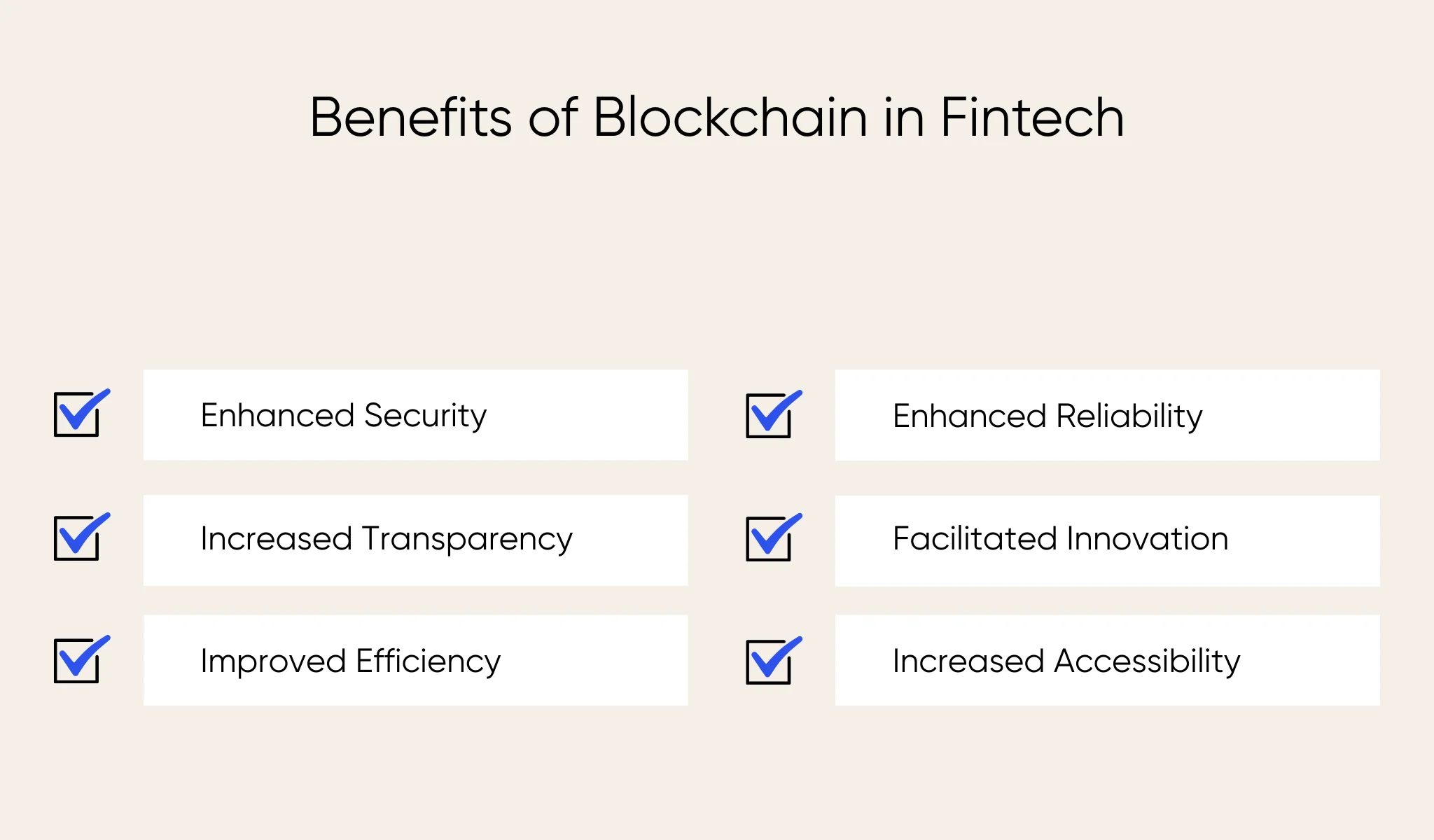
Enhanced Security
Blockchain in fintech provides robust security against cyber attacks, ensuring that financial transactions are tamper-proof. By distributing transaction data across multiple nodes, blockchain mitigates the risk of unauthorized access and manipulation by malicious actors, enhancing the overall resilience of the financial ecosystem. This heightened data security reduces the likelihood of cyber attacks and fosters trust among participants, ensuring the integrity and confidentiality of sensitive information exchanged over the internet.
Increased Transparency
The transparent nature of blockchain technology allows participants to verify and audit transactions inexpensively. Transactions are recorded on a shared ledger visible to all authorized parties, fostering trust and accountability. This transparency helps prevent discrepancies, promotes compliance with regulatory standards, and enables efficient auditing processes, enhancing overall transparency in financial transactions.
Improved Efficiency
Blockchain’s automation through smart contracts minimizes the potential for human error in financial transactions. By leveraging advanced algorithms and eliminating intermediaries, blockchain accelerates transaction processing and settlement times, promoting operational efficiency. This streamlined process reduces administrative overheads and facilitates seamless scalability, enabling businesses and financial institutions to handle growing transaction volumes effectively.
Enhanced Reliability
Blockchain’s resistance to data modification ensures the integrity and reliability of financial records, addressing concerns related to regulatory compliance and data integrity. Each block’s cryptographic hash preserves the integrity of personal information, ensuring the security and confidentiality of sensitive data within the blockchain network. Additionally, blockchain’s design features foster trust among stakeholders by ensuring transparent and secure transactions, addressing the limitations of traditional systems.
Facilitated Innovation
Blockchain technology empowers fintech startups to innovate and create new applications and services by hiring fintech software developers. Blockchain technology enables fintech startups to innovate by hiring fintech software developers. It unlocks new possibilities like digital currencies and smart contracts, fostering disruptive innovation. This drives advancements in finance and enhances transparency in capital markets for future growth.
Increased Accessibility
Blockchain technology democratizes access to financial services by providing a secure and transparent platform for peer-to-peer transactions. By eliminating the need for intermediaries and reducing transaction costs, blockchain opens up financial services to underserved populations and unbanked individuals, thereby promoting financial inclusion. The increased accessibility not only empowers individuals to participate in the global economy but also fosters economic growth and development by providing access to previously inaccessible financial services.
Key Takeaway
Fintech blockchain in 2026 is making operations more affordable and efficient, with near real-time settlements and programmable asset tokens.
But that’s not all it’s doing. It’s also becoming increasingly central to advanced security, transparency, and auditability in the financial ecosystem. Blockchain’s decentralized structure and cryptographic encryption essentially guarantee the integrity and security of financial transactions going forward.
Looking to be part of the next wave of fintech? Aloa’s expertise can turn your vision into a custom, scalable fintech solution built around your processes and growth strategy. Chat with us today and tell us about your business and your long-term goals.
If you’d prefer to explore some more, check out other fintech articles on our blog, or visit our Discord server full of fintech leaders interested in AI. If you like newsletters, Byte-Sized can help you stay ahead of the curve. Compiled by me every night, Byte-Sized is a quick rundown on the latest developments in AI and advanced tech, from fintech blockchain to healthcare AI and more.
FAQs
What is the primary advantage of using fintech blockchain solutions?
The primary advantage that fintech blockchain solutions offer is decentralization. Since data is stored across a distributed network, transactions are less reliant on intermediaries. This makes them faster, more transparent, and more secure thanks to the cryptographic security, ensuring that each record is tamper-proof.
How can blockchain technology reduce operational costs in financial services?
Blockchain introduces several cost-saving features, such as:
- Automated reconciliation: Blockchain maintains a single, shared ledger that all parties can access in real time. Banks and payment processors no longer have to cross-check records manually, saving hours of audit time.
- Reduced manual processing: Aside from cross-checking, blockchain also reduces other manual tasks like data entry and reporting. This further cuts labor costs and helps prevent costly human errors.
- Decreased intermediary fees: Traditional financial transactions used to go through clearinghouses, correspondent banks, and other intermediaries, each of which charged its own fees. With peer-to-peer settlement, these intermediaries are no longer necessary.
What are the potential applications of blockchain in digital payments?
Blockchain makes it possible to do near-instant cross-border payments and real-time settlement in digital payment systems. It can also power programmable payments in the form of smart contracts, tokenized assets, and stablecoins.
Aloa’s custom fintech development services are carefully designed to make advanced features like these work with a wide range of infrastructure and workflow setups. If you already have a workflow you’re comfortable with, we’re experienced in making sure that your blockchain solution works with it instead of against it.
How does blockchain impact customer trust in fintech services?
Blockchain is an instant trust-booster because of its inherent transparency and tamper-resistance. Users can verify records like transaction histories and smart contract statuses for themselves. This transparency also makes transactions easy to audit and ensure regulatory compliance.
In what ways can blockchain technology be integrated into existing fintech infrastructures?
Blockchain can be integrated through APIs, middleware layers, or hybrid architectures that connect distributed ledgers with legacy systems. If your workflows run on older tech, Aloa can help retool your infrastructure to be blockchain-ready. Our experiences in working with legacy institutions have taught us a lot about how to help businesses adopt blockchain without disrupting their day-to-day operations.