
Most health systems are buried in text. Clinical notes, medical records, discharge summaries, portal messages, call logs, scanned PDFs. Staff spend hours doing data entry, typing, and clicking through patient records just to find one detail. Even with all the talk about NLP in healthcare, the work is still slow. That hurts the quality of care, wears people out, and leaves important patient information trapped in charts.
At Aloa, we work with healthcare teams that want that text to be useful. We help you choose clear NLP use cases, test them with clinicians, and build secure tools that fit into the systems you already use.
In this guide, we explain how NLP works in real clinical workflows. We share nine practical use cases and a simple way to plan and launch a first project, one that fits your data, tools, and risk requirements.
TL;DR
- Your health system creates huge amounts of unstructured data that your structured EHR fields never capture.
- Natural language processing turns that language into structured data, risk signals, and automation that your teams can act on.
- High-value use cases today include AI scribes, coding and risk capture, triage bots, inbox routing, and trial matching.
- Evidence shows NLP can cut documentation time and inbox load while supporting better decisions, when teams validate and monitor it.
- The safest path starts with one or two clear workflows, a narrow pilot, human review, and strong HIPAA and governance guardrails.
- Aloa helps healthcare teams scope the use case, build and integrate NLP tools, and keep them safe and maintainable over time.
What Is NLP in Healthcare Used For?
NLP in healthcare helps your team make sense of unstructured text so they can act faster. Health systems use it to pull key details from notes, support coding, build cleaner reports, and automate routine tasks that normally take extra time.
A discharge summary is a good example. It mixes diagnoses, meds, follow-up plans, and social details in one long note. Most EHR fields only capture pieces of that. NLP reads the whole summary, pulls out the important points, and turns them into structured data your team can search and use right away.
This matters because documentation keeps growing while teams stay stretched. Modern clinical NLP lets you use the text you already have to cut manual work, spot risks earlier, and support decisions without adding more pressure on clinicians.
And to understand how it delivers those results, it helps to look at how NLP works behind the scenes.
How NLP in Healthcare Works
NLP in healthcare works as a simple pipeline. Your teams put in unstructured text, and the system turns it into clear, structured outputs. At Aloa, we help healthcare teams set up this pipeline in a secure, HIPAA-aligned way so it fits their existing tools and daily work.
Here’s how the process usually works:
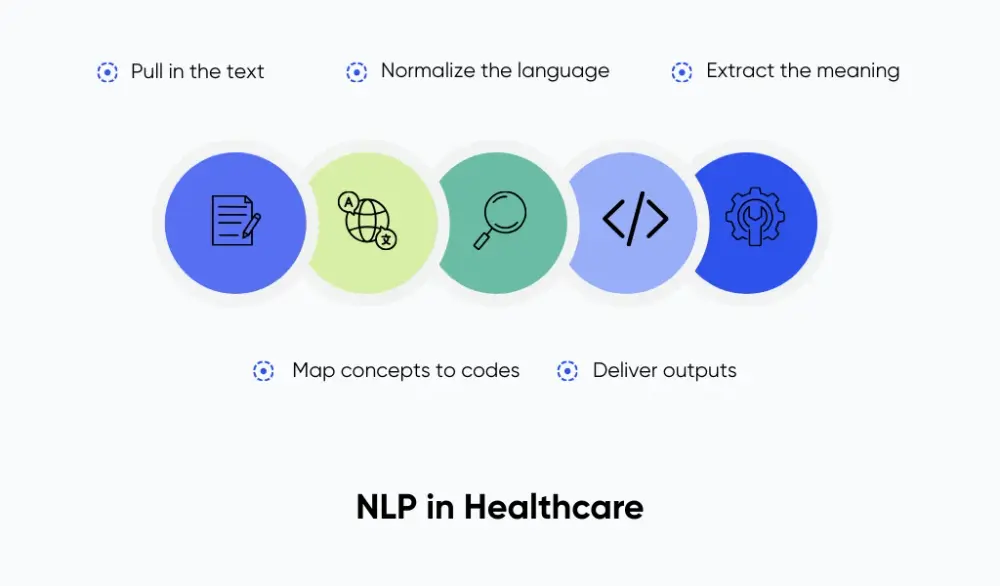
1. Pull in the text
The system brings in data from the places your teams already use, including EHR notes, problem lists, portal messages, secure emails, call transcripts, chat logs, and PDFs like outside records or referral letters.
Most teams store and process this data in HIPAA-aligned environments with clear access rules and tracking. Some keep NLP workflows on a separate secure platform so they can control who sees the data and how it moves.
2. Normalize the language
Clinical text is messy. People dictate, use shorthand, and often copy and paste content. The NLP system cleans this up so it can understand the text more easily. It removes boilerplate, fixes obvious errors, expands abbreviations, and converts audio to text when needed. This step gives the model a clean version of the language to work with.
3. Extract the meaning
Once the text is cleaned, the system identifies important clinical details. It spots symptoms, diagnoses, meds, allergies, and timelines, and tells them apart from personal information like names or addresses. Modern models also understand context, so they can catch negations, link events to the right patient, and determine whether something is current, historical, or planned.
4. Map concepts to codes
Healthcare depends on coded data. After extracting meaning, the system links each clinical concept to codes like ICD-10, SNOMED CT, LOINC, CPT, or internal organizational tags. This makes the output usable in analytics, billing, quality reporting, and downstream automation.
5. Deliver outputs your tools can use
The system generates structured results your teams can plug into everyday workflows. This includes problem lists, medication lists, alerts, summaries, or structured fields written back into existing tools. At this stage, the data becomes searchable, trackable, and ready for automation, which is where many organizations see early wins.
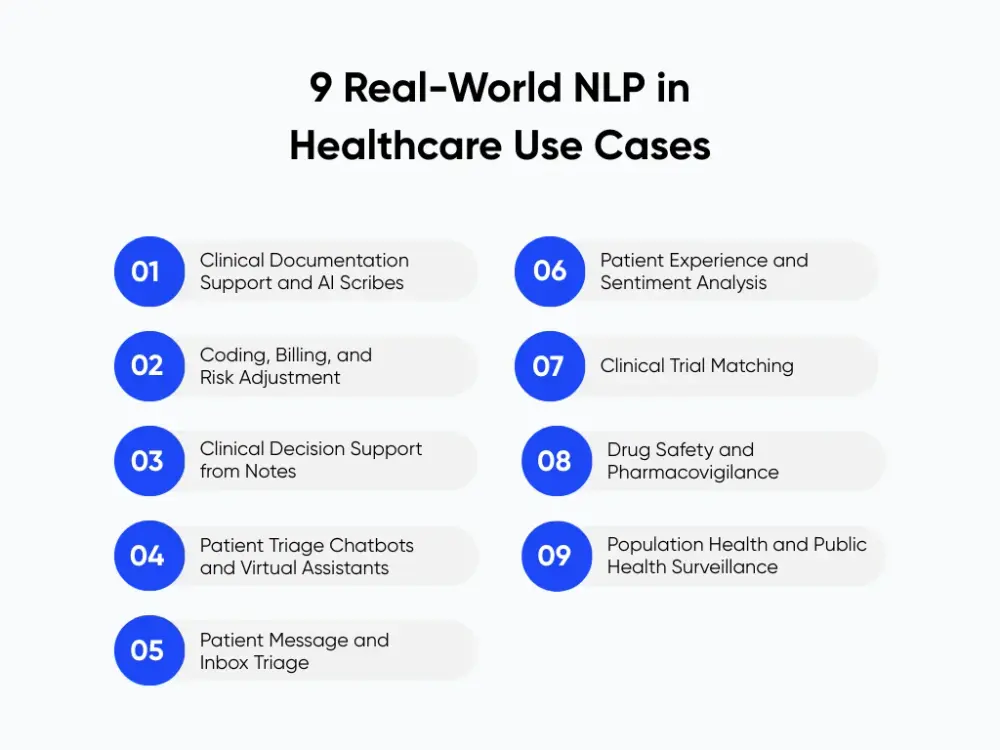
9 Real-World NLP in Healthcare Use Cases
Now let’s talk about where this actually helps people. These are nine use cases we see across hospitals, specialty groups, and digital health products:
1. Clinical Documentation Support and AI Scribes
AI scribes listen to the visit and draft the note for you. They use speech recognition and NLP to follow the conversation, pick out symptoms, history, exam, and plan, and drop them into your usual note format.
Studies on ambient AI scribes show less time spent on documentation and some improvement in burnout and cognitive load, though the impact on efficiency and cost still needs more proof. Systems like Kaiser Permanente and Mass General Brigham have reported lower burnout after rolling out ambient documentation tools.
In a normal flow, the clinician checks the draft, fixes anything that feels off, and signs. The system gradually learns the local style over time. You still own the note, but what used to take 15 minutes to write can shrink to a quick review.
If you go this route, you also need strong, HIPAA-safe transcription in place. Our guide to picking a HIPAA-aligned transcription setup for clinical work lays out the key questions to ask vendors and your IT team.
2. Coding, Billing, and Risk Adjustment
Coding teams spend a lot of energy reading notes line by line. They look for diagnoses, procedures, and risk factors that never made it into structured fields. NLP tools can scan those notes, suggest codes, and flag missing details that affect payment and quality programs.
For example, the model might spot clear language for chronic kidney disease stage 3 while the problem list only says “renal insufficiency.” That chart can go into a coder queue for review instead of waiting for a random audit to catch it.
Payers and providers already use these tools to support risk adjustment and quality reporting, especially in value-based contracts. When you feed models both structured fields and free text, they often predict outcomes and risk more accurately than with one type of data alone.
3. Clinical Decision Support from Notes
Most decision support only looks at coded fields. A lot of important detail never gets coded. Social context, function, and subtle symptom changes often live only in notes.
NLP can read those notes and pull out risk factors, care gaps, and red flag phrases. That signal can flow into risk scores or alerts. Think about readmission risk: the model can look at age and labs, but also phrases like “lives alone,” “frequent ED visits,” or “trouble managing meds.” Patients with higher scores can then get extra follow-up.
Researchers also test NLP for grouping patients by disease pattern, like Crohn’s disease, by combining rules and large language models. Early work shows this can match or beat manual chart review while saving time.
With this use case, we usually suggest a slow rollout, clear ways for clinicians to give feedback, and strong monitoring. Missing a true risk or firing too many false alerts can both hurt trust.
4. Patient Triage Chatbots and Virtual Assistants
Many health systems now have chatbots on their sites, inside patient portals, and even linked to social media channels. NLP lets these bots understand free text and pick a safe next step.
Here's a simple pattern you might set up:
- “I have chest pain” goes to an urgent message that tells the patient to seek care now, not wait for a portal reply.
- “I need a refill” routes into a refill workflow for staff.
- “I forgot my password” routes to support instead of landing in a clinician inbox.
Recent studies show that large language models, plus clear clinical rules, can help spot emergency language in portal messages. They then warn patients when messaging is not safe for their issue.
5. Patient Message and Inbox Triage
Inbox overload is a daily pain for many clinicians. Studies link higher time in the EHR and in the inbox with higher burnout risk.
NLP can help by sorting messages and routing them to the right person. A model can flag:
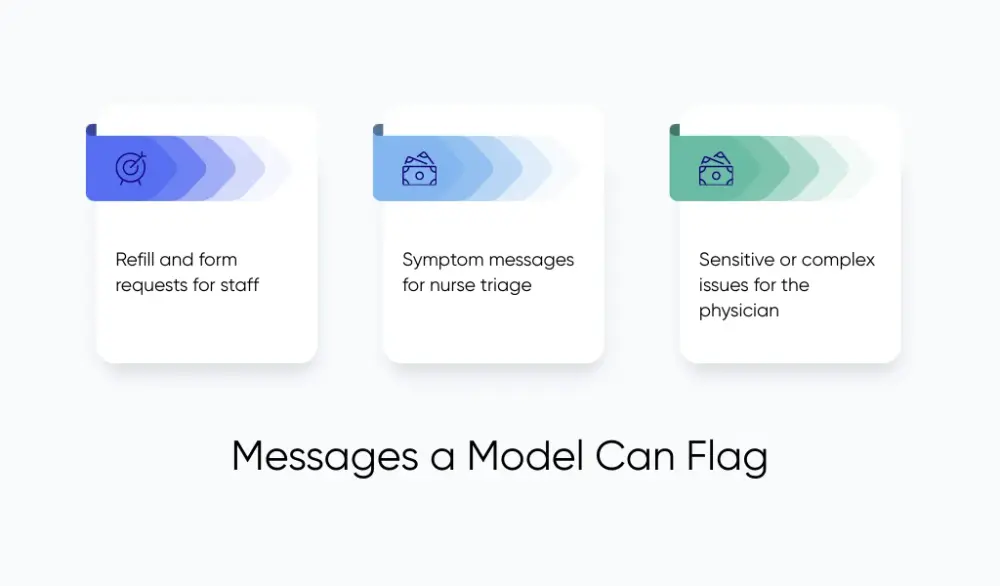
- Refill and form requests for staff
- Symptom messages for nurse triage
- Sensitive or complex issues for the physician
Some teams also let NLP-based systems draft replies for common questions. Staff or clinicians then review and send. That keeps humans in control but cuts copy-paste work.
When we help tech leads plan this, we often point them to our digest of AI use cases in healthcare operations. Inbox triage often pairs well with a few other quick wins, like form automation or routing of imaging follow-ups.
6. Patient Experience and Sentiment Analysis
Your surveys, complaints, online reviews, and call transcripts hold a lot of feedback. Most teams don’t have time to read every comment. NLP can group text by topic and sentiment so you can see patterns at a glance.
You might see that “confusing discharge instructions,” “long phone wait times,” or “unclear billing” come up again and again. From there, your team can pick two or three problems to fix and track if those themes drop over time.
McKinsey notes that payers use NLP on contact center logs and surveys to trace why people reach out and how they feel. They then redesign service flows, staffing, and scripts based on those insights.
7. Clinical Trial Matching
Trial teams still read many charts by hand to find eligible patients. Criteria live in long Word docs full of natural language. NLP can read the protocol, parse EHR notes, and suggest likely matches for staff to review.
For instance, an oncology trial might ask for “progressive metastatic disease after at least two prior lines of therapy” plus a certain mutation. NLP can search notes, pathology reports, and sometimes radiology text for those phrases and close matches, then build a short candidate list.
Recent work in cancer and neurology trials shows that NLP-based screeners can cut down the number of charts teams need to review, while finding more potential candidates.
8. Drug Safety and Pharmacovigilance
Many early drug side effects live in text, not codes. A patient might say “my legs swell since you started that pill” in a note or call log long before an official adverse event form appears.
NLP can scan notes, call logs, and free text reports for patterns that look like potential adverse drug events. Those candidates then go to a pharmacovigilance team for deeper review. Systematic reviews show that NLP can help hospitals monitor drug safety at scale, though methods and performance still vary.
Because this work touches safety, you need tight rules around PHI, clear audit trails, and careful review of alerts. Our guide on AI and healthcare compliance strategies walks through patterns for documentation, oversight, and model updates that we see work in practice.
9. Population Health and Public Health Surveillance
NLP can also help at the population level. Public health teams use it on case reports to spot early signs of outbreaks. Health systems use similar tools on EHR text to find trends in social needs, mental health risk, or function that codes miss.
One recent study used NLP on EHR notes to pull out social determinants of health, like housing, food, and transport issues, in patients with dementia. That extra context helped teams target support to the patients who needed it most.
If you want a wider view of how AI supports care beyond language, our overview of AI for hospital operations and patient care breaks down examples in imaging, scheduling, and other workflows that sit next to these text-based use cases.
Benefits and Challenges of NLP in Healthcare
NLP can take pressure off your teams, but it also brings work around data, trust, and safety. Here’s a clear view of both:
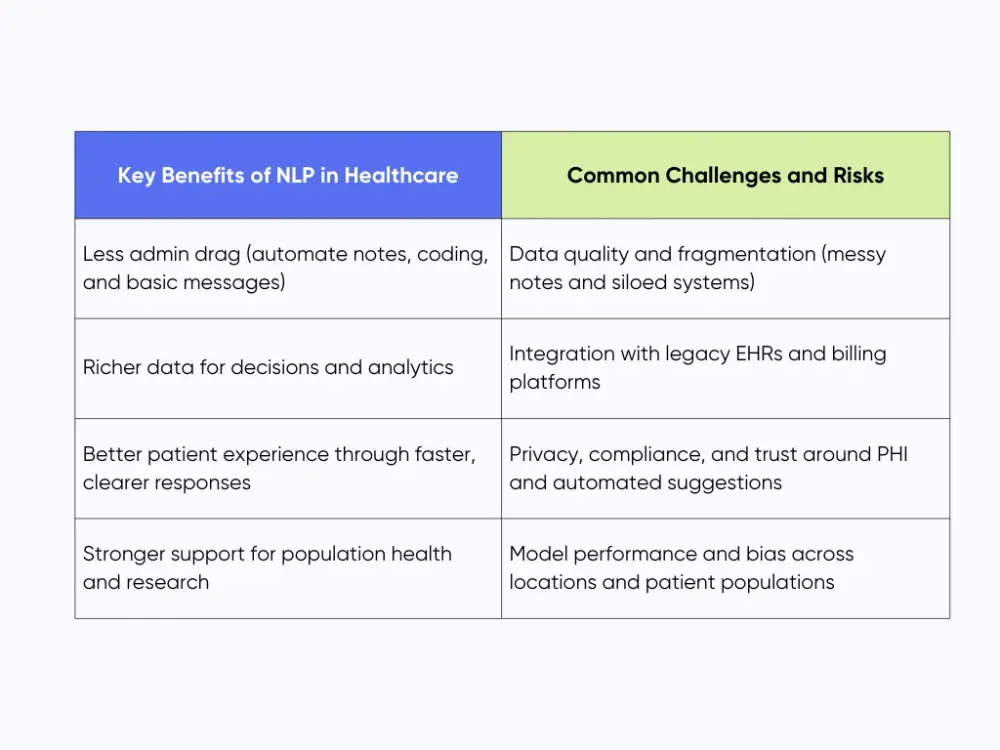
On the benefit side, studies show NLP can cut time on documentation, improve chart completeness, and help reveal patterns like risk factors and social needs buried in notes. That richer data can feed clinical decision support, quality programs, and population health work.
On the challenge side, reviews point to uneven data, hard EHR connections, and the risk that models work better for some groups than others. You also need tight PHI controls, clear audit trails, and a way to explain how systems behave so clinicians and patients can trust them.
In other words, NLP helps your teams turn language into useful information, but it adds a new layer of responsibility. Governance, validation, and change management matter as much as model accuracy. Our deep dive on keeping AI projects within HIPAA rules walks through controls that keep experiments from becoming problems later.
At Aloa, we help clients design governed NLP programs, not just single features. With our AI consulting services, we cover integration, monitoring, and compliance so your team doesn't have to bolt those pieces on after the fact.
Implement NLP in Healthcare with Aloa
You don’t need a huge AI program. You need one workflow worth fixing, a small pilot, and a plan to keep it safe after launch. Here’s how we usually do it with healthcare teams:
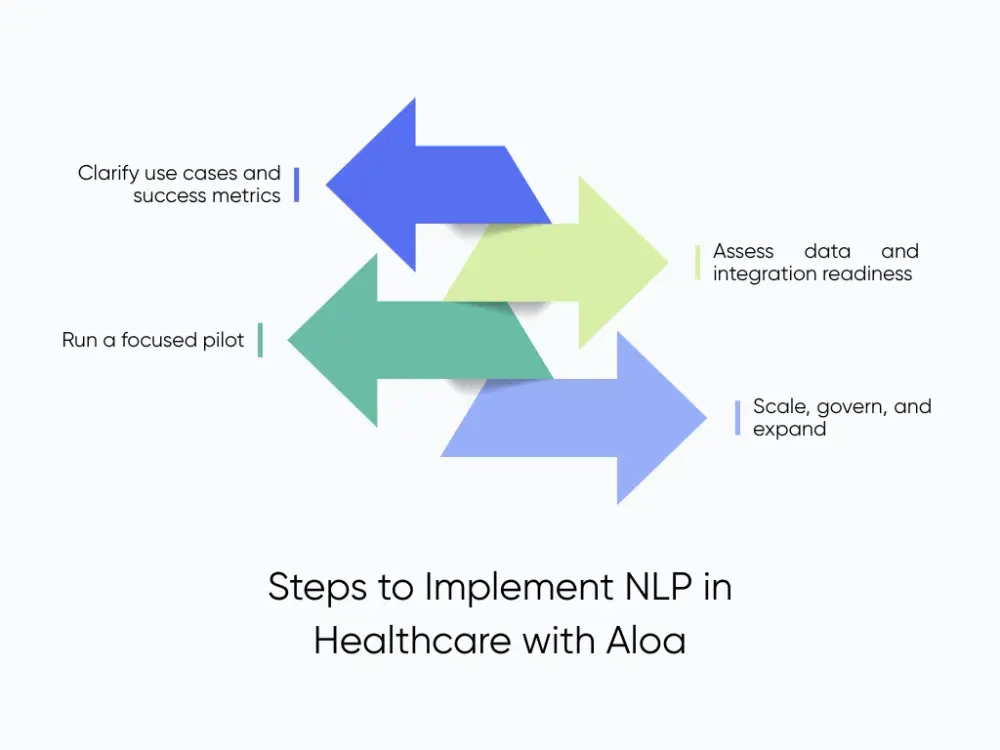
Step 1: Clarify use cases and success metrics
Pick one to two starter use cases, like transcription, computer-assisted coding (CAC), or a triage bot for portal messages. Keep it narrow. Make sure the text already exists in your systems.
Then choose simple success metrics. Track minutes saved per note, coder review time, coding accuracy, or message response time. When the goal is clear, the build stays focused.
Step 2: Assess data and integration readiness
List the systems that hold the text: your EHR, your portal, and your contact center tools. Map how text gets out and how results get back in.
Decide where NLP runs. Some teams use cloud APIs. Others keep it on-prem. We help you pick what fits your risk rules, budget, and IT setup.
Step 3: Run a focused pilot
Run a 6 to 12-week pilot with one clinic, one unit, or one service line. Use clear KPIs and keep a human in the loop for anything that could affect care or billing.
We also build the pilot as a simple, design-forward tool. Most healthcare apps feel like they were built to test your patience. We try to build the opposite. You can see examples in our healthcare AI case studies.
Step 4: Scale, govern, and expand
When the pilot hits the targets, move it into production. Roll it out in waves. Add monitoring, an incident plan, and a checklist for updating prompts, rules, or models as templates and guidelines change.
At Aloa, we support teams across the full lifecycle, from discovery and rapid prototyping to production builds and long-term support. Our NLP services cover the build and the governance work. And we offer transparent pricing so you can plan the pilot and the rollout without guesswork.
Key Takeaways
Text is one of your biggest assets. Notes, messages, and reports hold details that never make it into clean fields. NLP in healthcare is about turning that text into something your teams can use for AI scribes, coding help, triage, trial matching, and population work.
The safest way to move forward is to start small. Pick one or two high-impact workflows, run a focused pilot, and track basic numbers like time saved, accuracy, and response speed. Then make sure the system fits real workflows, has clear guardrails, and supports how clinicians already work.
At Aloa, we guide that whole path. We help you choose grounded use cases, stress test the value, design a safe setup, and build clean, easy-to-use tools instead of clunky add-ons. We then stay to monitor, tune, and grow what works.
If you want to scope a focused NLP project, reach out to our team. We’ll help you pick the right starting point and ship something your clinicians actually use.
FAQs About NLP in Healthcare
What is NLP in healthcare in simple terms?
NLP in healthcare is software that reads and understands medical language. It takes notes, messages, and reports and turns them into structured data, risk scores, summaries, or routing decisions that your teams can use.
Instead of only relying on codes and checkboxes, NLP lets your systems learn from the full story that clinicians and patients write or say every day.
What are good first projects for NLP in a hospital or clinic?
Strong first projects usually:
- Solve a clear pain, like long notes or inbox overload
- Use data you already have and control
- Have low to medium clinical risk, with human review
Common starting points include AI scribes for a small group, inbox triage for non-urgent messages, or coding support in one service line. Our article on how hospitals already use AI in daily care gives more examples of where teams start small and then scale.
How long does it usually take to launch an NLP pilot?
For most teams we work with, a focused NLP pilot takes about 6 to 12 weeks. In that time, we confirm the use case, prepare the data, tune the model, connect it to your tools, and let a small group of clinicians test the workflow. Keeping the pilot this tight helps you get a real result without long back-and-forth cycles.
Larger or highly regulated projects can take longer, especially when they involve multiple vendors, EHR updates, or several departments. When that comes up, we narrow the first phase so you can still launch a working pilot while we map out the next steps in the larger build.
How do we keep NLP systems compliant with HIPAA and other regulations?
You treat NLP systems like any other system that touches PHI. That means:
- Clear BAAs and data-flow maps for every vendor
- Strong access controls, logging, and retention rules
- Limits on where PHI travels, especially with external APIs
- Formal review from privacy, security, and clinical leaders
You also document which models you use, what data they trained on, and how you validate them over time. Our deep dive on keeping AI projects within HIPAA rules goes step-by-step through controls we help clients put in place.
Do we need an in-house data science team to use NLP?
A strong internal data team helps, but you can still run NLP projects without a large in-house group. You'll need:
- Someone who owns the use case and metrics
- IT and data staff who understand your systems and security rules
- A partner who can handle model work, integration, and MLOps
At Aloa, our NLP and AI development services plug into your team structure. We handle the heavy technical lift while you stay in charge of goals, governance, and adoption.
How do we know when an NLP system is safe and ready to scale?
You know an NLP system is ready to grow when:
- You have tested it on real data, not just synthetic examples
- You have measured error rates that matter for the use case
- Clinicians or staff say it helps more than it distracts
- You have monitoring and support in place for when something goes wrong
Before a wide rollout, many teams also run a “shadow period” where the system makes suggestions but humans still act as if it doesn't exist. That gives you a clear view of its behavior without putting patients at extra risk. Our guide on AI adoption strategies in healthcare shares more patterns for moving from pilot to reliable daily use.