
AI is no longer experimental. It’s reshaping how teams operate, build products, and support customers every day. In 2026, artificial intelligence business strategies and applications matter more than ever because the gap isn’t just between companies that are “using AI” and those that aren’t. It’s between teams that can tie their AI initiatives to real workflows and those stuck in random AI experiments.
At Aloa, we work with tech leaders who are tired of pilots that never ship and “AI initiatives” that don’t actually move the needle. Together, we’ll pick a few use cases worth betting on for your specific workflow, prove value fast with targeted prototypes, and then enhance them into production-ready systems that fit your day-to-day operations.
We’ll walk through how an AI business strategy links to real applications, which frameworks help you prioritize, how AI-enabled business models create value, where AI fits across functions, and how to execute with a clear roadmap.
TL;DR
- An AI strategy is more than “adding AI.” It should set the overall direction, clarify priorities, and suggest guardrails before any build starts.
- AI usually creates value in three ways: cutting costs through automation, growing revenue through personalization and retention, or adding AI-powered features that enhance the user experience.
- The most useful AI applications tend to cluster around customer journeys, operations and supply chain, and decision and people work.
- Serious AI work runs on focused pilots with clear owners and scorecards, then scales the use cases that move core metrics and shuts down the rest.
What are Artificial Intelligence Business Strategies and Applications?
An AI business strategy is your plan for how you use artificial intelligence to hit business goals. It spells out where AI will show up in day-to-day work, which problems it will solve, and what results count as success. Artificial intelligence business strategies and applications cover that full path, from the plan to the real projects people use.
Here’s the tell. You finally commit to an AI tool and spend months getting it working with your existing systems. After launch, no one can answer simple questions. What did it actually improve? Did it shorten cycle times, cut errors, or lift revenue? Are customers or staff any happier? That gap is what an AI strategy closes.
A strategy sets direction and guardrails first. It helps you choose what to build, what to skip, and what needs tighter control. Then you pick models, vendors, and workflows that match the plan, not the other way around.
When you do this up front, you cut wasted spend and shorten time to value. You also lower risk because you agree on data access, review steps, and usage rules before projects spread across teams.
Most strategies come down to five building blocks:
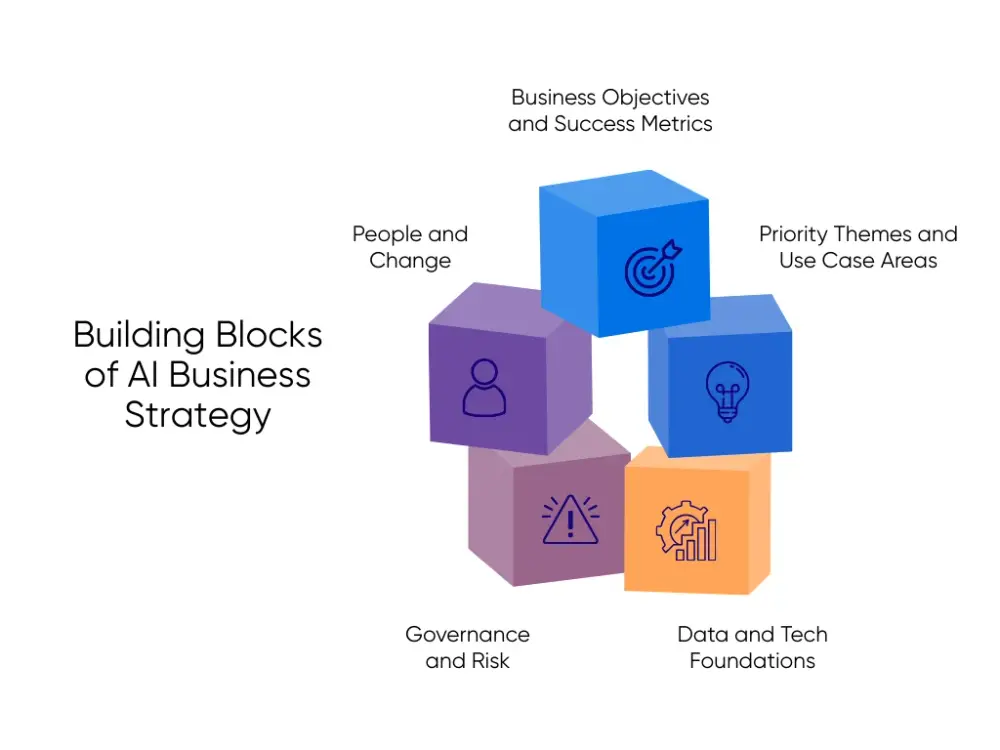
- Business Objectives and Success Metrics: Picking a few goals and defining the scoreboard.
- Priority Themes and Use Case Areas: Choosing focus areas like retention, fraud, or supply chain.
- Data and Tech Foundations: Setting standards for data quality and integration with existing systems.
- Governance and Risk: Defining how you handle sensitive data and model behavior.
- People and Change: Assigning owners and updating workflows so teams adopt what you build.
In the next sections, we’ll turn these blocks into frameworks, business model patterns, real use cases, and a roadmap you can run.
Artificial Intelligence Business Strategies and Applications in Practice
Here’s how this typically works inside a company: You start with the high-level stuff. You pick goals. You set priorities. You agree on data governance. Then you turn that into specific AI projects that live inside real workflows, with clear owners and metrics.
The mistake we see is starting with the build. A team ships a model or buys a tool, then tries to reverse-engineer the “why.” That’s how you end up with great demos and no clear impact. Every AI application needs to tie back to a business outcome: revenue growth, cost reduction, risk mitigation, or better customer experience. Pick one per project and measure it.
Once you anchor the outcomes, you can decide how each team uses AI so everyone works toward the same goals. Marketing and sales can use AI to score leads and tailor outreach. Operations and supply chain can use it for demand forecasting and inventory planning. Finance can use it for fraud detection and risk review. HR can use it for workforce planning. Product and customer experience can use it to route support and improve resolution time.
Let’s say your top priority is customer retention. You can choose to use AI for churn prediction, which flags accounts when logins drop or support tickets spike. The system sends tasks and message drafts to your account team so they can reach out before customers leave.
Core AI Strategy Frameworks for Business Leaders
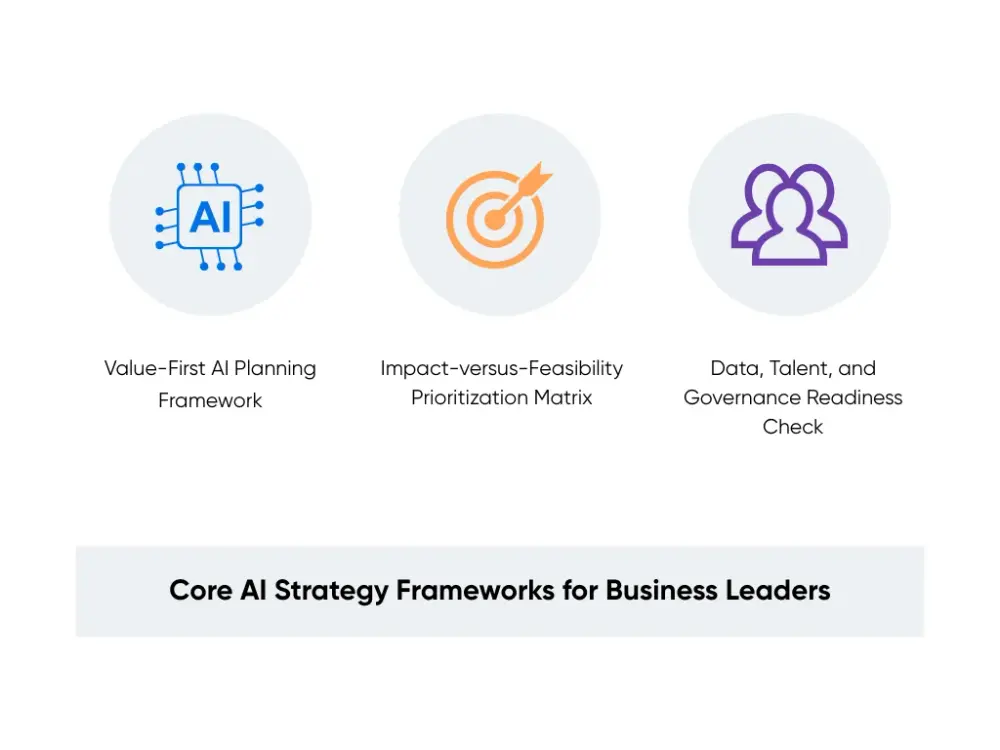
A good framework is a short checklist you reuse for AI decisions, so people stay focused on goals, data, and risk (instead of favorite tools). Without one, AI conversations can get too open-ended. One person wants a chatbot. Another wants predictive analytics. Someone else asks for an agent.
These three frameworks turn that wishlist into three simple questions: Where should AI live? What should ship first? Are we ready to execute?
Value-First AI Planning Framework
Start with value. Here’s the flow:
- Set the outcome: Pick one measurable goal, like reducing manual processing time.
- Name constraints: Call out risk limits, timelines, budget, and data privacy needs.
- Map the workflow: Write the steps people follow today and where work slows down.
- List AI use case ideas: Brainstorm ways AI can remove steps or reduce errors.
- Check feasibility: Confirm data access, integrations, and operational ownership.
- Choose tech last: Select the model, platform, and architecture that fits the use case.
Close the loop by writing a one-page plan with an owner, a metric, and a launch date.
For example, a finance team wants to cut invoice handling time by 30%. They map the workflow and find the bottleneck in data entry and exception checks. They test AI for document extraction, auto-coding to the right ledger, and smart routing for edge cases. Only after that do they pick tools.
Impact-versus-Feasibility Prioritization Matrix
Most teams have more AI ideas than their budget. The following matrix helps you sort your ideas by their potential impact on the business. You can score them by:
- Impact: How much it moves revenue, cost, risk, or customer experience.
- Feasibility: How hard it is to build and run with your current data and systems.
You can then sort them further into four buckets:
- Quick Wins: High impact, high feasibility.
- Strategic Bets: High impact, lower feasibility.
- Experiments: Lower impact, high feasibility.
- Low Priority: Lower impact, lower feasibility.
After you place ideas, pick a small portfolio and move on. Avoid the trap of “we’ll do all of them.”
Say your team starts with 20 ideas across sales, customer support, and operations. The matrix makes it clear that two ideas are quick wins, one is a strategic bet worth planning, a few belong in experiments, and the rest can wait.
Data, Talent, and Governance Readiness Check
These checks keep you from approving projects that cannot run in production.
Ask three sets of questions:
- Data Readiness: Do we have the data? Can we access it reliably? Do we trust its quality?
- Talent and Skills: Who will build it? Who will maintain it? Who will own the workflow change?
- Governance and Risk: What data is sensitive? What approvals do we need? How will we monitor model behavior?
When you find gaps, treat them as work items. You can fix them through hiring, training, process updates, or a partner. This is also where Aloa's AI consulting support can help you move from “we think we can” to “we’re ready.”
Now let's use these frameworks to talk about business model patterns and function-level use cases, so your strategy turns into a focused build plan.
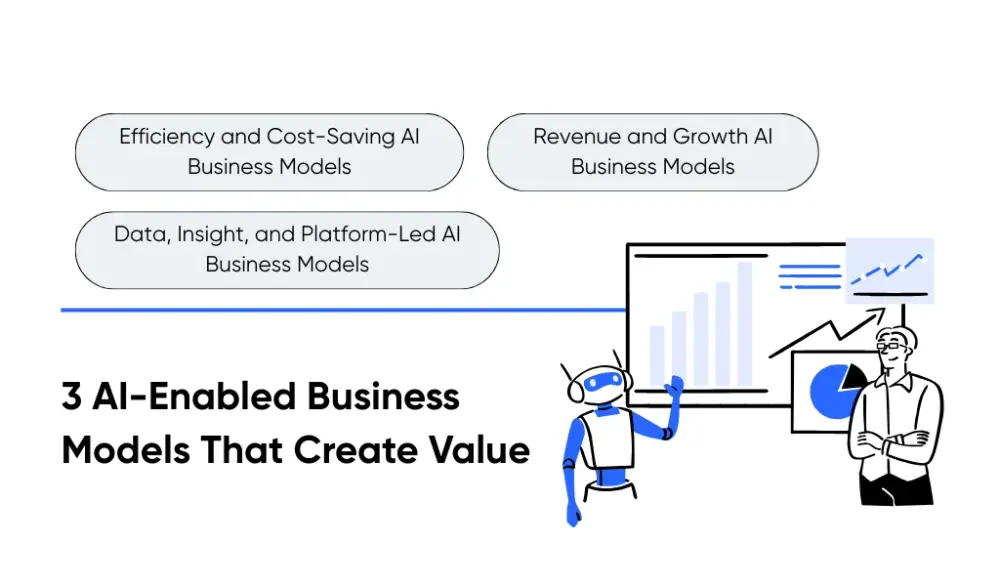
3 AI-Enabled Business Models That Create Value
Most teams start by using AI to speed up work. While that’s a great starting point, the bigger win comes when AI changes how you create and capture value. You can save more money, grow more revenue, or turn your data into something customers pay for.
Think of these as business model patterns. They help you group use cases and keep your strategy grounded in how your company operates and grows. Most companies blend all three. The mix depends on your goals, your risk limits, and how mature your data foundations are.
1. Efficiency and Cost-Saving AI Business Models
This model uses AI to reduce manual work and cut errors. It works by taking a repetitive task and letting a model do the first pass. Your team reviews exceptions instead of touching every item.
Common starting points are document-heavy work and ticket-heavy work:
- AI reads invoices or forms and pulls key fields into your system.
- AI routes support tickets to the right queue based on the message.
- AI flags odd transactions for review instead of making people scan rows.
- AI suggests better delivery routes based on constraints and timing.
Here’s what “value” looks like here: Handling time drops. Error rates fall. Backlogs shrink. You can also avoid hiring for pure volume.
A finance team, for example, can automate invoice intake. The model extracts vendor, amounts, and line items. It codes the invoice and sends edge cases to a reviewer. That turns a full-time manual workflow into a focused review loop.
This is where many teams start because the math is clear. You can tie savings to hours, headcount, and operating expense.
2. Revenue and Growth AI Business Models
This model uses AI to help you sell more and keep customers longer. It learns patterns from customer behavior, then uses AI algorithms to choose the next best action.
Common plays include personalization, targeting, and pricing:
- Product recommendations that adapt to behavior in real time.
- Churn prediction that flags accounts at risk and triggers outreach.
- Upsell and cross-sell suggestions based on usage and intent.
- Pricing guidance that responds to demand, inventory, and competition.
Say your ecommerce team uses AI to recommend products on-site and in email. A customer browses running shoes. The system suggests socks, insoles, and a higher-end model based on similar buyers. That increases conversion and average order value without blasting more ads.
A SaaS team can do the same with retention. The model detects usage drop-offs and prompts in-app guidance or a customer success touch. That extends lifetime value.
3. Data, Insight, and Platform-Led AI Business Models
This model treats AI capabilities as part of the product, not an internal tool. It works by packaging insights or features that customers rely on, then charging for access or making the product stickier.
You can do this in a few ways:
- Add AI-powered features like document analysis inside your platform.
- Provide benchmarks and predictive insights as a paid tier.
- Expose AI capabilities through an API so partners can build on it.
For example, a healthcare platform can offer AI document analysis for intake forms and prior authorization packets. The system extracts fields, flags missing info, and suggests next steps. Customers stick with the platform because it saves time every day. Partners can integrate through APIs, which grows the ecosystem.
These models turn your strategy into how your business runs. We’ll break this down by function, so you can see where to apply AI across marketing, operations, finance, HR, and product.
Artificial Intelligence for Business Applications: Function-by-Function Guide
This section focuses on high-impact applications. It does not try to list every use of AI under the sun. We want you to scan this and say, “Yep. That fits our work.”
We’ll group use cases the way most companies already operate. Customer-facing work, operational work, and decision and people work. Pick one or two per cluster, then build from there.
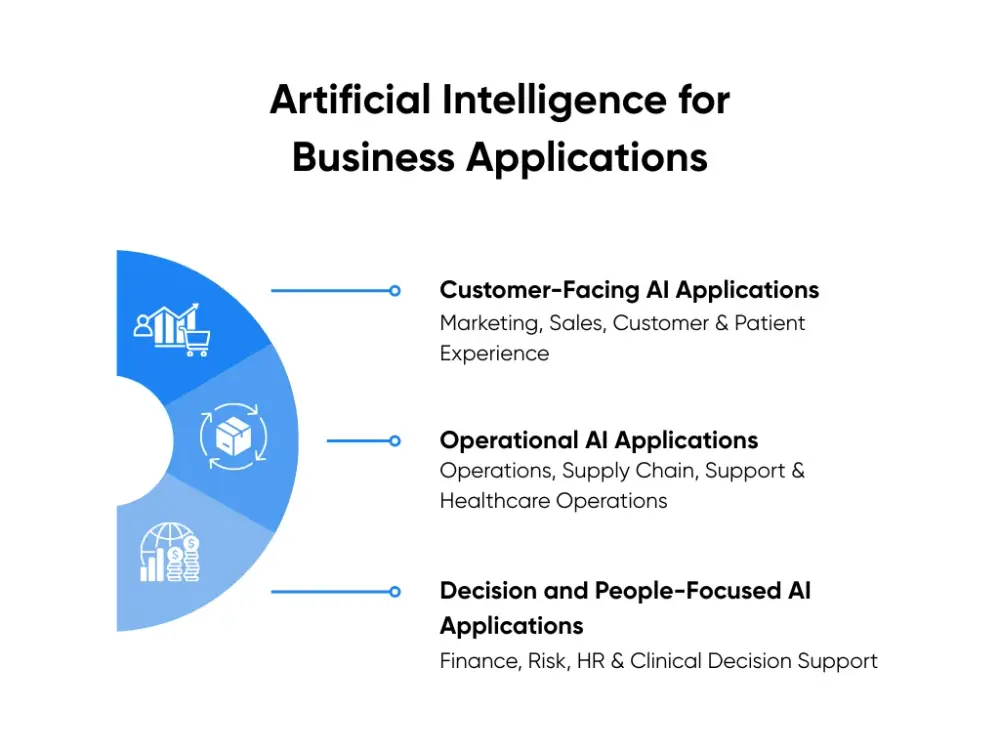
Customer-Facing AI Applications (Marketing, Sales, Customer & Patient Experience)
Customer-facing AI changes how people find you, buy from you, and get help. The system reads behavior and natural language, then suggests the next best action. That action can be a segment, an offer, a recommendation, or a reply.
Here are common plays:
- Segmentation and Propensity Modeling: Group customers by behavior, then predict who is likely to buy or churn.
- Lead Scoring: Rank inbound leads so sales starts with the best ones.
- Personalized Campaigns and Recommendations: Match content or products to what a person tends to do.
- Conversational Assistants: Answer questions, route requests, and hand off to a human when needed.
Here’s what it looks like in a sales cycle: Your team wants higher conversion and faster deal velocity. You score leads using sales data and intent signals, then reps focus on the top tier first. A website assistant answers common questions and routes qualified buyers to sales, while edge cases go to a person.
In healthcare, the same pattern can reduce friction. A virtual assistant helps patients find the right clinic, book a slot, and get reminders. No-show rates drop when outreach becomes consistent and targeted.
Operational AI Applications (Operations, Supply Chain, Support & Healthcare Operations)
Operational AI reduces bottlenecks and surprises. It forecasts demand, flags issues early, and routes work to the right place. Your team spends less time reacting.
Common use cases include demand forecasting, inventory optimization, routing and scheduling, predictive maintenance, and ticket triage for support. In healthcare operations, you see the same approach for bed planning, staffing, operating room scheduling, and patient volume forecasting.
A forecasting model also predicts demand for medical supplies by location and season. It suggests reorder points, then planners review exceptions instead of rebuilding plans every week. Stockouts drop, and overstock falls with it.
For equipment, a hospital may run predictive maintenance on imaging machines. The model flags patterns that often lead to failure, so the team schedules service before downtime hits. That protects capacity and reduces last-minute reschedules.
This cluster ties cleanly to cost and operational efficiency goals. You can track handling time, error rates, downtime, and operating expense without guessing.
Decision and People-Focused AI Applications (Finance, Risk, HR & Clinical Decision Support)
These applications support high-stakes choices. They scan large datasets for patterns people miss, then surface early warning signals. Your team still makes the call.
In finance and risk, common use cases include fraud detection, credit risk scoring, cash-flow forecasting, and scenario analysis. In HR, teams use skills mapping, learning recommendations, and attrition risk modeling. In healthcare, models can flag high-risk patients for care management, predict readmission risk, and support population risk stratification. These systems support clinical judgment; they do not replace it.
Here’s an example: A lender sees rising risk in one customer segment. The model detects shifts in payment behavior and cash-flow signals early. The team adjusts limits and review steps before losses grow.
This cluster also needs tighter governance. Hiring tools can drift into unfair outcomes, which is why the EEOC and DOJ warning on disability discrimination and AI hiring tools matters for HR use cases. In healthcare, teams should understand oversight lines for decision support, including FDA guidance on clinical decision support software.
Step-by-Step AI Strategy Roadmap for Implementation
AI work goes sideways when teams skip steps. They jump to pilots, then scramble to govern, integrate, and measure. This roadmap keeps the order clean, so you can move from idea to production without losing control:
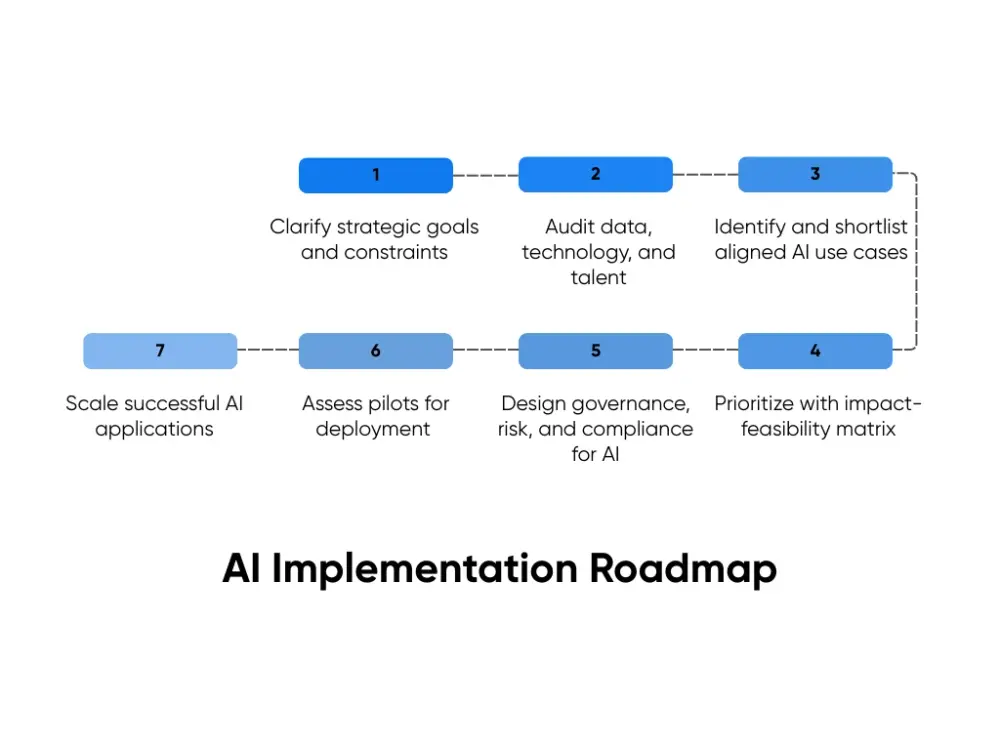
Clarify strategic goals and constraints: Pick the outcomes you want, like faster processing, lower risk, or higher retention. Set constraints up front too, like data privacy rules, budget, and timelines. Write the success metric in plain numbers.
Audit data, technology, and talent: List the data you need and where it lives. Check data quality, access, and refresh rate. Review your systems (including legacy systems) for integration limits. Then ask who will build, own, and maintain the AI system.
Identify and shortlist aligned AI use cases: Start from workflows, not features. Map where people spend time, where errors happen, and where decisions stall. Brainstorm use cases that remove steps or improve decisions, then keep the ones tied to your goals.
Prioritize initiatives using the impact-versus-feasibility matrix: Score each idea on business impact and how hard it is to build and run. Pick a small portfolio. Aim for a mix, like one quick win and one strategic bet.
Design governance, risk, and compliance for AI: Decide how you handle sensitive data, approvals, and review steps. Set rules for monitoring, access control, and human oversight. Make it easy for teams to follow, or they won’t.
Evaluate pilots and prepare for production deployment: Run pilots with clear owners and success metrics. Track quality, latency, and failure modes. Plan integrations, user training, and support before you call it “done.”
Scale successful AI applications and retire low-value efforts: Move proven use cases into more teams and workflows. Reuse data pipelines, models, and components. Shut down projects that do not deliver and free up budget and attention.
This is also where a partner can help without taking the wheel from you. Aloa can help refine goals, pressure-test use cases, run rapid prototypes, integrate with existing systems, and keep models performing after launch. You still own the strategy. We help you execute it cleanly.
Key Takeaways
AI has a habit of multiplying. One pilot turns into five. Five turns into tool sprawl. Then you’re managing platforms instead of outcomes. A clear strategy keeps AI pointed in one direction, and it turns decisions into a repeatable process. That’s the job of artificial intelligence business strategies and applications.
Start with a small set of AI initiatives that match your readiness. Keep governance tight. Tie each project to one outcome you can measure. Scale the winners, and close the tab on the rest.
Want help doing that without turning it into a long internal slog? Book a consultation with Aloa. We’ll help you pressure-test the business case, rank the best use cases, and map a realistic AI implementation plan. Then we can build with your team, integrate with your systems, and keep the AI solution optimized after launch.
FAQs
What is an AI business strategy in simple terms?
An AI business strategy is your plan for using AI to hit business goals. It defines where AI shows up in daily work, which problem it solves, and what result counts as success.
It also sets the rules. You name owners, decide what data teams can use, and define review steps and risk limits so projects don’t drift.

Why do we need an AI strategy instead of just buying AI tools?
Tools give you options, not direction. Too many tools usually lead to overlap, mixed standards, and pilots that never scale.
A strategy forces the hard choices early. You pick the outcome, assign ownership, and set guardrails for data access and review, then you choose tools that fit the plan.
How can we get started with artificial intelligence business strategies and applications?
Start with one workflow and one outcome you can measure. Map where time, errors, or delays show up, then pick a use case that targets that pain.
Our AI consulting team at Aloa can help you pick that first workflow, design the pilot, and connect it to your current systems.
How should businesses choose and prioritize AI use cases?
Use two filters: impact and feasibility. Impact means it moves revenue, cost, risk, or customer experience, and feasibility means you can build and run it with your current data and systems.
Plot ideas on an impact-versus-feasibility grid, then pick a small portfolio. Aim for one quick win and one strategic bet, and let the rest wait.
How can we measure the ROI of its AI strategy and applications?
Pick one measurable outcome per project and set a baseline before you change anything. Track the before-and-after change in cycle time, handling time, error rate, cost, conversion, or retention.
Count the full cost to run the system too, not only the build. Include data work, monitoring, human review, and adoption, because unused tools don’t produce ROI.
What should we look for when selecting an AI vendor or development partner?
Look for a partner who starts with your goals and constraints, then asks about data, integration, ownership, and governance. You want someone who can explain how the system will fit into your workflows and how performance will be monitored after launch.
Also look for honesty. A good partner will say “no” when the data is not ready or when a use case has weak economics, because that saves you time and budget.