
You’ve probably seen plenty of “AI tools” and generative AI apps online. Many follow the same pattern. They take your text, send it to ChatGPT, and show you the reply. When you see these tools, you might feel like a developer could build that kind of wrapper in an afternoon. The bigger question is whether the tool can use your data, follow your rules, and support the specific use cases and business needs your team cares about. That's why the ChatGPT wrapper vs AI product decision is so important.
At Aloa, we build custom AI systems and LLM solutions in-house as a software development partner. We connect the model to your data and map each workflow step to how your team works. We set guardrails for what the system can say or do, test accuracy, and design the setup to remain stable and cost-friendly at scale.
This guide helps you evaluate AI tools clearly. You’ll see how to look past the UI and focus on behavior, context, and control. You’ll also learn how to spot AI washing so you can choose tools that support your goals.
TL;DR
- ChatGPT wrappers forward prompts to a single LLM or foundation model with minimal memory, logic, and integration. They suit demos, experiments, and low-risk helpers.
- Native AI products add data pipelines, vector search, rules engines, and workflow integration to solve complex tasks reliably.
- Strong products support fine-tuning, model routing, observability, and vendor flexibility instead of burying logic in one prompt.
- Performance, cost, security, and compliance depend on architecture: where data flows, which systems connect, and how you control models.
- Use wrappers for quick validation; choose AI products when work involves patients, money, regulated data, or daily operations.
ChatGPT Wrapper vs AI Product: A Quick Comparison
A ChatGPT wrapper takes what you type, wraps it in a standard prompt, sends it to a large language model, and hands the answer back. An AI product adds its own data, rules, and workflows around the model so it can solve business tasks. That's the key ChatGPT wrapper vs AI product difference.
Here’s a quick side-by-side view:
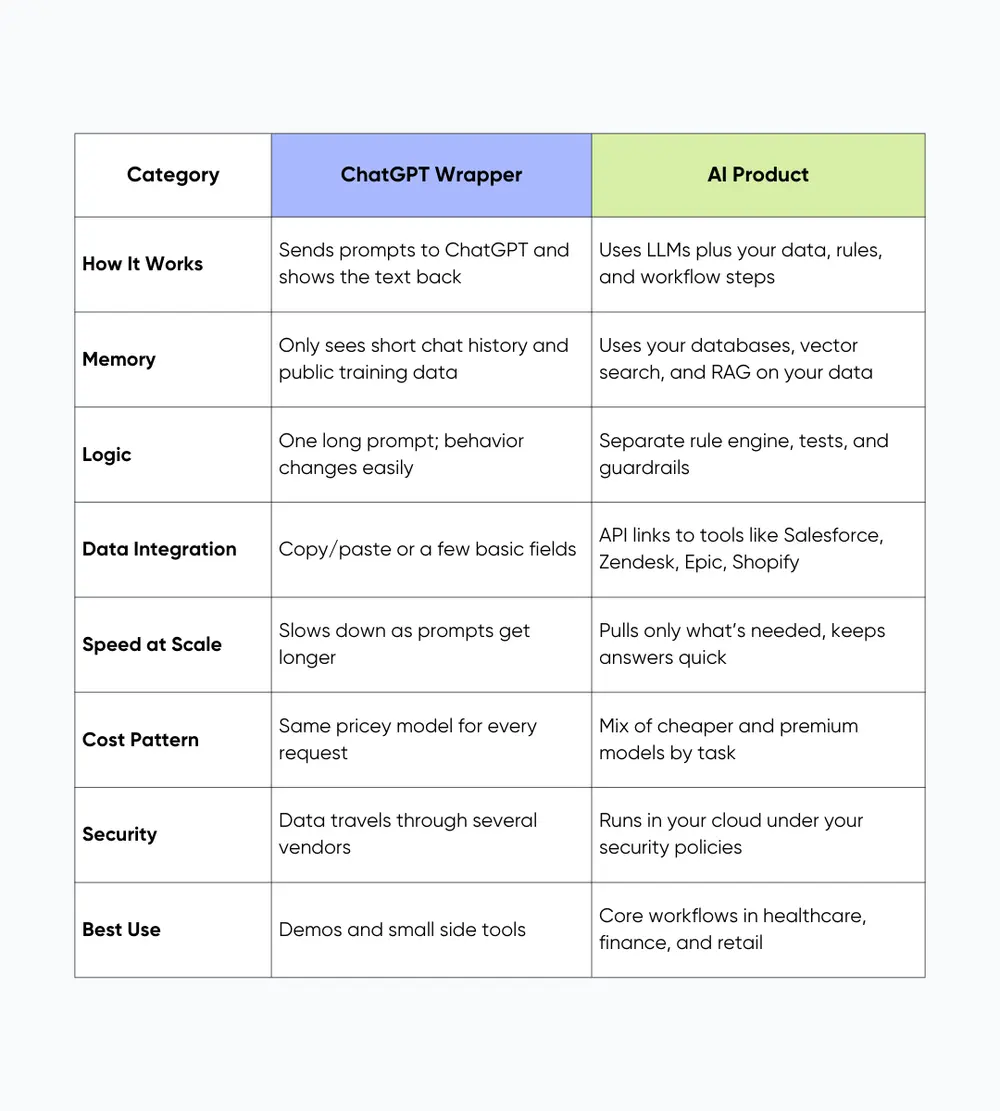
Let's break down how these differences show up in architecture, customization, performance, and security.
Difference #1: Technical Architecture: The Foundation Layer Difference
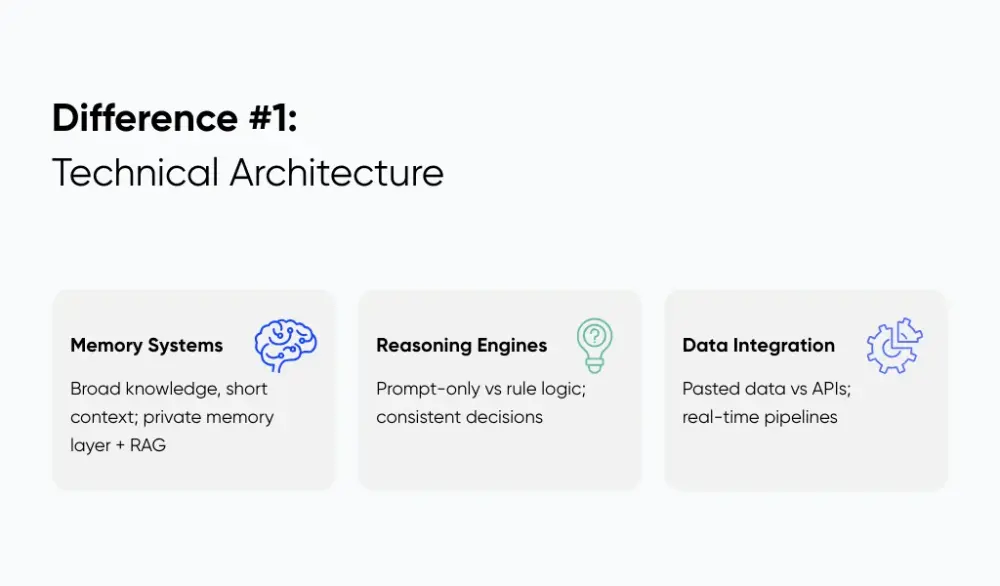
A wrapper only passes messages to a model. An AI product adds memory, rules, and data pipes. Those parts decide if the tool can actually support your team or if it tops out as a demo.
Memory Systems
ChatGPT has broad knowledge, but it comes from public data up to its last training cutoff. It doesn't know your store inventory, pricing rules, customer data, or other proprietary data. It also only remembers what fits in the short context window, which works like temporary memory.
In retail, if a shopper asks Target, “Can I pick up this TV from the downtown Chicago store today?”, a wrapper might give generic delivery tips because ChatGPT has no live access to Target’s inventory. This happens because a simple GPT wrapper cannot store or query your data.
A true AI product builds its own memory layer. It stores your product catalog, store locations, and stock levels in private databases and vector indexes. It then uses retrieval augmented generation to ground model output in trusted, current data.
So when a customer asks about that TV, the AI product checks your inventory first, then uses the model to explain pickup or delivery options clearly.
Reasoning Engines
Good memory is helpful, but reasoning is what keeps answers consistent. Wrappers rely only on prompts. You write long instructions and hope the model follows them. You can't see or shape how the model breaks a problem into steps. Pallet’s explanation of agent architectures describes this as a “single-model interaction layer” that offers limited control.
Now picture a simple bank rule: one late-fee waiver per customer per year. A wrapper might follow that rule sometimes but ignore it when the conversation gets long.
A genuine AI product separates language from rules. It builds logic flows for fee limits, approval paths, and pricing constraints. The model handles natural language and gray areas, while the rules engine enforces the boundaries. At Aloa, we also run "golden questions" and test suites on every update so you can see whether the system’s reasoning improves or slips.
If you ever evaluate a custom LLM application development company, you should ask: “Where does your reasoning live? In prompts, or in actual rule logic?”
Data Integration
Wrappers treat data as text you paste. You copy a Shopify record or a Salesforce note and ask the model to summarize it. That helps for quick tasks, but nothing stays connected.
A full AI product links to your systems through APIs and webhooks. In ecommerce, that might mean pulling orders from Shopify, stock from your warehouse system, and customer history from your CRM. Enterprise RAG patterns often depend on constant access to these sources so answers reflect current data.
When we build these products at Aloa, we create a clear pipeline. Your systems send data into an ingestion layer. We clean and tag it, then store it in databases and vector stores. The AI layer queries those stores in real time.
Difference #2: Customization and Control: Beyond Prompt Engineering
A basic ChatGPT integration is quick. You add a text box, send prompts to the API, and show whatever comes back. That’s fine for a demo. It falls apart when you need an AI that follows your medical rules, your approval steps, and your patient-safe language.
Depth of Model Customization
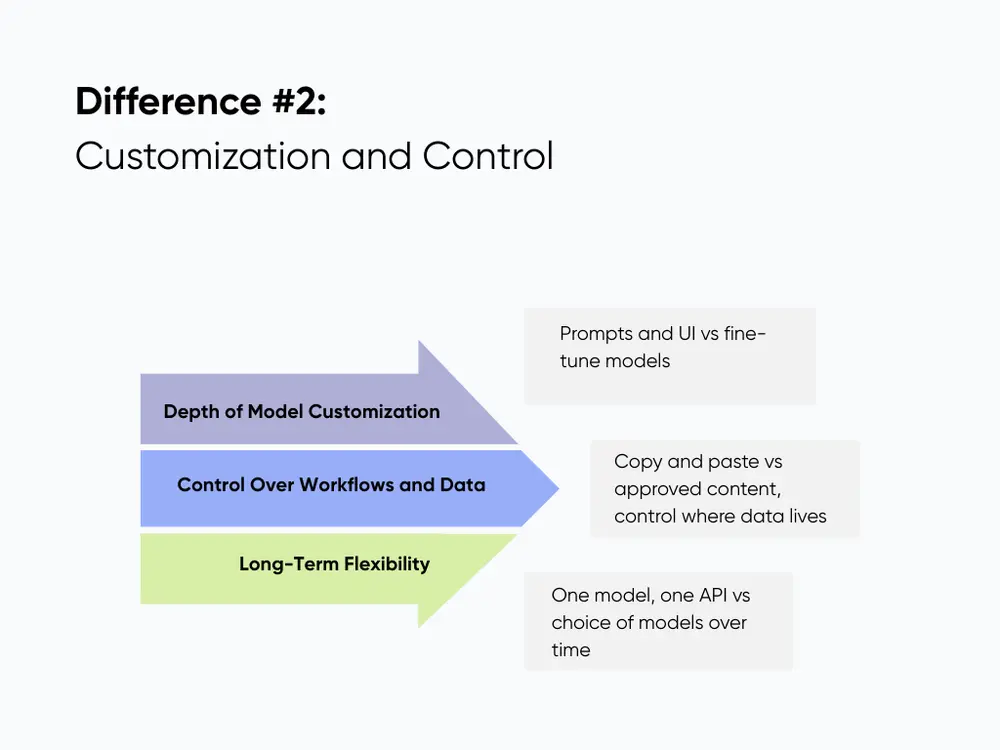
Wrappers let you tweak prompts and adjust the UI. That’s it. You can change tone, add a few “don’ts,” and include example questions, but you can’t change how the model thinks. You can’t train it on your clinical notes, your discharge templates, or your triage language. This is why builders often call wrapper tools “ChatGPT with a skin.”
A full AI product goes much deeper. You can fine-tune a model on your own data so it learns your writing style and medical workflows. OpenAI and Microsoft both explain that fine-tuned models perform better on specialized tasks and often cost less to run.
A clear example is Salesforce's Agentforce. It doesn’t rely only on generic prompts. It pairs large models with each company’s Salesforce data so the AI speaks in that company’s language and follows its workflow. A hospital using Salesforce Health Cloud can generate care summaries or follow-up messages that match its own style guides and policies.
At Aloa, we blend traditional software engineering with using the latest AI models. We design intelligent solutions that work with your operations. When you evaluate vendors, ask: Can you change the model’s behavior at the system level (fine-tuning, RAG, constraints), or are you only adjusting prompts? That's how to tell if a product is just prompt engineering in a nice UI.
Control Over Workflows and Data
With wrappers, you can copy text from your EHR or patient FAQ, paste it into a chat box, and send it to an external API. It’s straightforward, but it doesn’t give you much control.
A full AI product gives you more control. Let’s say a hospital staff uses a portal to create patient notes, tag them with the right condition, and let a clinical lead approve each one. Approved items then become part of the AI’s knowledge. Azure OpenAI’s “on your data” feature uses this pattern so your AI agent answers from your vetted content, not from the open internet.
A simple wrapper takes each message, sends it to the model, and sends back the raw reply. It never stores what your team approves or learns from past cases, so every request starts from zero.
With a native product, you can also control where data lives. A hospital might keep PHI inside its own Azure environment and only allow the model to access de-identified or structured fields. You decide who can edit knowledge, who can publish changes, and how AI responses get logged for review.
A simple wrapper can live in a HIPAA-compliant setup, but it doesn’t enforce these rules. It usually sends each request to an external API with limited control over fields, logs, or retention. That setup often carries more compliance risk than a full product.
Long-Term Flexibility
Wrappers rely on one model (i.e., ChatGPT) and whatever price or limits that model has. If the API price changes over time or model behavior shifts, your entire tool changes with it.
There’s a way to build your AI product so it doesn’t rely on a single model. At Aloa, we design systems that let you switch between models like OpenAI, Anthropic Claude, or Gemini without breaking your workflows. A good example of this approach is Salesforce’s Agentforce. It follows the same idea by supporting both OpenAI and Anthropic models, allowing hospitals the flexibility to choose whichever performs best for their clinical content. It also reduces single-model dependability.
If the vendor keeps pointing back to ChatGPT as the entire engine of your suggested build, it could be that their expertise is limited to a single model. Check out our guide on AI skills for tech leaders to better vet the vendors that you work with.
Difference #3: Performance and Scalability: When Volume Meets Reality
Wrappers often feel smooth in a small pilot. As more people use them and prompts get longer, the cracks show. You start to see slower replies, rate limit errors, and higher API bills. This happens because each request pushes a large context through one model call again and again.
Latency Analysis
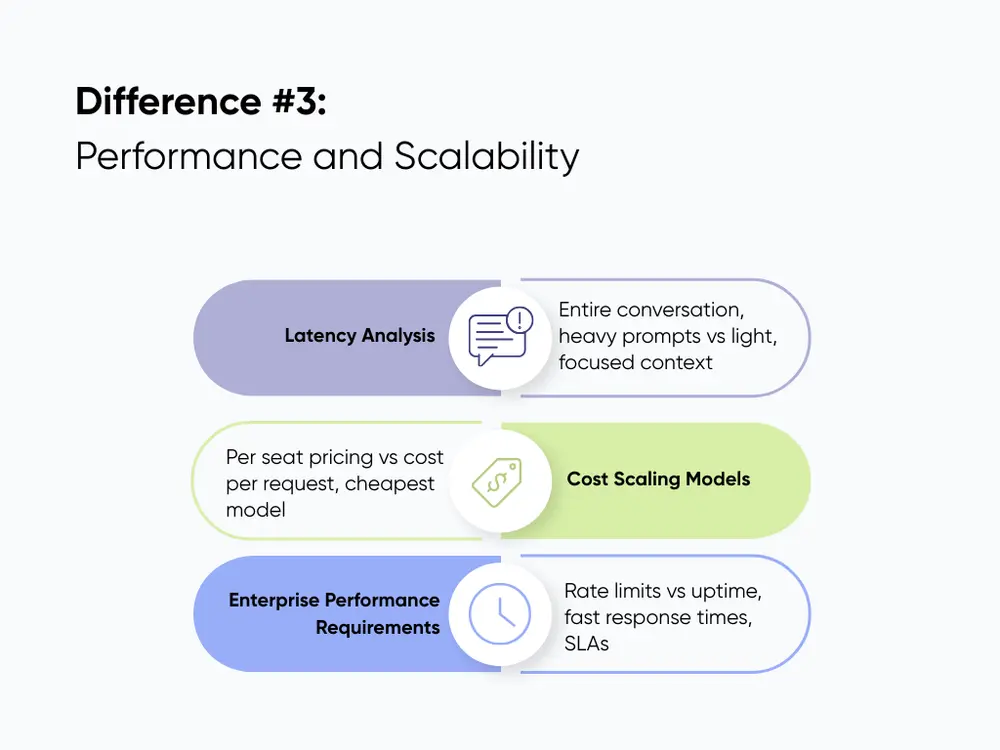
Wrappers resend the entire conversation to the model on every request. As chats get longer, prompts get heavier. Heavy prompts slow the model down and cost more to process.
Think about a support copilot inside Zendesk for a SaaS team. One enterprise customer might have ticket threads going back six months. A wrapper keeps shoving long blocks of those messages into every prompt. Soon, an agent waits five to ten seconds for each reply. The model also forgets earlier details because the context window fills and starts cutting off older messages.
A native AI product handles this differently. It stores past tickets in a database. When the agent asks something, the system pulls only the few pieces that matter: maybe the last fix, the customer’s setup, and a recent error screenshot. RAG sends that light, focused context to the model. Responses stay quick and accurate because the model sees only what it needs.
Cost Scaling Models
Every request to an AI model uses tokens. Bigger models cost more. As your usage grows, so does your bill.
Wrappers often mask this behind a flat “per seat” price. But when your support volume jumps, like during a product launch or a holiday sale, the cost math breaks. The vendor either raises prices or slows requests to stay within budget.
A full AI product plans for scale. At Aloa, we benchmark several language models and match each task to the cheapest model that remains accurate. A routing question goes to a lightweight model. A deep troubleshooting step goes to a premium model. This keeps cost per request predictable, even when your daily volume spikes.
Enterprise Performance Requirements
Enterprises need solid uptime, fast response times, and clear SLAs. Platforms like Agentforce run huge volumes of AI predictions while keeping the reliability that Salesforce customers expect.
Wrappers can’t match that. If ChatGPT slows down or hits a rate limit, your entire tool stalls. You can’t cache results, switch models, or scale the system when traffic climbs.
A full AI product gives you these controls. In Aloa’s HIPAA-compliant medical transcription projects, clinics rely on quick, accurate notes during packed schedules. We manage load, scale the stack, and monitor performance so doctors aren’t waiting between patients.
Difference #4: Security and Data Privacy: The Enterprise Imperative
Latency slows teams down, but security failures stop everything. In healthcare, finance, and other regulated fields, a ChatGPT wrapper vs AI product gap often shows up in where data travels, who touches it, and who controls it.
Data Flow Security
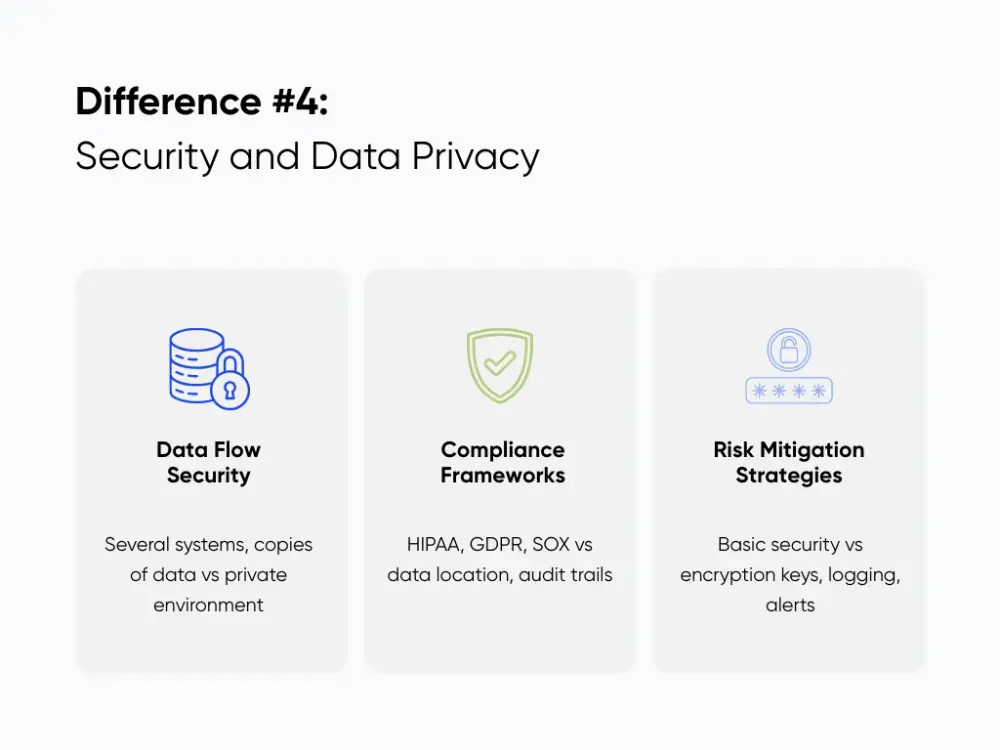
A wrapper sends your data through several systems. Say a nurse types discharge notes into an AI tool. The wrapper’s backend receives the text, forwards it to ChatGPT, and stores logs along the way. Copies of that message may sit in three places: your app logs, the wrapper’s logs, and the model provider’s logs. You may not know where those servers are or how long the data stays there.
HIPAA warns that patient health information must be protected at every step. A native AI product keeps the path short and easier to audit. At Aloa, we design AI systems so sensitive data moves through a few well-controlled services instead of a long vendor chain. We keep the AI stack inside environments you manage, apply your existing security policies, and set up clear logging. Your security team can trace how data flows and who accessed it.
Compliance Frameworks
HIPAA, GDPR, and SOX each set strict industry standards and requirements:
- Hospitals must track who viewed or edited PHI.
- Banks need audit trails for anything tied to financial reporting.
- GDPR requires knowing exactly where personal data is stored and processed.
Wrappers make this difficult. If you can’t confirm which country holds your logs, how long prompts are stored, or which vendor employees can access them, you can’t pass an audit.
Some healthcare clients ask us for near-perfect accuracy and complete traceability for any flow that touches patient care. That’s only possible when all data stays in their cloud and doesn’t leak into a chain of outside vendors.
A native AI product lets you set data location, retention rules, and processor roles. You can plug those settings straight into your existing compliance checks.
Risk Mitigation Strategies
Wrappers offer basic security like HTTPS and role settings, but little else. You can’t customize monitoring, alerts, or incident response. Security teams already warn about fake or unverified “ChatGPT-style” tools that collect extra data behind the scenes.
A native AI product lets you bring your own safeguards, including:
- Encryption keys
- Identity provider
- SIEM for logging and alerts
- Data loss prevention checks
- Incident response plan
In one Aloa healthcare build, every AI-generated patient education draft went into a staff approval queue. Nothing reached patients without human review. A wrapper can’t support that kind of workflow.
Owning your AI stack also protects you in the long term. You can switch model providers without losing your logic or exposing your data. A wrapper locks you into someone else’s pipeline and forces you to accept their risks.
Key Takeaways
The question is not “AI or no AI.” The question is what you trust AI to handle. ChatGPT wrappers work for quick tests, side tools, and simple experiments. Once the work touches patients, money, or core operations, you need an AI product built around your data, rules, and workflows, not a single clever prompt.
Start by writing your own enterprise AI vendor evaluation checklist. Define what “good” means for accuracy, data sources, speed, data security, and cost. Use that list to judge every tool so you’re not pulled in by shiny demos or vague “AI-powered” claims. That's the heart of the ChatGPT wrapper vs AI product decision.
If you want a partner that can take you from a simple ChatGPT wrapper to a native AI product, book a consultation with Aloa. Our team will help you define your requirements, choose a high-impact first use case, and check whether your data and systems are ready. From there, we'll design and build a custom AI product inside your cloud so your team can use it safely in daily work.
FAQs
What exactly is a ChatGPT wrapper?
A ChatGPT wrapper is a simple app that sends your text to ChatGPT and shows whatever comes back. Think of tools that look fancy but act like, “Type here → we call ChatGPT → here’s the answer.” If the ChatGPT API goes down, the whole tool stops because it has no reasoning engine of its own.
What defines a true AI product versus a wrapper?
A true AI product has its own brain around the model. It pulls live data from your systems, follows your rules, and runs inside your workflows. For example, a bank’s AI that checks a customer’s account history, applies fee-waiver rules, and logs decisions is a product (not a wrapper). It has its own databases, search layer, logs, guardrails, and rule logic. You can swap the model (OpenAI, Anthropic, Gemini) and the product still works.
How can I tell if a vendor is selling a wrapper or a genuine AI product?
Ask straightforward questions like:
- “Where does my data get stored?”
- “How do you search my internal records: vector DB, SQL, something else?”
- “What systems do you integrate with? Salesforce? Zendesk? Epic? Shopify?”
- “Can I see an architecture diagram?”
If the answers sound like, “We just send your text to ChatGPT,” it’s a wrapper. If you want to build your own baseline before those conversations, you can walk through our executive AI learning path to get up to speed on the basics.
When does it make sense to choose a wrapper over a native AI product?
Wrappers are great for fast learning and low-risk work, such as:
- Trying out a new idea for customer service, like answering common customer queries
- Testing prompts with your sales team
- Giving marketing a quick copy-draft helper
- Running small internal experiments that don’t touch PHI or financial data
They’re cheap, quick, and good for early validation.
When should I invest in a native AI product instead of a wrapper?
Choose a full product when:
- The AI touches patient care (e.g., discharge notes), money (e.g., loan logic), or daily operations (e.g., support triage)
- You need strict compliance, audit trails, or data controls
- Many employees rely on the system every day
- You need stable operational costs, fast responses, and the ability to tune or swap models
That’s when a wrapper becomes too risky and too limited.
What role can Aloa play in helping me choose between wrapper and native AI solutions?
Aloa helps you make the call and then builds the system you need. Through our AI consulting services, we map your workflows, evaluate your data, define accuracy and security requirements, and match LLM solutions to your specific business challenges. If a wrapper is enough for early testing, we’ll say so. If you’re ready for a full AI product, we design and build it in your cloud with real integrations, real guardrails, and real accountability. We build everything in-house so your team gets an AI system they can trust every day.