

You’ve searched “AI app development cost” and found numbers ranging from $10,000 to over $1 million. That spread isn’t useful when you’re trying to set a real budget. The problem is that most cost guides list ranges without explaining what actually eats your money. According to McKinsey’s 2025 State of AI report, 78% of organizations now use AI in at least one business function. But plenty of those companies burned through their first AI budget before finding what works.
At Aloa, we build custom AI applications through a proof-of-concept-first process. We’ve seen firsthand how teams overspend when they skip validation and jump straight into full-scale development. Our approach front-loads risk so you know what works before committing six figures.
This guide breaks down what AI app development actually costs in 2026, what drives those numbers, and how to structure your budget so you don’t end up paying for an expensive lesson.
TL;DR
- AI app development cost ranges from $30K to $500K+ in 2026, depending on complexity, data needs, and scale.
- Data preparation and model strategy are the two biggest cost drivers, not the underlying technology.
- Hidden costs like model retraining, infrastructure scaling, and compliance can add 20–40% to your initial estimate.
- Starting with a proof of concept ($15K–$40K) saves you from committing six figures to an unproven idea.
- Outsourcing to an experienced AI development partner can cut costs 30–50% compared to building an in-house team.
What Does AI App Development Actually Cost in 2026?
The short answer: anywhere from $30,000 to $500,000 or more. That’s a wide range, and it depends almost entirely on what you’re building. A chatbot that answers FAQs and a computer vision system that inspects manufacturing defects aren’t in the same cost category. According to Statista’s AI market forecast, the global AI market reached $244 billion in 2025 and is projected to surpass $800 billion by 2030. That growth is pushing demand for custom AI builds, which means the price of AI app development platforms is climbing too.
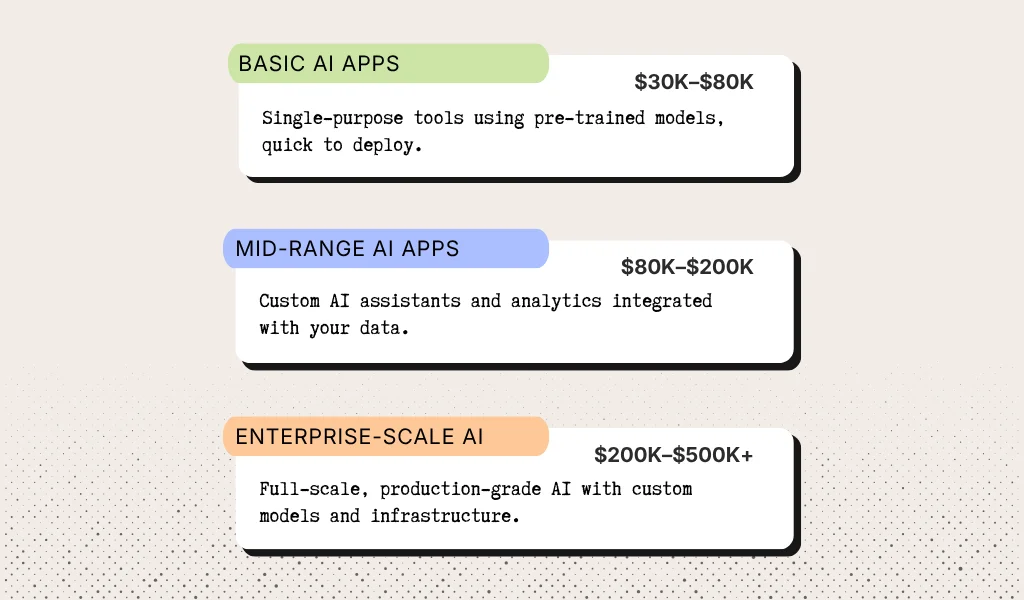
Basic AI Apps ($30K–$80K)
These are focused, single-purpose tools. Think chatbots powered by pre-trained language models, simple recommendation engines, or rule-based automation with a light machine learning layer. You’re plugging into existing APIs (OpenAI, Claude, Google Vertex) rather than training anything from scratch. Development typically takes 6–12 weeks with a small team. The AI app development cost stays low because you’re customizing, not inventing.
Mid-Range AI Applications ($80K–$200K)
This is where most businesses land. Custom AI assistants that understand your specific domain. Predictive analytics dashboards that pull from your internal data. Personalization engines that go beyond basic filtering. These projects need your own data, some model fine-tuning, and real integration with your existing tech stack. Development runs 3–6 months, and you’ll need data engineers alongside your ML team.
Enterprise-Scale AI Systems ($200K–$500K+)
Full automation pipelines, computer vision systems, or generative AI platforms built from the ground up. These are production-grade systems handling complex workflows across multiple departments. They require custom model training, dedicated infrastructure, rigorous testing, and ongoing optimization. The AI development cost at this tier reflects 6–12+ months of work with a cross-functional team.
What Drives the Price Up (and Down)?
Two AI projects can look similar on the surface and cost wildly different amounts. The difference comes down to five factors. Instead of just listing them, here’s a framework: answer these questions about your own project and you’ll have a much clearer picture of where your AI development cost will land.
.webp)
Data Readiness and Preparation
This is where budgets quietly balloon. If your data is clean, structured, and centralized, you’re in good shape. If it’s scattered across legacy systems, full of gaps, or needs manual labeling, expect this phase to consume 25–40% of your total budget.
Picture a healthcare company that wants to build a diagnostic AI. Their patient records sit in three different systems, use inconsistent formats, and contain sensitive data that needs HIPAA-compliant anonymization. Just getting that data ready for model training could cost $50,000–$100,000 before a single line of model code gets written. On the flip side, if you’re building on top of public datasets or using synthetic data generated by LLMs, this cost drops significantly.
Model Strategy: Build, Fine-Tune, or Plug In?
Your model approach is the single biggest cost lever you control. Three options exist, and each carries a different price tag. API-based integration (plugging into GPT-4, Claude, or Gemini) is the cheapest entry point: you pay per token and skip training entirely. Fine-tuning a pre-trained model with your own data hits the middle ground, typically adding $10,000–$50,000 to the project. Training a model from scratch? That’s enterprise territory, often $100,000+ just for the compute time.
Most businesses don’t need custom training. Fine-tuning or prompt engineering on existing models covers 80% of real-world use cases. If you’re unsure where to start, our guide on how to make an AI walks through the decision process step by step.
Infrastructure and Compute
Cloud platforms (AWS, Google Cloud, Azure) make it easy to start training models without buying hardware. But usage-based pricing means costs compound fast. Training a medium-sized NLP model on AWS can run $20,000–$35,000 per month in compute alone.
After launch, inference costs (the cost of actually running the model for each user request) become the ongoing expense. Say your AI assistant handles 10,000 queries per day. At even a fraction of a cent per query, that adds up to thousands monthly. The infrastructure piece of your AI app development cost isn’t a one-time expense. It’s a recurring bill.
Integration Depth With Existing Systems
Connecting your AI to a single API is straightforward. Connecting it to your CRM, ERP, legacy database, and three internal tools is not. Every integration point adds engineering time, testing complexity, and potential failure modes. If you’re curious about the broader app development cost picture, our breakdown of mobile app developer cost covers similar integration dynamics.
Team Composition and Location
A senior ML engineer in the US costs $150,000–$200,000 per year. The same skill level in Eastern Europe or Latin America runs $60,000–$100,000. A full AI team (data scientist, ML engineer, backend developer, project manager, QA) can easily cost $400,000+ annually in the US. Outsourcing to a dedicated AI partner cuts that by 30–50% while giving you access to specialists who’ve already solved problems similar to yours.
How Do AI App Costs Compare by Use Case?
Your specific use case determines where you fall on the cost spectrum. Here’s a practical reference for how much does AI cost across different application types.
AI Chatbots and Virtual Assistants: $30,000–$80,000. Key drivers are pre-trained models, light integration, and low compute usage.
Recommendation Engines: $50,000–$150,000. Real-time data processing and continuous model updates push costs higher.
Predictive Analytics: $60,000–$180,000. Data quality and model accuracy requirements determine where you land in this range.
Generative AI Applications: $80,000–$250,000+. Ongoing compute, fine-tuning, and usage-based pricing make these costlier over time.
Computer Vision Systems: $100,000–$300,000+. Large labeled datasets, heavy training compute, and specialized hardware drive the cost to build AI in this category.
Predictive Maintenance (IoT): $150,000–$500,000+. Sensor integration, data pipelines, and industry compliance requirements make this the most expensive category.
The pattern is clear. The more custom data you need, the more real-time processing involved, and the deeper the system integration, the higher the cost to build AI. If your use case maps to an existing model’s strengths, you’ll stay on the lower end. For a step-by-step walkthrough of the build process, check our guide on how to make an AI.
The Hidden Costs That Blow AI Budgets
Here’s where projects go sideways. The initial build is only part of the story. Teams that budget exclusively for development end up blindsided by what comes after launch.
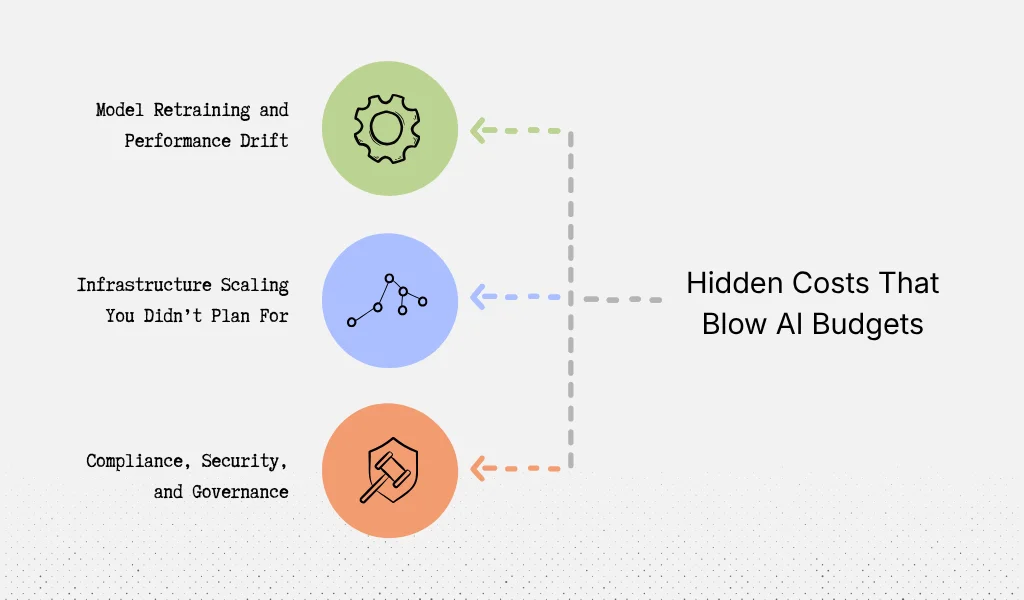
Model Retraining and Performance Drift
AI models don’t age like wine. They degrade. User behavior changes, new data patterns emerge, and your model’s accuracy starts slipping. This is called model drift: the gradual decline in a model’s predictive performance over time. For a production system, expect to budget $10,000–$30,000 per retraining cycle. Most models need updates quarterly or semi-annually. Without this line item, your AI gradually becomes less useful, and nobody notices until customers start complaining.
Infrastructure Scaling You Didn’t Plan For
Initial cost estimates usually assume steady usage. Reality is different. If your AI product gains traction, inference costs spike. A system handling 1,000 daily queries costs a fraction of one handling 50,000. Say your AI-powered customer service tool goes from a pilot team to company-wide rollout. Your compute bill might triple overnight. Cloud providers make it easy to scale up. They also make it easy to overspend if you’re not monitoring usage closely.
Compliance, Security, and Governance
If you’re in healthcare, finance, or any regulated industry, compliance isn’t optional. GDPR, HIPAA, SOC 2 audits, explainability requirements, and bias testing all add cost. Depending on your industry, compliance can tack on 10–15% to the overall AI app development cost. Aloa’s AI services include compliance planning from day one because retrofitting governance into a live system costs far more than building it in.
How to Plan Your AI Budget Without Overspending
Here’s the contrarian take that most cost guides won’t give you: starting with a full-scale build is the most expensive mistake in AI. The companies that get the best return per dollar are the ones that validate first and build second.
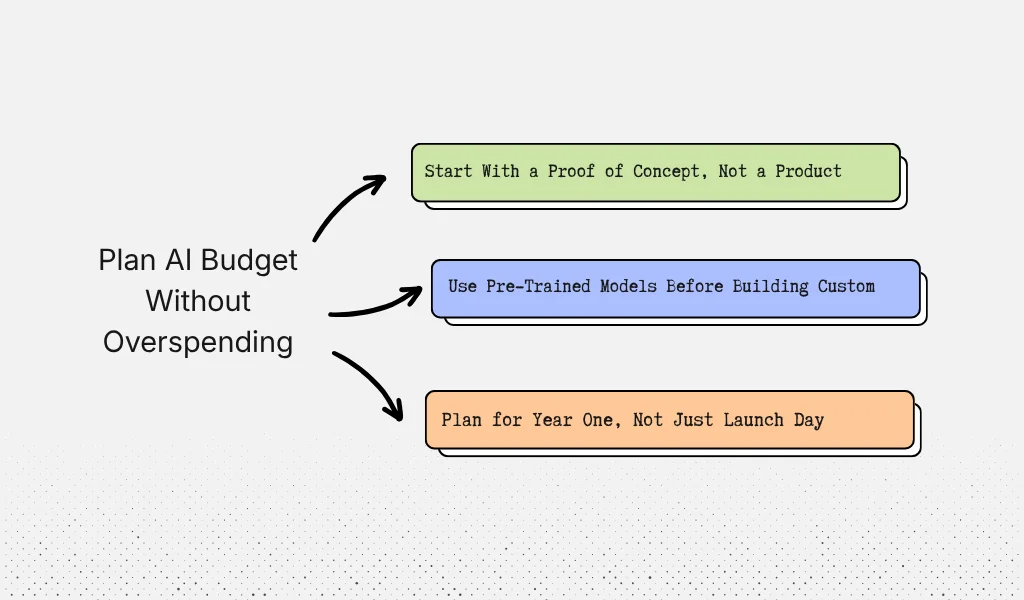
Start With a Proof of Concept, Not a Product
A proof of concept (PoC) is a 4–8 week sprint that tests whether your AI idea actually works with your real data, your real systems, and your real constraints. It typically costs $15,000–$40,000. That might sound like a lot for something that isn’t a finished product. But compare it to committing $200,000+ to a full build that might not deliver. The PoC kills bad ideas early. It also gives you hard evidence to present to stakeholders when you ask for the bigger budget. This is exactly how Aloa structures AI development services: front-load the risk, validate feasibility, then build with confidence.
Use Pre-Trained Models Before Building Custom
Unless you have a genuinely unique data problem, you probably don’t need a custom model. Pre-trained models from OpenAI, Anthropic, Google, and Meta cover natural language processing, image recognition, code generation, and more. Fine-tuning one of these with your domain-specific data costs a fraction of training from scratch. Save custom model development for when you’ve proven the use case works and you need performance that off-the-shelf can’t deliver.
Plan for Year One, Not Just Launch Day
A responsible AI budget accounts for 12 months of operation, not just the build. Include retraining cycles, infrastructure scaling, monitoring tools, and at least one round of user feedback integration. A good rule of thumb: budget 15–25% of your initial development cost annually for maintenance and improvement. If your build costs $150,000, plan for $22,500–$37,500 per year in ongoing costs. That’s the real cost to build AI when you factor in the full lifecycle.
Key Takeaways
The AI app development cost in 2026 isn’t one number. It’s a function of what you’re building, how ready your data is, and whether you validate before you commit. Basic AI apps start around $30,000. Enterprise systems can exceed $500,000. But the companies that spend wisely aren’t the ones with the biggest budgets. They’re the ones that test first and scale what works.
At Aloa, we don’t start with a six-month build. We sit with your team, identify the highest-impact use case, run a focused proof of concept, and only move to full development once we’ve proven it works. We’re engineers who build AI systems every day, not consultants who hand you a slide deck.
If you want help turning your AI idea into working software without burning through your budget, schedule a call with Aloa. We’ll map your use case, estimate real costs, and lay out a clear path from concept to production.
Frequently Asked Questions
How Much Does an AI Developer Cost?
A senior AI or ML engineer in the US typically earns $150,000–$200,000 per year. In Eastern Europe or Latin America, comparable talent ranges from $60,000–$100,000. These rates reflect full-time salaries. If you’re working with a development partner, you’ll pay project-based fees that include the full team, which often works out cheaper than hiring individually.
How Much Does It Cost to Develop an AI Product?
It depends on the product’s complexity. A simple AI-powered chatbot might cost $30,000–$80,000. A predictive analytics platform could run $80,000–$200,000. Enterprise systems with custom models and deep integrations regularly exceed $300,000. The biggest variable in AI app development cost is whether you’re building on pre-trained models or training something from scratch.
How Long Does It Take to Build an AI App?
Timelines vary by scope. A proof of concept takes 4–8 weeks. A focused MVP runs 2–4 months. Full production systems typically require 6–12 months. Longer timelines usually correlate with higher costs due to extended team engagement and infrastructure usage.
Is AI Development Worth the Investment for Small Businesses?
It can be, if you start small. A focused AI tool that automates a specific workflow (customer support, data entry, lead scoring) can deliver ROI within months. The key is picking a use case where AI solves a real problem, not adding it because competitors are talking about it.
What’s the Difference Between Generative AI and Traditional AI Development Costs?
Traditional AI (predictive models, classification systems) typically has a higher upfront cost but stable ongoing expenses. Generative AI costs less to start, especially using API-based LLMs, but scales with usage. Every query, every generated response, and every fine-tuning run adds to your bill. Over 12 months, generative AI often costs more in total.
Can I Reduce AI App Development Cost by Outsourcing?
Yes. Outsourcing to experienced AI development teams can reduce costs by 30–50% compared to building in-house. You skip the months-long hiring process, get immediate access to specialists, and pay project-based fees instead of permanent salaries. The tradeoff is less day-to-day control, which is why choosing a partner with strong communication practices matters.
How Do I Know if My AI Project Is Worth the Investment Before Committing a Full Budget?
Run a proof of concept first. A 4–8 week PoC costs $15,000–$40,000 and tells you whether the technical approach works with your actual data. It also gives you realistic cost projections for the full build. If the PoC fails, you’ve spent a fraction of what a full build would have cost.
What Happens to Costs After the AI App Launches?
Post-launch costs typically run 15–25% of the initial development budget annually. This covers model retraining to maintain accuracy, infrastructure scaling as usage grows, security patches, and feature improvements based on user feedback. Budget for this from day one so the ongoing AI development cost doesn’t catch you off guard.