
Many mid-size companies are running AI projects. Only a few can clearly explain what they’re getting out of them. Industry reports suggest nearly 85% of these projects fail to deliver real ROI. When that happens, the blame rarely lands on the technology. They would often look to the CTO and blame their vague goals or poorly defined AI ROI metrics.
AI tends to create this problem because its performance is probabilistic rather than deterministic. It feels like a black box where the output can vary dramatically, anywhere from working like magic and being unable to answer a simple question that any human could. As a result, an AI feature that performs at 70% or 80% in a demo can still easily disrupt your workflow once people rely on it. Those misses can force your team to double-check results and lead to significant hidden costs.
At Aloa, we build AI systems in-house and plan around these risks. We split AI work from the rest of the build and run small tests to prove feasibility. We also avoid fixed-scope promises that push financial risk onto you. In this guide, you'll get a clear way to measure AI value and turn AI projects into numbers your leaders trust.
TLDR
- Most AI projects miss ROI because leaders skip feasibility checks and use vague metrics.
- AI ROI has three layers: hard ROI (money saved/earned), soft ROI (risk and rework avoided), and strategic ROI (systems that grow instead of being rebuilt).
- The nine core AI ROI metrics track financial impact, workflow gains, accuracy gaps, and long-term system strength.
- To measure ROI, baseline first, test feasibility with a capped POC, use a Go/No-Go gate, and build predictable value before adding AI.
- ROI varies by industry; regulated sectors require higher accuracy and stronger foundations.
What to Care About in AI ROI Metrics?
AI ROI is the value your company gets from an AI project after accounting for all costs. When you track AI ROI metrics, you compare what the AI helps you save or earn with what you pay to design, build, test, and support it. Same basic math as any project, but AI behaves differently, so your ROI measurement changes too.
Traditional software acts the same way every time. You give it an input, and it gives you the same output. AI doesn’t do that. It learns over time, changes with new data, and sometimes gives odd answers. You can’t always predict what it will spit out or how often it will be wrong. So you treat AI like an experiment, not a feature with a fixed price or a guaranteed timeline.
Because of this, you need longer measurement periods and different success checks. Before you talk about revenue or cost savings, check three things: Is the idea feasible? How accurate can the model get on your data? How stable is it over weeks and months? Many CTOs follow this path: prove the model on actual data, roll it out wider, then measure the full financial impact.
It helps to look at AI ROI in three layers:
Hard ROI: Clear Financial Gains
Hard ROI is the money side. These numbers drop straight into a spreadsheet. You track things like:
- The cost of an AI test run, for example, 100 to 200 hours to see if a model can reach 90% accuracy on claims.
- The fixed-fee work for non-AI parts, like the claim workflow, the agent screen, or the rules that check the model.
- Time saved per task, like cutting claim reviews from 12 minutes to 7, or lowering cost per ticket by sending simple questions to a virtual assistant.
Hard ROI answers one question: How much value did we get back for the money we spent?
Soft ROI: Risk and Trust
Soft ROI is the risk you avoid and the trust you protect. It still affects your business, even if you don't tag a clear price. For example:
- You skip a model that only hits 70% or 80% accuracy and would force your team to recheck every payout.
- You wait on a full build until you see the AI work on your own data.
- You avoid rebuilds later because you tested the risky AI parts first and let the rest of the system grow around them.
Soft ROI keeps your team from living in cleanup mode and keeps your name off a failed AI launch with no tangible benefits.
Strategic ROI: Long-Term Strength
Strategic ROI is the base you build for the future. For example:
- When your system design is clean, you don't rebuild everything when a new model comes out.
- New AI features plug into the same data flows and workflows, so upgrades feel like add-ons, not full rewrites.
- You can delay AI when accuracy isn’t ready, ship a solid non-AI version now, and collect good data for a stronger AI upgrade later.
When you talk about AI ROI, bring all three layers together. Show the clear money gains, the risks you avoided, and the long-term strength you added to your system. That mix gives your leaders a clear, honest picture of why your AI plans make sense.
What Are the Essential AI ROI Metrics to Track?
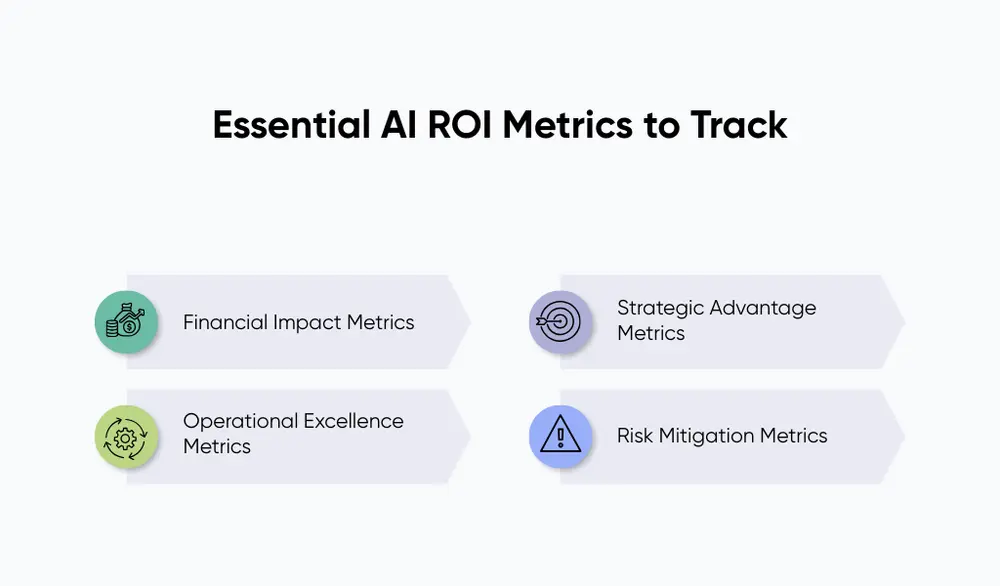
When you track AI ROI metrics, you want numbers that show where your AI initiatives save money, speed up work, remove risk, or make your system stronger for the future. These metrics fall into four groups: financial impact, operational excellence, strategic advantage, and risk mitigation.
Financial Impact Metrics
These metrics show direct gains. They’re simple, spreadsheet-friendly, and easy for your finance partner and other business leaders to check.
1. Feasibility Cost vs Full-Build Cost
AI feasibility should be small and capped. Spend 100–200 hours to see if a model can hit the required accuracy. Then track:
- Feasibility Spend = hours used × hourly rate
- Avoided Cost = estimated full build cost not spent
Example: Your team wants an AI to read invoices. You pay for a 150-hour feasibility test instead of a $300k full build. The test shows the model only hits 78% accuracy, far below your 95% requirement.
ROI: You avoided wasting the full build budget.
At Aloa, feasibility work is about reducing decision risk before you commit to a larger build. We isolate the AI layer, test it with real data, and check how often it meets accuracy thresholds. We also map how those results affect human review time, workflow friction, and downstream cost. That way, you get a clear picture of whether the model is ready to scale or needs more refinement.
2. Predictable vs Experimental Spend Ratio
Non-AI engineering (like UI, database work, or workflow tools) is predictable, so you can use fixed-fee pricing. AI engineering is experimental, so you track it hourly with limits.
A CFO sees this ratio as a risk signal:
- Predictable spend (low risk)
- Experimental spend (higher risk)
Example: If 70% of your budget goes to predictable engineering and 30% to AI experiments, that’s a reasonable balance. If it flips (say 30% predictable, 70% experimental), you’re exposed.
3. Profit Impact Metrics
These metrics show clear financial improvement:
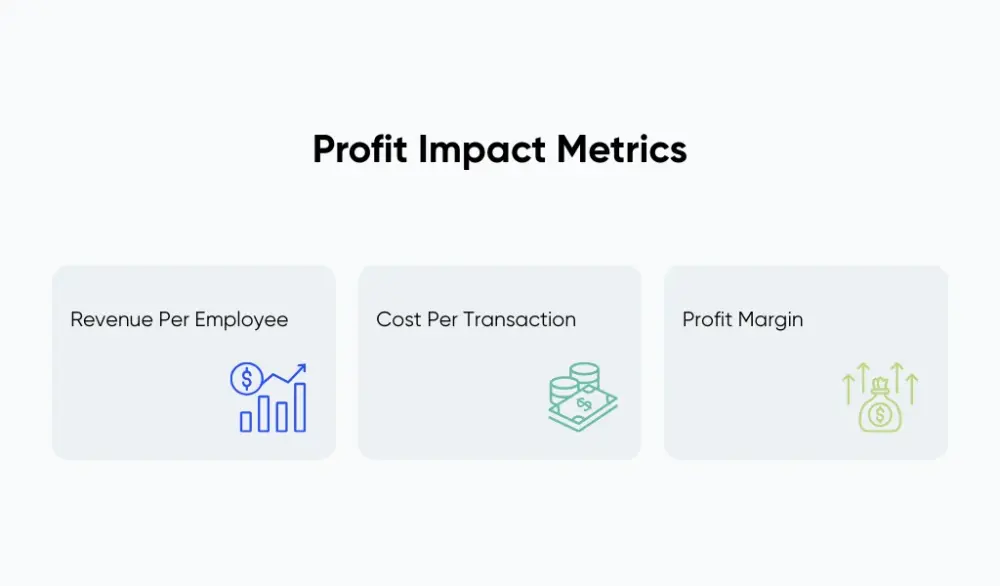
- Revenue per employee: If reps handle 30% more customers because AI drafts responses, revenue per head goes up.
- Cost per transaction: If AI drops claim handling from $11 per claim to $7, that’s measurable ROI.
- Profit margin: If your margin rises from 18% to 23% after automation, you can tie that to the system’s output.
They answer: Did this AI solution make or save money in a measurable way?
Operational Excellence Metrics
These metrics show how the AI reduces work, improves operational efficiency, and cuts errors.
4. Workflow Step Reduction
Aloa maps the whole workflow before coding. And the goal is simple: remove steps you don’t need.
Example: A customer refund process has 9 steps. After AI and automation, you drop it to 5 steps. That means fewer handoffs, fewer blockers, and faster cycle times.
Metric: Workflow Compression = old steps – new steps
5. Time per Work Unit
This tells you how long each unit of work takes after AI.
Example: Loan applications take 30 minutes. After AI pre-checks, they take 14 minutes. If your team handles 200 loans a day, that’s hours saved and clear productivity gains.
Metric: Cycle Time Reduction = old time – new time
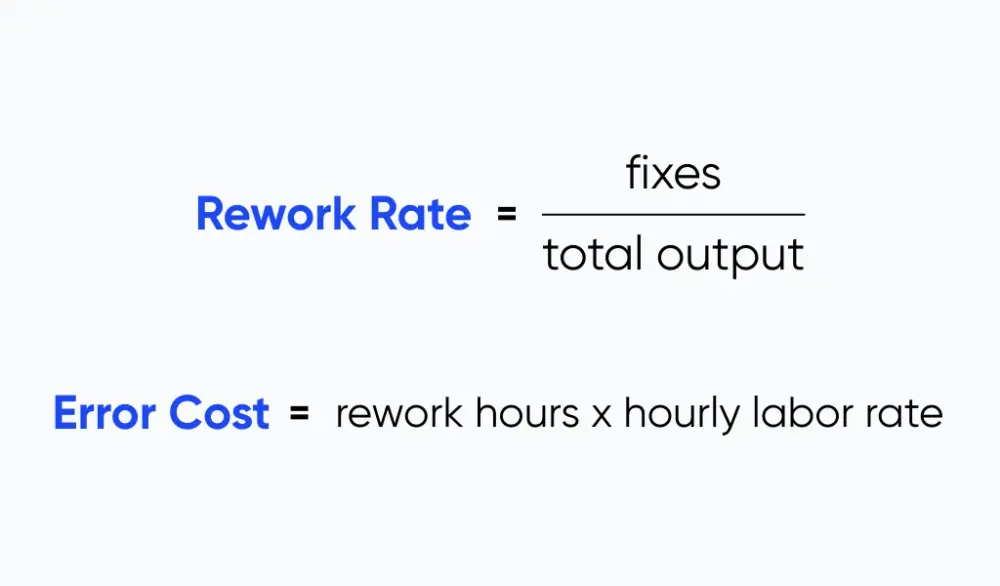
6. Rework Rate and Error Cost
A system with 70–80% accuracy creates rework, and rework destroys ROI.
Example: Your support AI suggests answers, but agents must fix 1 out of every 4 responses. That’s 25% rework, which adds labor cost instead of removing it.
Metrics:
- Rework Rate = fixes / total outputs
- Error Cost = rework hours × hourly labor rate
This is where accuracy becomes a financial metric, not just a technical one, with a direct business impact.
Strategic Advantage Metrics
These metrics show long-term value: how AI helps you compete and how well your system holds up over time.
7. Extensibility (Build-On-Ability)
You should be able to add new features without tearing up what you already built. A good codebase expands as your needs grow instead of forcing you to rebuild every time you introduce something new.
Example: You launch an onboarding system without AI. Six months later, you add ID document extraction. You plug it in without rewriting the whole workflow. That’s extensibility.
Metric: Extension Cost = cost of adding a new feature
Lower cost here means a stronger foundation and lasting competitive advantage.
8. AI Readiness
This measures how “plug-in ready” your system is for AI later.
Example: Your fraud system uses manual rules today, but all data is already structured and clean. When AI becomes feasible, it can slot in with minimal rework.
Metric: Readiness Score = % of system that supports future AI without redesign
This helps you justify delayed AI when accuracy isn’t there yet and still align with your long-term strategic goals.
Risk Mitigation Metrics
These metrics show risks you avoided and how well your risk management efforts pay off.
9. Accuracy Threshold Gap
Most enterprise workflows need near-perfect accuracy. Anything less creates mistakes your team must fix.
Example: Your required accuracy is 96%. Your current model hits 83%. You have a 13% gap, which makes the feature non-viable.
Metric: Accuracy Gap = required accuracy – actual accuracy
This gap tells you whether you should move forward, pause, or redesign.
Other risk metrics include:
- Compliance errors avoided
- Cost of manual audits reduced
- Incidents or misclassifications prevented
This category explains why some AI projects save money by not shipping.
When you track all nine metrics, you give your team a full picture of AI value: money earned, work improved, future upgrades made easier, and costly risks avoided. It turns AI from a guess into something you can measure and defend with clear numbers.
How to Calculate AI ROI Metrics?
To measure AI ROI, set up a plan with clear before-and-after data, simple checkpoints, and clean ROI tracking. At Aloa, we use a six-phase method below to keep projects on track and stop costs from spinning out:
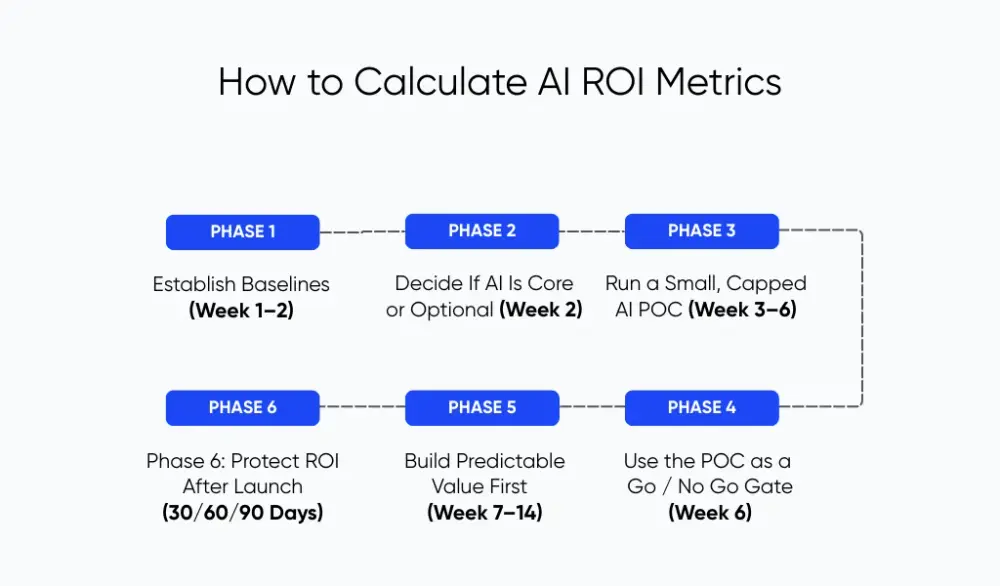
Phase 1: Establish Baselines (Week 1–2)
Start by writing down how the work runs today. Map each step and capture numbers your team can check:
- Time per task
- Number of steps
- Error rate
- Cost per case
- Weekly volume
If your team reviews 500 claims a week and each claim takes 12 minutes with two manual checks, that becomes your baseline. Every improvement later connects back to these numbers using the same ROI formula across projects.
Share this snapshot with your leaders so everyone agrees on what “before AI” means.
Phase 2: Decide If AI Is Core or Optional (Week 2)
Ask one question: Does this product need AI to function, or can it run without it?
- If AI is core, test feasibility first.
- If AI is optional, build the workflow now and add AI later.
For example, a fraud review tool can run on rules-based automation and AI-driven logic. AI can boost accuracy later, but the system still works without it. Ship the rules engine first so you get value sooner, and set up clean data flows so AI attaches smoothly later.
Keep leaders aligned by listing:
- Accuracy you need
- Whether the product can ship without AI
- Value you can deliver right now without AI
Phase 3: Run a Small, Capped AI POC (Week 3–6)
Run a small AI proof of concept capped at 100–200 hours as part of your AI pilot program framework. This keeps costs under control.
The POC should answer one thing: Can the model hit your accuracy target on your actual data?
If you need 95% accuracy for automated approvals and the model reaches only 82%, stop the AI work here. The cap prevents you from spending months and money chasing something that won’t reach your bar.
Use a simple timeline: prep data → test models → share accuracy results.
Give leaders a short update with: required accuracy, achieved accuracy, hours used, and Go/No Go.
Phase 4: Use the POC as a Go / No Go Gate (Week 6)
Use the POC as the decision point:
- Go if the model hits the target.
- No Go if it doesn’t.
Still ship the parts that don’t depend on AI, like the workflow engine, rules, and dashboards. That keeps the project moving without forcing AI that isn’t ready.
Show leaders one clear slide: required vs actual accuracy, plus how much rework the team would face if the model shipped below target.
Phase 5: Build Predictable Value First (Week 7–14)
After the decision gate, build the pieces that give consistent value and predictable timelines, including:
- Workflow engine
- UI
- Routing rules
- Dashboards
- Audit tools
For example, in a support system, you can auto-route tickets and trim handle times before AI drafts any responses. That way, your team sees improvements while the AI continues working in the background.
Estimate non-AI work as a fixed cost. Keep AI work hourly with a clear cap.
Phase 6: Protect ROI After Launch (30/60/90 Days)
ROI can fade if accuracy drops or people slip back into old habits. Keep the system healthy by checking in often:
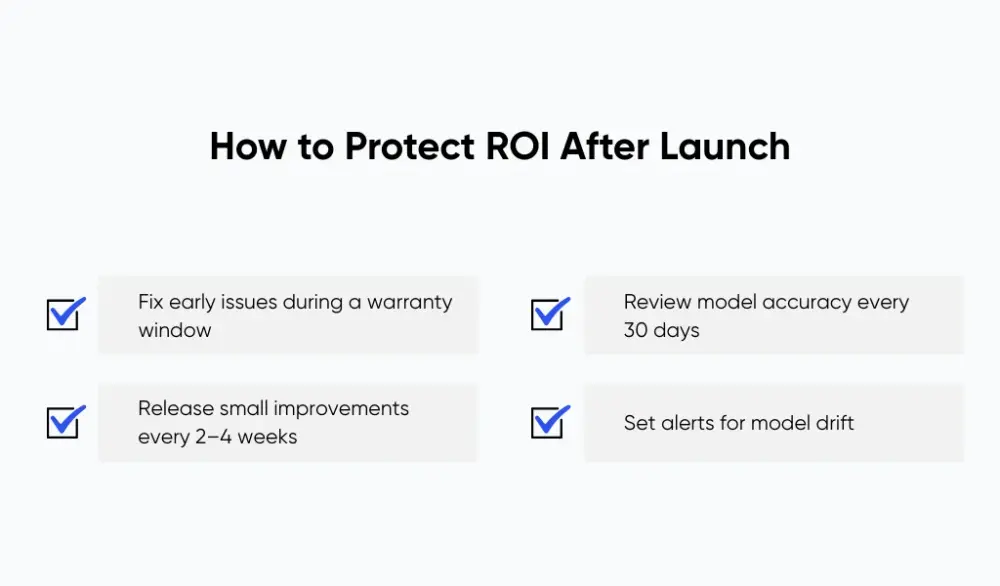
- Fix early issues during a warranty window
- Release small improvements every 2–4 weeks
- Review model accuracy every 30 days as part of continuous monitoring
- Set alerts for model drift
If accuracy drops from 94% to 88%, retrain the model or clean the data before rework spreads through the team.
Share a dashboard with leaders showing:
- Time per case before and after
- Error rate before and after
- Accuracy over time
- Cost per case
- Rework hours avoided
Give updates at 30, 60, and 90 days so they see clear progress.
This six-phase method keeps AI projects controlled and measurable. You move step by step, shut down ideas that aren’t viable, and use clear numbers to show exactly how AI affects your work.
Industry-Specific ROI Benchmarks and Case Studies
AI ROI varies widely by industry. Accuracy needs, risk levels, data quality, and adoption rates all shape how much value companies can capture. And we break these patterns down in our overview of how different businesses adopt AI.
Here’s what different sectors are actually seeing in money saved, time reduced, and work improved:
High-Impact Industries
Manufacturing, finance, and healthcare tend to see strong returns because they handle huge volumes and tightly controlled processes. Good models pay off quickly. Bad ones cause costly mistakes.
In manufacturing, AI keeps production lines running. Automakers use computer vision and predictive models to spot defects early and prevent breakdowns. Large plants have cut unplanned downtime by 35–50%, saving tens of millions of dollars each year in scrap, rework, and warranty costs. These gains only showed up after they improved image quality, fixed lighting issues on the line, and tuned the model until it met the accuracy bar.
Financial services rely on extremely high accuracy. JPMorgan’s COIN platform uses AI to read loan agreements and legal documents. It replaced about 360,000 hours of manual review work per year by turning weeks of reading into seconds. COIN succeeded because it reached lawyer-level accuracy and sent unusual documents back to humans. Anything less would have increased risk and wiped out ROI.
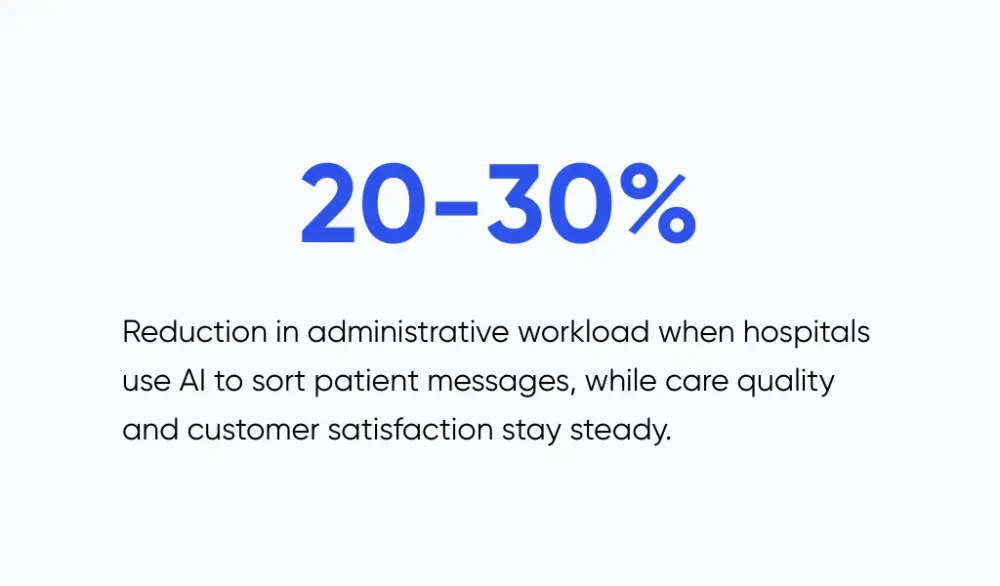
Healthcare orgs face similar demands. Many hospitals now use AI to sort patient messages so nurses and doctors can focus on urgent cases. Studies show this can reduce administrative workload by 20–30% while keeping care quality and customer satisfaction steady. But accuracy must be high. A single incorrect clinical suggestion can create safety or legal problems. That’s why hospitals start with low-risk tasks like message routing and keep a human decision-maker in the loop.
Emerging Opportunities
Retail, logistics, and energy are seeing quick AI wins. They process repeatable tasks at scale but face fewer regulatory roadblocks, which lines up with what we see in our breakdown of AI adoption by industry.
Retailers use AI to forecast demand, adjust inventory, and lift average order value by keeping the right products in stock. Based on leading research, forecast errors often drop by 20–50%, which means fewer empty shelves, fewer markdowns, and less cash stuck in slow-moving stock. Most retailers see results within 6–12 months because their sales data is already well organized.
Logistics companies use AI for routing. UPS’s ORION system is one of the strongest examples. It cuts about 100 million miles of driving and saves 10 million gallons of fuel each year (worth over $300 million in annual savings). The challenge wasn’t the model itself; it was mapping every routing rule and helping drivers trust and follow new routes.
Energy companies use AI for predictive maintenance. Reports from McKinsey and Shell show that AI can lower maintenance costs by about 20% and cut unplanned downtime by 20–35%. These gains depend on accurate sensors and strict alert rules. Too many false alarms and workers will start ignoring the system.
Regulatory Considerations
Finance, healthcare, insurance, and government teams measure ROI differently. Money saved matters, but risk avoided often matters more.
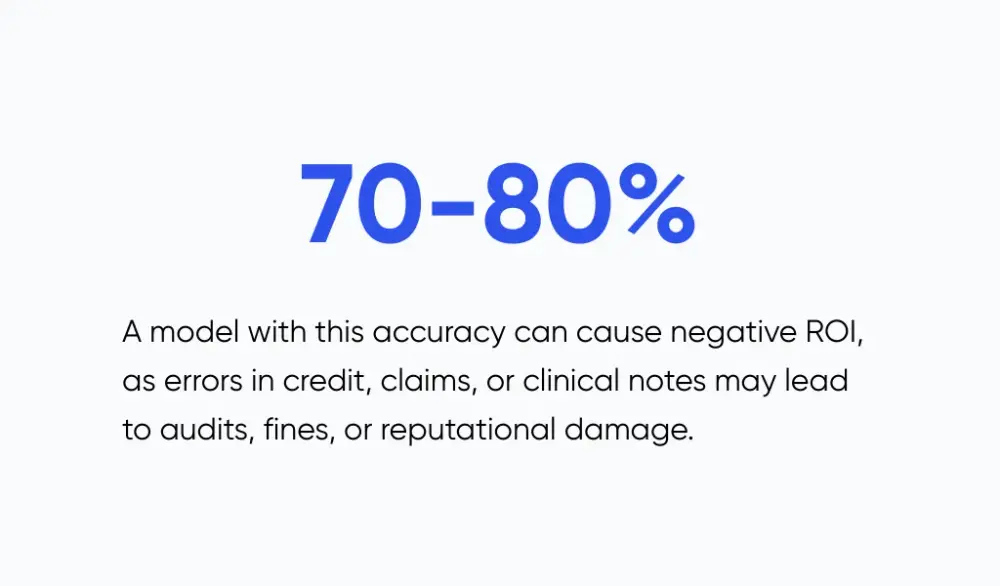
A model that hits only 70–80% accuracy can produce negative ROI. One incorrect credit decision, misrouted claim, or unsafe clinical note can trigger audits, manual reviews, fines, or reputational damage. Because of this, these industries track:
- Fewer manual audit hours
- Fewer compliance exceptions
- Lower reporting errors sent to regulators
Research from Deloitte shows that organizations with strong AI ROI measure both financial gains and compliance improvements, not just short-term savings.
Another pattern: regulated industries often get stronger ROI from non-AI foundations before introducing AI. Clean data, reliable routing rules, and solid audit trails reduce risk and pay off quickly. Once that groundwork is in place, AI can plug in more safely, support stronger customer experience, and produce higher returns without threatening compliance.
How to Optimize Your AI Project’s ROI Metrics?
Once you can measure AI ROI, improve it on purpose and align it with core business goals (and to grow your own skills, you can follow our beginner-to-executive AI learning path). Top companies don't treat AI as one big gamble. They treat it like a portfolio. They stack projects in the right order, match them to what the tech can do today, and track more than cost-cutting.
The AI Portfolio Effect
Think about your AI work as Lego pieces that support a clear AI business case template across projects. Some give clear value right away. Others exist to make later projects cheaper, quicker, and safer.
You get better ROI when you line projects up like this:
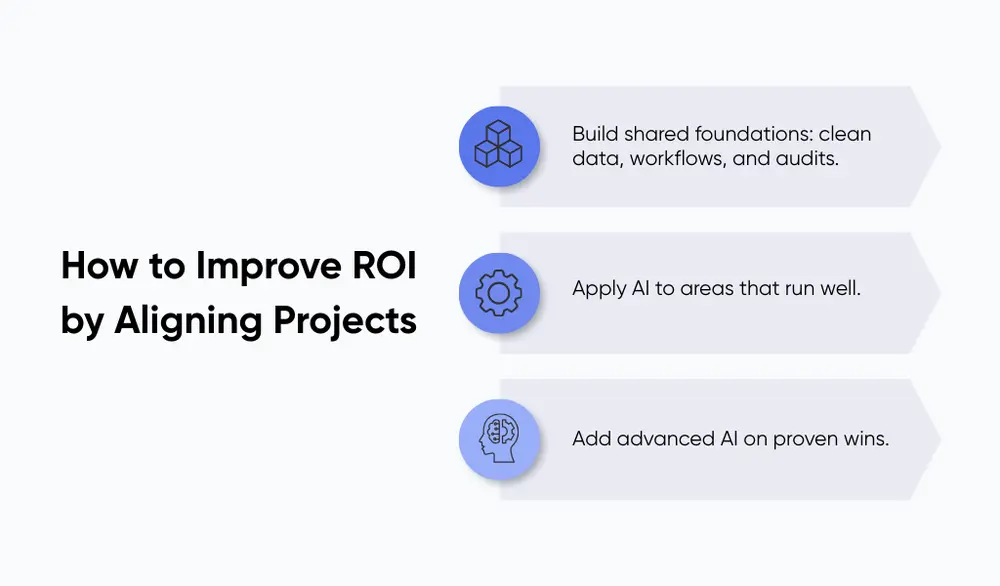
- Build shared foundations first, like clean data, workflow engines, and audit trails.
- Add AI to the parts that already run well.
- Layer more advanced AI on top of wins that you already proved.
Say you want smart claim automation. You start with a strong claim workflow and clear rules. That alone saves time and money. Next, you add AI document extraction. After that, you add risk scoring on top. Every step reuses what you already built, so your portfolio ROI adds up instead of starting from zero each time.
When we plan with clients at Aloa, we map these dependencies and pick work that supports other use cases later. That way, every new AI project reuses models, data, and tools you already paid for. If you want to deepen your own skills here, our guide for learning AI development as a tech leader walks through the same thinking from your side of the table.
Emerging Technologies
New AI types like agentic systems and multimodal AI models behave differently from classic automation. They can plan steps, call tools, and work with text, images, and other formats together.
For these, you track things like:
- Tasks completed end-to-end without human intervention
- Time saved on supervision
- How close the output is to an expert’s work
Some ideas still sit on the edge of what's possible. Fully autonomous agents for complex financial work are a good example. Accuracy is not there yet for many companies. ROI looks stronger when you match use cases to tech readiness. You start with low-risk tasks, count how often humans must step in, and only then move agents closer to core workflows.
Security also affects the ROI of AI. Many “AI wrappers” sit on top of other models and may not handle data well. More businesses now judge ROI together with security and trust. If a tool saves time but exposes data, it hurts ROI in the long run.
Future-Proofing Your ROI Framework
Going forward, ROI isn’t only about money and minutes but also broader business impact and ESG reporting. You need to show how AI affects the planet, people, and how your systems grow.
You can add a few extra lines to your ROI view for:
- Energy use per transaction, especially for large models
- Reduction in travel or paper-heavy steps
- Fewer complaints or issues linked to bias or unfair results
Many companies now report on ESG, so AI will be viewed through the same lens. It also helps if your systems can grow instead of needing full rebuilds. This resonates with our view at Aloa: design so future models can plug into the same base. Over time, you track long-term ROI as lower cost per new feature and faster time to ship, not only first-year savings.
If you treat AI as a live portfolio, watch new tech with a calm eye, and measure both money and impact, your AI ROI metrics will still make sense a few years from now, not only this quarter.
Key Takeaways
As a CTO, you get better returns from AI when you treat it like a series of controlled experiments. Test feasibility first, define clear accuracy goals, put limits around risky work, and build a system that can grow without constant rewrites. These habits make conversations about AI ROI metrics simpler and keep your C-suite aligned on what success means.
Over the next month, lock in your baseline numbers and meet with your leaders to confirm which AI ideas are worth testing. Run a small feasibility check before making any commitments, and set up a dashboard that shows changes in time, errors, and cost.
If you want help turning this into a clear, working plan, reach out to Aloa today! We build everything in-house, from AI strategy and use-case selection to data readiness checks, capped feasibility sprints, and phased rollout plans. We’ll help you validate your AI ideas fast, set the right AI ROI metrics, and build a roadmap that protects your budget.
FAQs About AI ROI Metrics
What is the difference between hard ROI and soft ROI for AI investments?
Hard ROI is the money you can clearly measure, like cost reduction per ticket or cutting hours of manual work. Soft ROI is about reducing risk and avoiding messes. For example, skipping a model that’s only 75% accurate saves your team from tons of rework and prevents compliance problems. If soft ROI is weak, any money you “saved” will get wiped out by fixes and mistakes.
What are the most important AI ROI metrics I should track?
Track a few key metrics: time per task, error rate, rework rate, cost per case, and the model’s accuracy compared to the accuracy you actually need. Also track how much you spent on feasibility vs. how much a full build would have cost. These numbers show whether AI is saving money, speeding up work, or avoiding bad investments, using key performance indicators your team already understands.
How do I establish a baseline before implementing AI to measure true impact?
Pick one workflow and measure it as it is today. Count how many items your team handles each week, how long each item takes, how many steps it goes through, how many mistakes appear, and what that costs. Get the numbers from system logs, not guesses. Then share a one-page “before AI” snapshot so everyone agrees on the starting point.
How do I account for AI projects that don't show positive ROI immediately?
Some AI projects teach you what won’t work before they deliver savings. Treat early tests as small, capped experiments. Write down what you learned and which ideas you ruled out. If a project still doesn’t show real value after a capped test, stop it and put your budget toward a better opportunity.
When should I bring in external expertise to help measure AI ROI?
Bring in help when you’re unsure what accuracy you need, what to measure, or how to set boundaries for risky AI work (and consider upskilling with focused AI courses for business leaders so you can ask sharper questions in those conversations). It’s also useful when your teams disagree on use cases or when your data isn’t clean. An outside partner can help you set targets, run feasibility tests, and build dashboards that show clear results.
How can Aloa help me establish and track AI ROI metrics?
Aloa’s enterprise AI strategy consulting helps you turn AI ROI into a working plan. We help you choose use cases, map your workflows, and set strong baseline numbers. We also run capped feasibility tests to check if a model can hit your accuracy goal before you invest more. From there, we build dashboards that track time, errors, cost, and accuracy. If you want a partner who can guide the strategy and build the system with your team, book a consultation, and we’ll help you create an AI plan you can defend and scale.