
Insurance leaders are pushing to bring artificial intelligence into their workflows. About 77% say they need generative AI in insurance to stay competitive. But only 29% of customers feel okay talking to an AI service agent. That gap creates pressure for health insurance disruptors. You need to move faster than giants like Aetna, but you can’t afford mistakes with member trust, data privacy, or compliance. The stakes are high.
At Aloa, we build custom AI systems for health insurance innovators who want tools their teams can use every day. We help insurance organizations identify the highest-value use cases, test them with quick prototypes, and then securely plug them into your current workflows. Our experience in HIPAA and other regulated settings sets us apart from other service providers.
In this guide, you’ll see where generative AI fits across the insurance value chain, which use cases are worth testing first, and how to move from early pilots to systems your staff can rely on.
TL;DR
- Generative AI handles the heavy reading in medical insurance. It pulls key facts from long medical records, claim notes, and policies into short summaries.
- Biggest wins sit in core operations. Underwriting, claims intake, fraud review, and service co-pilots see value first.
- Impact shows up in numbers. Insurers cut handling time, speed decisions, reduce errors, and improve communication.
- Risk and regulatory compliance still matter. Shadow AI, wrong answers, and PHI misuse are real, so guardrails and review are required.
- Start small, then scale with experts. Pilot one workflow, measure results, then partner with builders like Aloa to move into production.
What Is the Role of Generative AI in the Insurance Industry?
Generative AI in insurance helps speed up the claims process, prevent some losses, and automate routine tasks like data entry and document review. These models can read long forms, pick out key details from customer data, draft emails or letters, and answer questions in plain language. That's different from older predictive models, which mostly score risk using historical data, set prices, or flag outliers in rows of numbers.
Across the value chain, generative AI plugs into daily work and reflects wider enterprise adoption trends. In the front office, it can guide members through benefits, explain coverage, and handle common service questions. In the middle office, it can summarize medical records, build underwriting notes, and organize prior authorization details. In the back office, it can draft claim narratives, support coding, and help check policies and procedures.
To matter, every use needs to tie back to clear business results or metrics like loss ratio, combined ratio, claim cycle time, FNOL speed, and CSAT.
Use Cases of Generative AI in Insurance
Below are some of the most effective uses of generative AI in insurance. Picture how a plan like Oscar, Bright Health, or Clover runs behind the scenes. These examples map directly to those kinds of operations:
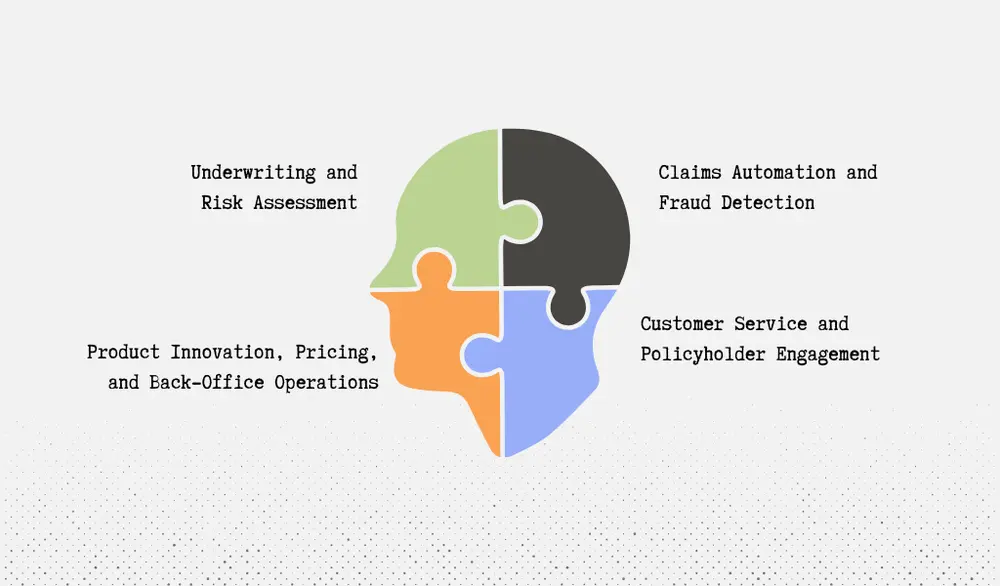
Underwriting and Risk Assessment
Underwriters often sift through 50–200 pages of medical history before pricing a member. Generative AI cuts that workload sharply.
Imagine a 45-year-old applying for an individual health plan during open enrollment. They report diabetes and high blood pressure and upload a recent imaging report. A GenAI assistant pulls together their application answers, recent claims, pharmacy fills, and clinician notes into one summary. It highlights the three biggest cost drivers (for example, a recent A1C spike, uncontrolled blood pressure, and a pending surgery). It also flags mismatches, like checking “no heart condition” while a cardiology visit appears in their history.
Instead of reading five PDFs, the underwriter gets a short underwriting brief plus an audit log showing why the assistant surfaced certain items. That transparency helps during audits and gives compliance teams a trail they can explain to regulators.
Claims Automation and Fraud Detection
Claims operations involve dozens of handoffs, from intake forms to adjuster notes, medical bills, attachments, and emails. GenAI can remove a lot of that friction.
Let’s say a member needs to submit a reimbursement claim for an out-of-network urgent care visit. They open your mobile app and answer a few questions about the injury date, the clinic that treated them, and what they paid at the visit. GenAI turns those answers into structured claim fields, checks the policy for coverage, and drafts a follow-up message (“We received your claim. We still need the bill from XYZ Urgent Care.”) for a staff member to approve.
When the bill arrives, GenAI reads the PDF, picks out CPT/ICD-10 codes, dates, NPI numbers, and amounts, then loads them into your claim system. No manual typing.
Fraud prevention teams get better signals too. GenAI can spot unusual patterns, like a provider billing the same high-cost back procedure 30 times a month with identical notes. It doesn’t replace fraud scoring models; it adds context so investigators know which claims deserve attention first.
Customer Service and Policyholder Engagement
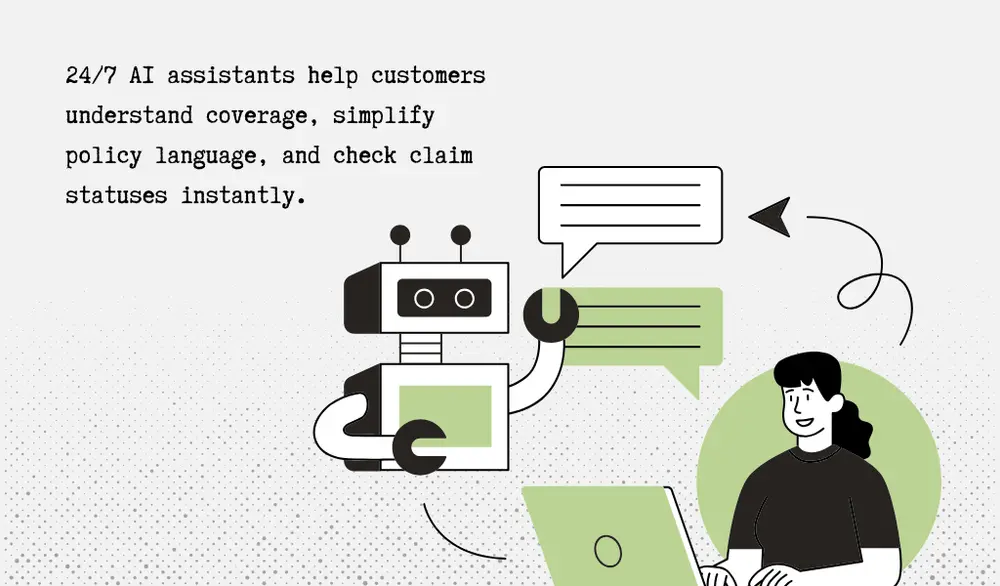
Member questions usually boil down to coverage, cost, or status. Generative AI handles the repetitive ones so agents can focus on complex issues.
A member opens your app to ask, “Is Dr. Nguyen in network?” GenAI checks the directory, pulls the right plan rules, and responds with a clear yes/no plus the expected copay. Another member might ask, “Why did my $600 MRI only pay $350?” The assistant breaks down deductible, coinsurance, and plan limits in plain English.
It can also send renewal reminders (“Your 2026 plan selection window opens next week”) or preventive nudges (“You’re eligible for a free annual physical”).
Since only ~29% of customers trust AI agents, these assistants need strict guardrails. That means clear hand-offs to human staff, tight control over what data the model can see, and careful prompt design. This is where experience in healthcare and other regulated builds matters. Teams like Aloa design virtual assistants to respect HIPAA boundaries, log every interaction, and follow rules your compliance leaders sign off on.
Product Innovation, Pricing, and Back-Office Operations
Plan and product teams spend a lot of time rewriting policy language. GenAI drafts new benefit wordings, adapts them for different states, and produces a one-page “What this plan covers” summary that fits into onboarding flows.
Pricing teams can use GenAI as a research helper. For example, an actuary can ask, “Summarize CMS’s latest risk adjustment update and how it affects diabetes-related claims,” and get a clear outline to review, not a pile of PDFs.
Back-office teams get support too. IT can use GenAI to refactor claims rules. Legal can compare two versions of a provider contract and see line-by-line differences. Compliance can generate draft audit responses or policy updates without starting from scratch.
Benefits of Generative AI for Insurers
The examples above can also move the numbers on your P&L. Here’s how:
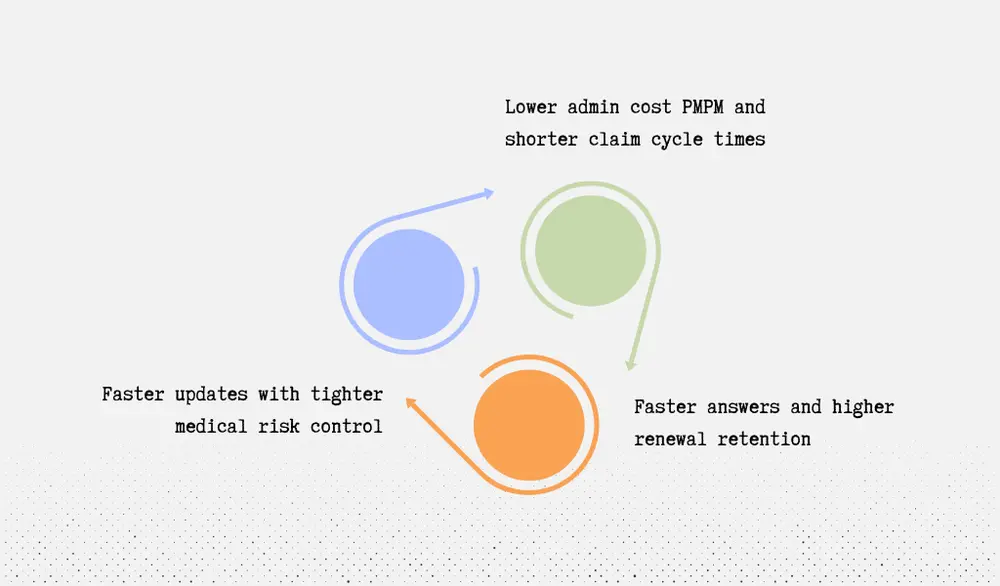
1. Lower admin cost PMPM and shorter claim cycle times
Generative AI removes a lot of manual steps that drive up operational costs. Underwriters get a one-page summary instead of reading a 100-page medical file. Claims staff see diagnosis and procedure codes already pulled from the bill instead of typing them in by hand.
In one deployment, a generative AI underwriting assistant cut underwriting costs by about 80% and was built in roughly 60 days instead of several months. For a health plan, that kind of change lowers admin cost per member, speeds claim setup, and lets the same staff handle more quotes and claims without extra hires.
2. Faster answers and higher renewal retention
Members are more likely to stay with a health plan when getting help is quick and straightforward. Lemonade used AI in its claims flow and cut handling time by around 25%, which raised customer satisfaction. Other insurers use GenAI to load an agent’s screen with a short claim summary before they pick up the call. The first person the member talks to can often fix the problem. Shorter calls, quicker payouts, and fewer transfers lift CSAT and support better renewal rates when acquisition costs keep rising.
3. Quicker product updates and tighter control of medical risk
Generative AI helps product teams rewrite benefit summaries, adjust state-specific language, and draft filings in minutes instead of weeks. Plans can react sooner when insurance regulators change rules or when a competitor launches a new benefit.
At the same time, GenAI helps underwriters and actuaries pull key details from provider notes, imaging reports, and prior claims. A clearer view of conditions, medication history, and use patterns supports sharper pricing and more accurate medical cost forecasts, which feeds into a healthier loss ratio.
Challenges, Risks, and Compliance Considerations
Generative AI can help a lot, but it also creates potential risks. Leaders need to see those risks clearly before they scale anything, especially in healthcare-focused generative AI use cases.
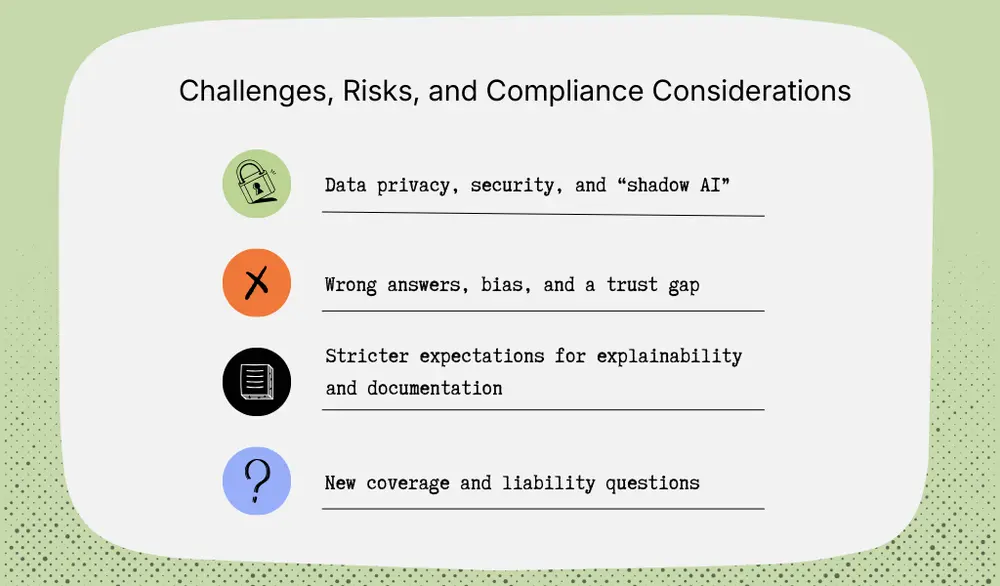
1. Data privacy, security, and “shadow AI”
Health plans store diagnoses, lab results, mental health notes, and payment details. That's some of the most sensitive data in the system.
Now picture an analyst at a plan like Aetna or Kaiser copying a spreadsheet of claims into a free chatbot to “clean the data.” Or a call center rep pasting PHI from the EMR into a random browser tool to draft an email. In both cases, that data just left your approved systems and may sit on someone else’s servers, raising ethical concerns about data handling.
This kind of “shadow AI” work, outside IT and compliance, increases the chance of a HIPAA problem, breach costs, and tense calls with regulators. You need written rules on which AI tools staff can use, what data is never allowed, and logs that show who used which tool and when.
Aloa has already helped medical groups replace ad-hoc ChatGPT use with fully HIPAA-compliant, ChatGPT-style assistants that keep PHI inside approved systems with proper access controls and audit trails. If you want to explore a similar setup for your team, talk to our engineers today!
2. Wrong answers, bias, and a trust gap
GenAI can sound confident and still be wrong.
A member might ask a bot, “Is my child’s surgery covered?” If the bot reads the plan wrong and says “yes” when the answer is “no,” you now have an angry family and a written chat log that a regulator can review.
Bias can creep in too. If underwriting notes lean on old patterns in your data, some groups may get tagged as “higher risk” more often, even when that doesn’t match their actual health profile. Since many customers already feel unsure about AI agents, a few bad answers or unfair patterns can push them away from your brand.
3. Stricter expectations for explainability and documentation
Supervisors and state regulators want to know how you made decisions, especially for pricing and underwriting. “The model told us to” doesn't work.
If you use GenAI to summarize records or suggest a claim outcome, you need a clear trail. That means recording what data the model saw, what it flagged, what it suggested, and which human approved the final decision.
Without this, auditors can ask you to pause a system, redo past reviews, or slow down new AI launches until you show stronger control and better documentation.
4. New coverage and liability questions
As more companies use GenAI, insurers and reinsurers are changing policy wording. Some add exclusions for AI-related errors. Others sell add-on coverage that only applies to AI-driven losses.
For a health plan that uses GenAI, this raises a serious concern: if an AI tool gives bad guidance and that causes a big loss or fine, who pays? Does your current E&O or cyber policy cover it, or did an AI exclusion remove that safety net? Someone on your team needs to read your policies closely and compare them to your AI roadmap before you switch on high-impact use cases.
How to Get Started with Generative AI in Insurance
Most insurance firms have tried a chatbot or a drafting tool. But nothing in production moves claim cycle time, admin cost PMPM, or CSAT. Getting started with generative AI means changing that.
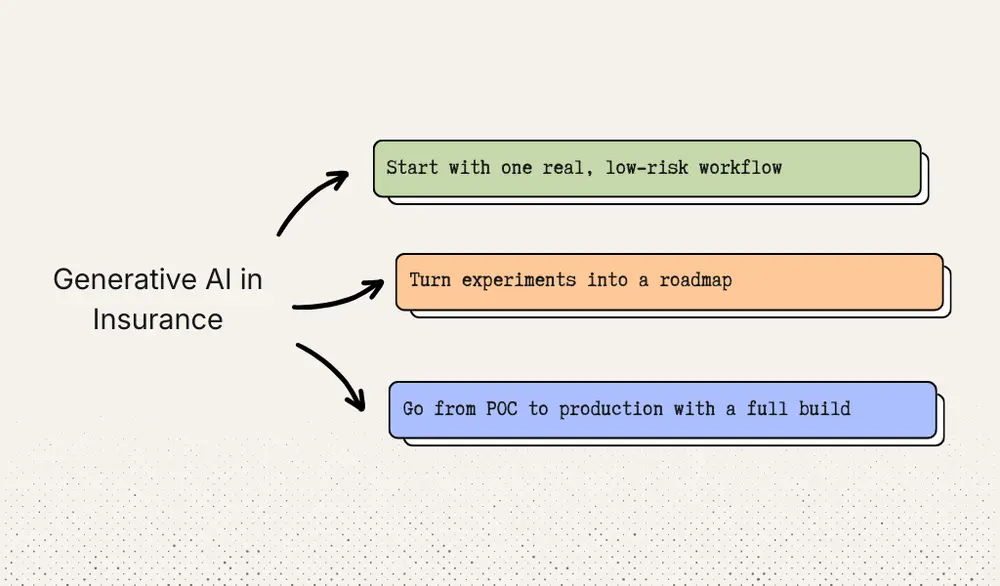
1. Start with one real, low-risk workflow
Pick a job your staff already complains about. For example, give a small underwriting pod 50 de-identified cases and let them use GenAI to create one-page summaries of medical histories. Or have a claims lead ask reps to use GenAI to draft missing-info emails, then edit them. Track how long each task takes, how many edits people make, and where the model slips. You'll learn where GenAI helps your plan without touching live PHI.
2. Use Aloa to turn experiments into a roadmap
Most teams stall after this stage. They see promise but don’t know which use cases to fund or how to stay within HIPAA and audit rules, something we’ve seen across many real-world generative AI rollouts. At Aloa, we give you direct access to senior AI engineers for architecture reviews, vendor/tool choices, and a concrete “what’s next” plan. Our generative AI solutions focus on things like document summarization, RAG search over your own policies, and member-facing assistants that escalate to humans and respect your compliance rules.
We usually narrow things down to 2–3 use cases tied to hard metrics (claim cycle time, admin cost PMPM, CSAT), then design a proof of concept that fits your budget and data reality.
3. Go from POC to production with an end-to-end build
Once a prototype proves its value, you need a real build: SSO, role-based access, logging, human oversight, and monitoring. Aloa’s custom AI development and managed AI services cover that full layer: we fine-tune models on your data, build RAG backends, and connect to your claim and policy systems. We also handle ongoing improvements under clear SLAs and transparent pricing (hourly with a cap, plus POC pricing usually ~10% of the full build).
In short: let your teams experiment, then bring in Aloa to pick the right bets, prove them out, and ship production-ready tools that your underwriters, adjusters, and member support teams actually use.
Key Takeaways
Generative artificial intelligence can take on real work inside an insurance plan. It can pull key details from long medical files, speed up claim reviews, and give members clearer answers about coverage and costs. And the best way to use it is to start small. Test one workflow, and measure how much time and rework you save. Then invest in the few use cases that actually move numbers like claim cycle time, admin cost PMPM, and renewal retention.
Aloa exists for health insurance challengers that want to do this but don’t have the in-house depth to build the systems themselves. We’re engineers who build every day and test new models the hour they drop. We bring that hands-on experience straight into your underwriting, claims, and service workflows. And because we work in regulated industries, we design with HIPAA, data safety, audit trails, and human review in mind from the start.
If you want a partner who can design and build generative AI in insurance, schedule a call with Aloa. We’ll review your stack, surface a few high-impact opportunities, and lay out a clear plan to get them into production.
FAQs About Generative AI in Insurance
What are the most impactful generative AI use cases in insurance right now?
For most health insurers, the biggest wins are in underwriting and claims. An underwriter who used to spend 45 minutes reading a 120-page medical file can upload those records to an internal AI tool and get a one-page summary in seconds. It highlights key diagnoses, recent hospital stays, and risky meds, with links back to the exact pages, so the underwriter can double-check and decide. On the claims side, AI can take a long member email plus a phone note, turn it into clean claim fields, suggest the right queue, and draft a simple follow-up asking for missing documents.
How is generative AI different from the predictive analytics we already use?
Predictive analytics scores things: it looks at coded data and says, “This member is high risk next year,” or “This claim looks abnormal.” It is strong at ranking and forecasting but doesn't explain itself in plain language. Generative AI, on the other hand, reads and writes. It can read doctor notes, benefit booklets, and chat logs, then turn them into short summaries, scripts, or member emails. In practice, you might use a fraud score to pick which 20 claims to review, then use generative AI to write a brief for each case so your SIU team can move faster.
Is generative AI safe to use with sensitive health data?
It can be used more safely if you treat it like any other PHI system. That usually means running the model in a private cloud your IT team controls, not in a public chatbot. You limit exactly which databases and document folders it can see, and you log every request. For sensitive workflows, like benefit explanations, a human still reviews the AI’s draft before it goes to a member. Many health insurers start with de-identified data or internal policy drafts, then add live PHI only after security and compliance sign off on the design.
How can a mid-sized insurer start if we don’t have a big data science team?
Pick one painful, repeatable workflow and run a small pilot. For example, choose “summarize medical records for stop-loss quotes” or “draft prior auth letters.” Track how long that task takes today, then let a small group test an AI assistant for a few weeks and compare time and quality. A partner like Aloa can handle model choice, secure deployment, and integrations with your existing tools. We’ll map your workflow, build a prototype on your real data, and, if it works, turn it into a supported, production-grade generative AI system your team can rely on.
Will generative AI replace underwriters, adjusters, or agents?
In the near term, it's more likely to act as an assistant than a replacement. An underwriter still owns the final rate but may rely on AI to pull key facts from a stack of records instead of reading every page. An adjuster still decides whether to approve a claim, but AI can draft the first version of the letter they then edit. For agents and member-service reps, AI can pull the right section of the benefit booklet during a call and suggest clear wording, while the rep checks it for the member’s specific situation.