
What It Actually Takes to Ship AI in Healthcare
When people see an AI clinical documentation demo, they tend to focus on the output. They notice the generated note, the clean structure, and the formatting. That part is visible, so it becomes the story.
In practice, generation is not the hard part.
We worked for several months alongside a radiation oncologist who was running real patient cases daily. From the beginning, the LLM could produce a high-quality clinical note once it had clean text. That milestone came early. The system looked promising in controlled tests.
What consumed most of the engineering effort wasn’t writing the note. It was reliably extracting usable text from the documents physicians actually work with.
Those documents are messy. They include faxed PDFs with heavy compression artifacts, scanned pathology reports with dense, irregular tables, EHR screenshots captured at inconsistent resolutions, and clipboard images that arrive partially corrupted. You’re not ingesting well-structured PDFs exported from a developer tool. You’re ingesting the operational reality of a clinic.
That ingestion layer becomes the system.
OCR Is the Real Failure Surface
Modern OCR models are impressive in general-purpose settings. They’re far less stable in medical contexts.
On certain pathology layouts, we observed OCR models fabricate content outright. In one case, a model generated thousands of table rows from a single-page scan. It didn’t misread a number. It invented structure.
This is not a prompt tuning issue. You cannot instruct a model not to hallucinate structure it believes it sees. And in healthcare, silent corruption is unacceptable. A model that occasionally fabricates table data without throwing an error is more dangerous than one that simply fails.
We ended up building a validation layer that sits between OCR and note generation. A second model checks the extracted text against the source image and looks for structural inconsistencies. If something looks wrong, like wrong excessive rows, missing sections, or layout anomalies, the file is rerouted through a more capable vision model. Failures don’t silently pass downstream.
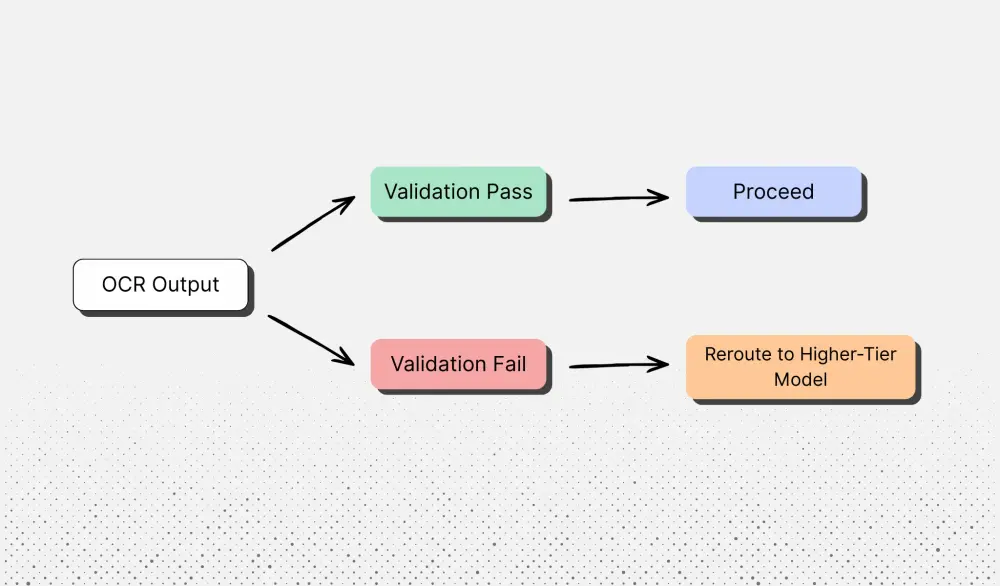
That layer added cost and complexity. It also prevented a single bad file from contaminating an entire report.
Most AI healthcare teams will encounter this problem. It’s not unique to one stack. The issue is structural: medical documents are visually complex and inconsistently formatted, and current OCR systems are not built with clinical liability in mind.
The Competitive Benchmark Is ChatGPT
Another reality that reshapes product decisions: physicians already use ChatGPT.
Before our system existed, our clinical partner was copying and pasting records into GPT-4 to get draft summaries. That means your product is not competing with another startup’s marketing page. It’s competing with a browser tab.
If you’re slower than ChatGPT, users will revert. If you’re less accurate, they’ll revert. If your system hides what it extracted, they'll distrust it.
We found that adoption hinged less on model cleverness and more on workflow alignment and transparency. Physicians wanted to see exactly what text was extracted from each uploaded file. They wanted to rearrange sections of the generated note to match their personal documentation flow. And they needed the entire process, even with 30 or more files, to complete in under a minute.
The architectural work to support that speed under real infrastructure constraints mattered more than incremental improvements in prompt phrasing.
Infrastructure Constraints Are Real
Early prototypes often run in idealized environments. Production does not.
New cloud accounts are heavily quota-limited by default. Initial OCR request ceilings can be extremely low. Scaling those limits requires support tickets, review cycles, and time. You cannot assume that because a model performs well in development, it will scale smoothly in production.
We had to design around those constraints while waiting for quota increases. That meant batching files, parallelizing processing across services, and implementing model fallbacks so that hitting one service limit would not stall the entire workflow.
These constraints shape architecture. They affect latency, cost, and user experience. They also force you to think about failure handling from day one.
In healthcare, “temporary slowdown” during a clinical workflow is not a minor inconvenience. It is a blocker.
Unit Economics Are Subtle but Critical
The encouraging part is that AI clinical documentation can be economically viable. But viability depends on careful architectural choices.
A typical 10-file report might cost only cents in model usage. Changing model versions can significantly shift that cost profile while maintaining or improving quality. At the same time, safeguards, such as OCR validation reruns, introduce additional per-file overhead when anomalies are detected.
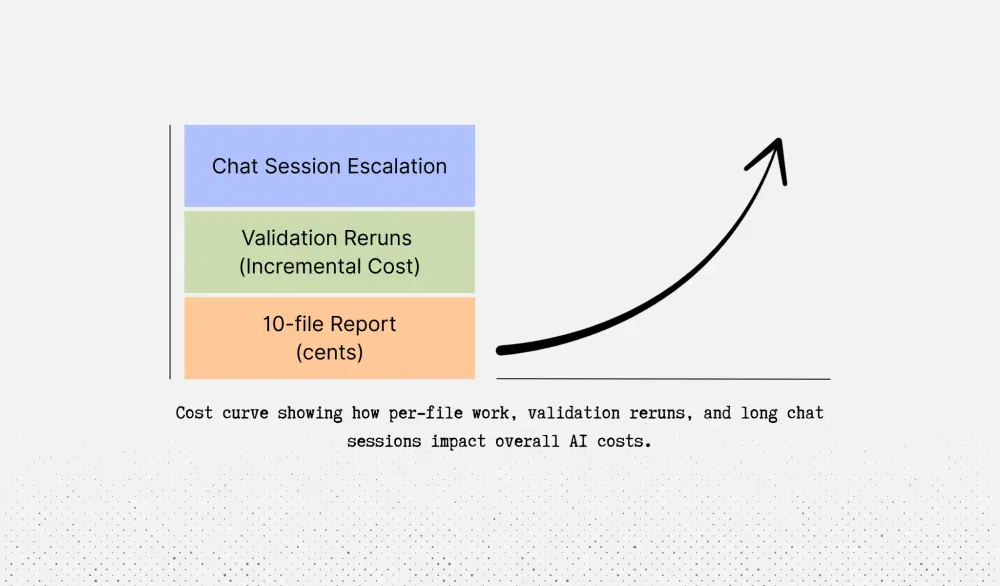
Chat-based interactions compound costs as sessions lengthen. The cost curve is not linear; it can accelerate depending on how conversations evolve.
If you’re building a subscription product, you must price for variability. Some physicians will upload minimal documentation. Others will run heavy, multi-file workflows daily. Architecture decisions around fallback systems, model selection, and validation frequency directly affect margin.
These are not abstract finance concerns. They feed back into engineering design.
Compliance Is Ongoing Discipline
HIPAA compliance is often described as a binary state. In practice, it’s an operational posture.
Using AWS’s HIPAA conformance pack provided a structured way to evaluate infrastructure alignment with recommended controls. Continuous monitoring is more important than a one-time checklist. Certain controls may be deferred pre-launch for cost reasons, but that decision should be explicit and documented.
In our case, compliance review by the clinical organization’s leadership was part of the deployment process. Approval depended on infrastructure transparency and documentation, not marketing claims.
In healthcare, security posture is part of product quality.
The Pattern That Emerges
Looking back, the visible AI component, the language model generating a note, was the least surprising part of the system.
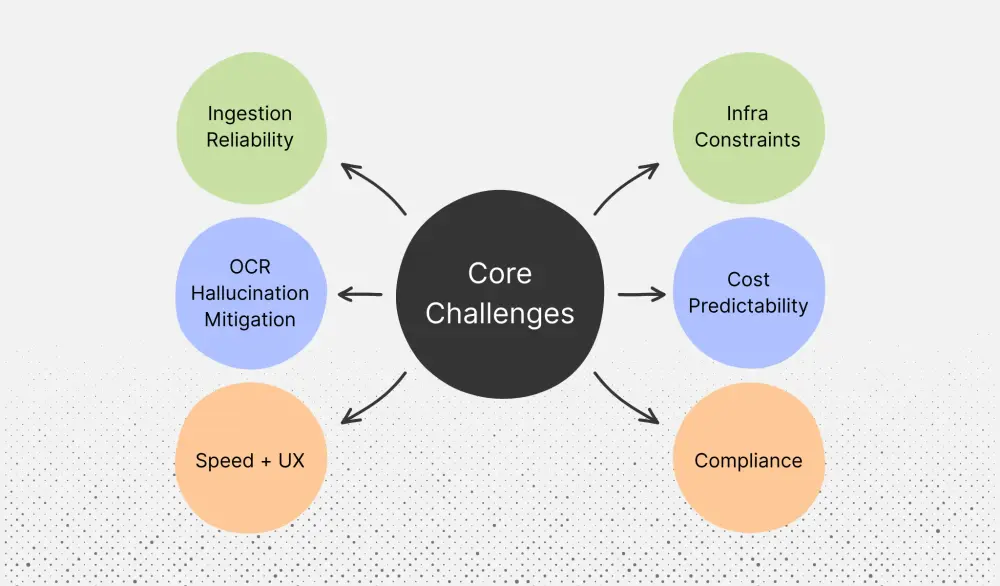
The hard parts were:
- Extracting reliable text from heterogeneous, degraded medical documents
- Detecting and mitigating OCR hallucinations before they propagate
- Matching or exceeding the speed and usability of ChatGPT
- Designing around cloud quota constraints
- Maintaining predictable unit economics under variable usage
- Treating compliance as continuous infrastructure discipline
Shipping AI in healthcare is less about model brilliance and more about systems engineering under clinical constraints.
The demo can look clean in a controlled environment. Real-world deployment requires building for corrupted inputs, inconsistent formats, infrastructure throttles, and skeptical users who already have a fallback tool open in another tab.
If you’re evaluating AI in healthcare, the right questions are not just about model accuracy benchmarks. They’re about ingestion reliability, validation architecture, infrastructure ceilings, and cost sensitivity under load.
That’s what it actually takes to move from an impressive demo to a system a physician is willing to use in daily clinical practice.