
The retail industry runs on razor-thin margins. A promo that doesn’t land, a jump in returns, or even one extra person on every shift can quietly wipe out a quarter’s profit. That’s why interest in generative AI in retail has taken off. Leaders want practical ways to protect margin and make shopping experiences feel smarter and more personal.
Generative AI isn’t just another predictive model. In retail, it uses your product catalog, inventory, transactions, and customer behavior to write product copy, suggest offers, and build action lists for store teams. And with more than half of consumers now using gen-AI tools in their daily lives, the bar for “instant and personalized” has never been higher. They expect the same when they shop.
At Aloa, we help retailers turn these ideas into production-ready generative AI systems. Our engineers dive deep into your workflows and validate ideas with fast prototypes. Then we turn the strongest ones into custom AI tools that fit your inventory rules, brand voice, compliance needs, and store operations. We tie each project to clear metrics like margin, conversion, operational efficiency, and long-term revenue growth.
This guide walks through the most promising use cases and a practical roadmap to get there.
TL;DR
- Generative AI in retail uses your own store, product, and customer data to personalize shopping, automate content, and support your teams.
- Top use cases today include virtual shopping assistants, tailored campaigns, smarter product pages, and store-manager copilots that turn data into clear actions.
- Successful rollouts start small: pick 1–3 workflows, attach simple KPIs, prototype quickly with real users, and add guardrails and training.
- Aloa partners end-to-end, helping retailers choose the right use cases, build sandbox prototypes, and ship production-ready generative AI tools into existing operations.
How Is Generative AI Used in Retail?
Generative AI in retail is used to turn everyday retail data into clear actions. It looks at what shoppers buy, what they browse, what they return, and even how long they linger on a page. Then it creates specific messages and product ideas for each person, like “Here are two shirts that match the jeans you viewed earlier” or “Your size is back in stock.”
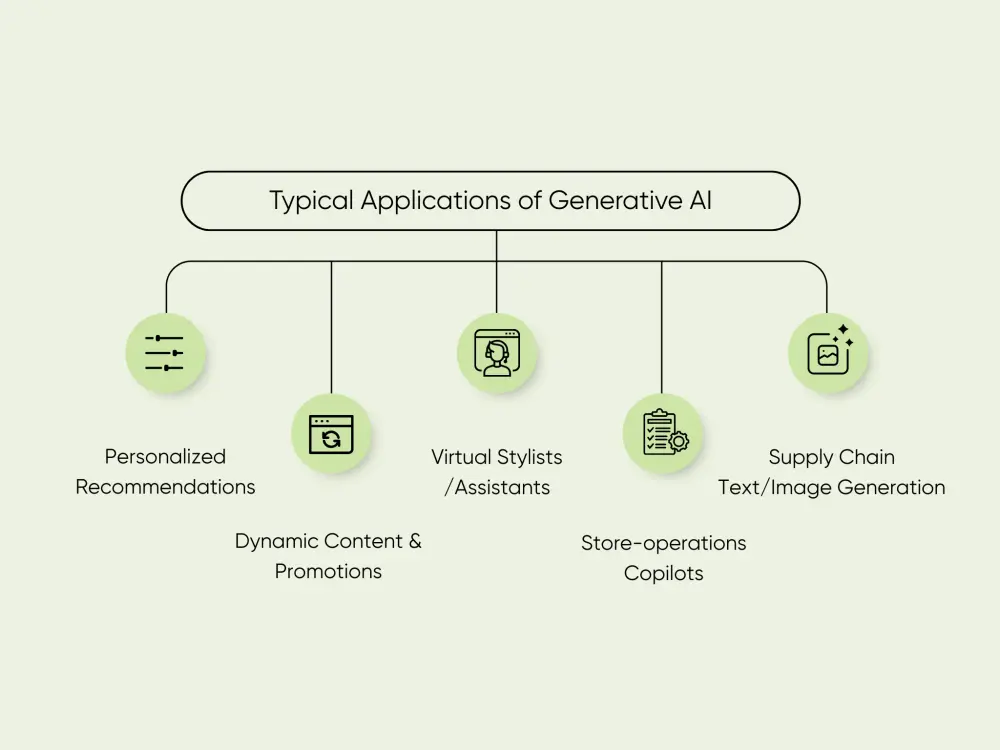
Here's how retailers often use it today:
- Product Guidance: Customer-facing chatbots suggest items based on clicks, past orders, and real-time availability.
- Content Creation: Marketing teams use AI to write product descriptions, emails, and on-site banners tied to trends and inventory.
- Virtual Styling: Digital assistants answer fit questions and build outfit suggestions or themed carts.
- Store Operations: Copilots compare shelf photos to planograms, generate daily task lists, and flag staffing needs.
- Supply Chain Communication: AI drafts packaging copy, sample images, and vendor updates so supply teams can review options fast.
In each case, the AI learns from your sales, customer behavior, and store data. Then it turns that learning into clear words, images, and next steps that save time and make each experience feel more personal.
Common Generative AI Use Cases in Retail
Now let’s look at a few use cases you can actually ship. These are the areas where leaders usually see quick wins in customer experience, sales, and day-to-day operations. Most current projects cluster around customer conversations, marketing, and content.
Customer Experience and Conversational Commerce
Customer questions never stop. Generative AI can help you triage those inquiries in plain, natural language so your team can handle more of them without burning out. This is conversational commerce: letting shoppers talk to your brand through chat, messaging, or voice and turning those conversations into real help and sales.
Picture a retailer that sells apparel with a strong app and a busy site. Instead of browsing through pages of products, a shopper can directly type, “I need a black dress for a winter wedding in Aspen under $150.” The virtual assistant then checks live inventory, filters for winter-friendly fabrics, looks at the shopper’s size from past orders if any, and returns three options. It also suggests a coat to complete the outfit, given popular outfit choices in Aspen, CO. This creates a high-quality, unique shopping experience that will likely leave a lasting impression on the shopper.
Conversational commerce doesn’t stop at online-only retailers. A grocery chain might let customers build a list with an AI chatbot. When they walk into the store, a shopper can scan a shelf tag and ask, “Which of these was the best fit for the item on my list?” and the assistant highlights the options on the spot.
As these assistants show up across channels that best fit your business, you’ll start to see the impact on your numbers. Conversion rate, average basket size, first-contact resolution, and CSAT all improve as the AI reduces minor friction points and frees up your employees’ time to spend more time with customers who need real help.
Hyper-Personalized Merchandising and Marketing
Now think about your email, push, and ad calendar. Many retailers still send broad messages and rely on basic segments. Generative AI lets you get far more specific without burning out your marketing team.
Let’s say you have a lifestyle brand and a robust loyalty program. One shopper mainly buys kids’ sneakers. Another mostly buys office clothes. A generative AI system can pull from their order history, browsing patterns, and location to write personalized versions of a “back-to-school” email or push notification. One leans into playground durability. The other focuses on “first week at a new job” outfits.
Retailers then A/B test these variants and let the models learn which versions drive more opens, clicks, and orders. In practice, this turns marketing campaigns into a steady loop. Your team sets the brief, voice, and limits. The AI creates options, runs controlled tests, and surfaces winners. Many leaders start their generative AI use cases here because the data lives in the CRM and the revenue impact is easy to track.
Product Content and Catalog Operations
If you manage a large catalog, you know how much effort disappears into product copy and data cleanup.
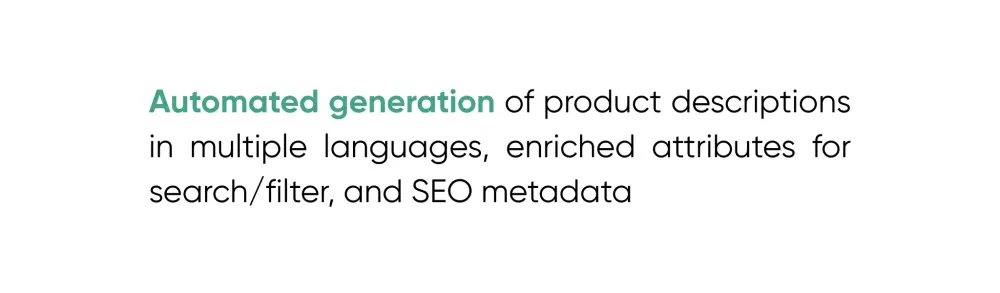
Imagine a home goods retailer adding hundreds of SKUs from different suppliers before a holiday push. Each item arrives with a spec sheet in a different format. An AI content tool reads those specs and past examples, then drafts clear descriptions and bullet points in your brand voice. It also fills fields like material, color, room type, and style so search and filters work properly.
The same system can create localized versions. A Canadian site might need different wording and sizes than a US site. The AI generates both, and your team reviews and approves instead of writing from scratch. For SEO, it suggests page titles and meta descriptions that match how people search, like “small space sofa” or “washable rug.”
Most retailers add a simple review step here. AI drafts the description and tags. A merchandiser checks details and tone, then clicks approve. That’s how you protect the brand while cutting hours of manual work, especially during seasonal drops or big vendor onboarding cycles.
At Aloa, we often build these tools to save time and effort for our clients. For example, we might create a catalog assistant that connects to your existing product systems and applies your tone and approval rules.
Real-World Examples of Generative AI in Retail
Here are real examples of how big retailers use generative AI in ways that match the use cases we just covered:
Walmart and Others Use AI to Help Shoppers
Walmart’s AI chatbot, Sparky, lives inside the Walmart app. A shopper can type something like “snacks for a kids’ movie night” and Sparky suggests chips, popcorn, and drinks, all from nearby stores. Walmart has shared that people who use Sparky place orders that are about 35% larger, because the assistant makes it easy to find and add related items.
Other large retail businesses now do something similar. Target, Amazon, and eBay use AI helpers that answer questions such as “Is this good for sensitive skin” or “Can this ship by Friday,” suggest specific products, and let shoppers add items to cart straight from chat instead of digging through long menus and filters. These adoption patterns mirror broader enterprise trends showing how generative AI is scaling fast across industries.
Nike and Zalando Personalize Marketing with AI
Nike uses AI to decide what each person sees in the Nike app and on the website. If someone often looks at running shoes and tracks their runs, the AI shows more running gear, tips, and offers. If another person buys mostly training clothes, they see more strength and gym content. The same data shapes which push notifications and emails they receive, so each message ties back to what that shopper actually does.
Zalando, a large online fashion retailer in Europe, uses generative AI to speed up campaign work. The team can describe a theme, such as “spring street style,” and the AI helps crop and create product images for social posts, app banners, and on-site tiles. This cuts production time from weeks to days, so Zalando can swap in new looks while a trend is still hot.
Walmart and Amazon Improve Product Pages with AI
Walmart uses AI to clean up and enrich product listings in its huge catalog. The system improves titles, rewrites weak descriptions, and fills missing details like size, color, and material. It also helps summarize long blocks of customer reviews into a few clear points, so shoppers can see common praise and complaints right away.
Amazon uses generative AI in a similar way on its product pages. It scans thousands of reviews, finds patterns, and turns them into a short paragraph that highlights what people like and what they do not. Shoppers get a quick read on fit, quality, and common issues without scrolling through pages of text.
All of these examples show the same idea in practice: generative AI does the heavy lifting on content and suggestions, while people still set goals, define rules, and check the final experience.
Benefits of Generative AI in Retail
Once you see how Walmart speeds up shopping, how Nike personalizes its app, and how Amazon cleans up product pages, it’s fair to ask what this means for your own business.
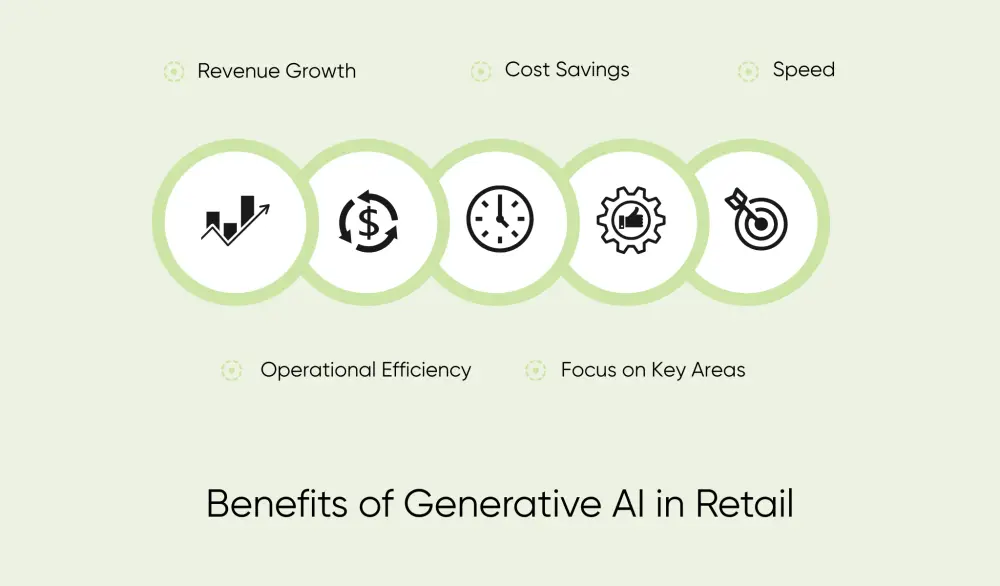
Revenue is usually what people care about the most. Industry studies show companies using AI in marketing and sales often see revenue grow up to 15% and marketing ROI improve by 10–20%. You get that lift when AI shows shoppers products that actually fit their needs. Think of a customer who adds socks and a water bottle to their cart because your AI noticed they buy running gear often.
Cost savings can also add up quickly. A contact center that gets thousands of “Where is my order?” messages can let an AI assistant pull status from order and shipping systems. This is where generative AI shines: it’s great at answering high-volume, repeat questions that follow clear policy rules. Human agents can then spend less time repeating the same steps and more time on complex or sensitive conversations that really need a person.
Finally, there’s speed and efficiency. A marketing team that once waited three weeks for new copy can now test a few ideas in one week. A merchandising manager can update product titles and attributes across a whole category in one sprint. A store leader can ask a copilot, “Which stores might run low on cold-weather items this weekend?” and get a clear answer in seconds instead of digging through spreadsheets.
Most of the value in retail AI shows up in customer operations, marketing and sales, and product or R&D work. But that value only appears if you focus on the right use cases and wire AI into the systems your teams already rely on.
At Aloa, we design AI solutions around each retailer’s goals, pain points, and existing stack. Together, we pick a few high-impact workflows, then build and integrate custom tools that fit your data, processes, and guardrails. We tie every AI project to clear targets like revenue, margin, customer scores, or hours saved, so you can see whether the implementation is actually delivering on GenAI’s promise.
How to Implement Generative AI in Retail
The easiest way to start is with real problems that your business is trying to solve. Sit with your store leaders, support team, and marketers and ask, “What slows you down every week?” Maybe it’s WISMO tickets, late campaign copy, or managers buried in spreadsheets. Choose at least one that clearly ties to money in or hours back. That’s your starting list.
Next, don’t start with a full system that could ideally replace multiple functions. At Aloa, we’ll often spin up a quick prototype in a safe sandbox. For one fashion retailer, we started with a simple “copy helper” that pulled from a sample of their catalog. Merchandisers used it for two weeks to draft emails and product pages. We watched where it helped, where it got things wrong, and tightened the rules. Only after it was clearly saving hours did we connect it to live tools and workflows.
Finally, lay the groundwork: basic data pipes into POS, e-commerce, CRM, and inventory, plus a setup where the AI only answers from your own catalog, policies, and playbooks. Add review and feedback so humans can spot issues early. If your team is already stretched thin, this is where a hands-on AI partner that actually builds (not just advises) can make the difference between a cool demo and something your stores use every day.
Risks, Challenges, and Governance Considerations
Once you start putting AI into real workflows, the risks get real, too. The good news: most of them are manageable if you prepare in advance.
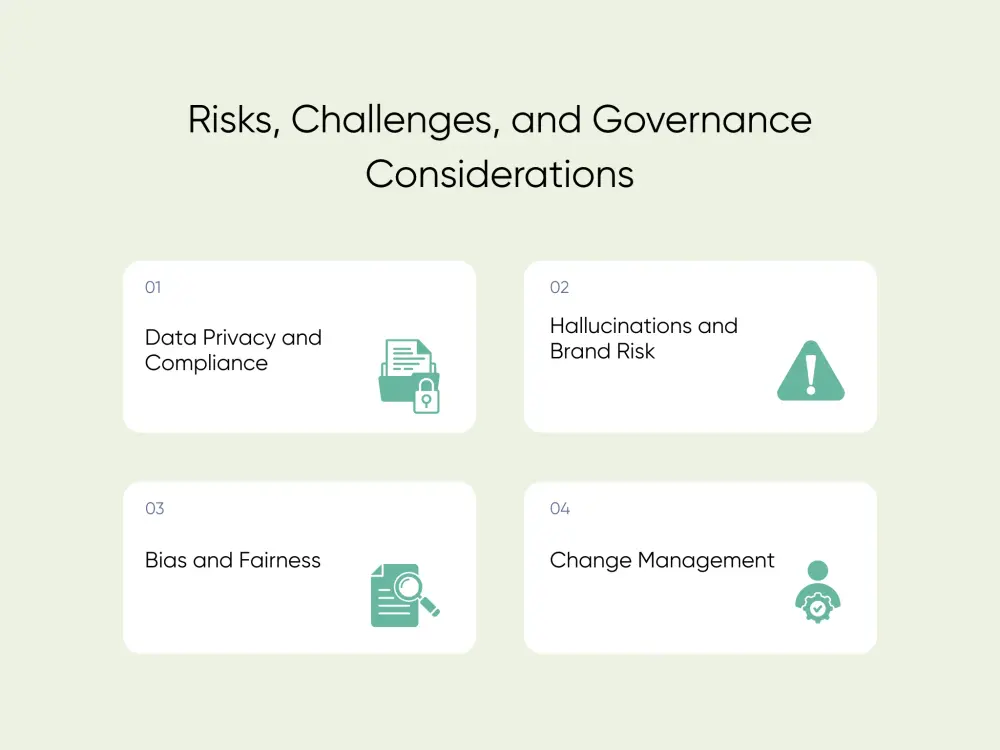
1. Data Privacy and Compliance
Think about your loyalty program and in-store cameras. If an AI assistant can see purchase history, video clips, or customer feedback, you need clear rules: what data it can access, where it lives, who can see the outputs, and how long you keep it. That usually means running AI in secure environments, limiting access by role, and logging who did what so you can answer regulators and customers when they ask.
2. Hallucinations and Brand Risk
Generative AI sometimes makes things up in a very confident tone. It’s called “hallucination.” In retail, it may be that a bot promises free returns when your terms say otherwise, or generates a product description that isn’t consistent with the actual product. This is why you must control where AI draws information from (your policies, catalog, and FAQs). You should also build in human approval for higher-risk content so it cannot be altered by AI.
3. Bias and Fairness
If your historical data is skewed toward certain neighborhoods (maybe because you have more stores there or you’ve always run your promotions in those zip codes), an AI promotions system can learn that pattern and keep rewarding the same areas. Customers in those neighborhoods might keep getting the strongest discounts and offers, while similar shoppers in other areas see less. That’s bad for customers and bad for your brand. Simple checks, like reviewing who's getting discounts, recommendations, and credit offers by segment, help you spot and correct skewed patterns.
4. Change Management
As we’ve seen repeatedly in GenAI adoption across industries, AI must be implemented by humans to succeed. Store staff and agents need training, examples of “good” vs “bad” use, and a clear answer to “What happens if the AI is wrong?” When they know their feedback is expected and valued, they’re more likely to speak up when something looks off. And that feedback is what makes the rollout more efficient and effective.
How Aloa Helps Retailers Ship Production-Ready Generative AI
Aloa is your end-to-end AI partner for retail and brick-and-mortar brands. We design, build, and support systems in-house, so the same team that scopes your use cases also ships and maintains your tools.
We’ve done this in highly regulated spaces like healthcare, where privacy, safety, and audit trails are non-negotiable. That experience carries over to retail: we’re used to working with sensitive data, strict policies, and complex approval flows.
Our process is simple but disciplined:
- Deep discovery to understand your workflows, constraints, and KPIs.
- Rapid prototyping so real users can try tools in a safe environment.
- Scaling to production with the right data connectors, guardrails, and monitoring baked in from day one.
Because we speak both business and engineering, we can help you decide where AI actually fits, which risks matter most, and how to measure success. If you’re exploring use cases like store-manager copilots, internal CX assistants, or catalog tools, you can start by exploring Aloa’s Generative AI Development Services and Brick & Mortar AI offerings to see how this approach can fit your own roadmap.
Key Takeaways
Generative AI in retail is already helping brands in many ways. The biggest wins often come from starting small: choosing a handful of high-impact workflows, setting clear goals, and testing quick prototypes with the people who will actually use them. When you build in clean data, clear rules, and a bit of training from the start, the tools stick and make a real difference.
If you’re thinking, “We don’t have the time or team to pull this off,” Aloa can help. We’re hands-on builders who work side-by-side with your team to shape ideas, test them fast, and turn the strongest ones into simple, reliable tools that fit smoothly into your daily operations.
If you want a partner who can help you choose the right AI projects (and then actually build them), book a consultation with Aloa. You’ll feel the difference right away. We experiment with new models the hour they drop and bring that learning directly into your project, so you can move faster with confidence.
FAQS about Generative AI in Retail
How do I choose generative AI use cases that will actually move our P&L?
Start with problems that show up in your weekly reports and your team’s complaints. For example: “WISMO tickets are up 40%,” “Email campaigns always ship late,” or “Stores keep fixing bad product data.” Those are good use cases because you can tie them to clear numbers like fewer tickets, faster launches, or better conversions. If you can’t put a metric next to it (revenue, margin, hours saved), park it for later.
We already use AI for demand forecasting. Do we really need generative AI as well?
Forecasting models tell you what will happen (“jackets will spike in the Northeast”). Generative AI helps your teams act on that faster. A planner can ask, “Which stores will run low on jackets and what should we ship this week?” and get a simple, natural-language action list instead of a dense spreadsheet. It doesn’t replace your existing AI; it sits on top and makes it easier to use.
What kind of data do we need before we talk to a GenAI partner?
You don’t need a perfect data warehouse. You do need basic access to where work already lives: POS and e-commerce orders, CRM or loyalty data, your ticketing system, and a product catalog with at least “good enough” attributes. A partner like Aloa will then map and clean what’s there as part of building the first prototype, instead of asking you to “fix everything” upfront.
How long does it take to go from idea to a working GenAI pilot in stores?
For a focused use case, you should expect a first pilot in about 6–8 weeks. At Aloa, a typical path looks like: a few days of discovery to pick the workflow and define success, 1–2 weeks to build a sandbox prototype, and the remaining time to test it with real users and tighten guardrails before touching production. Pricing is usually hourly with a cap, so you can control spend while you learn.
What’s the biggest mistake retailers make with generative AI?
Trying to “do AI everywhere” and treating it like a side project. Retailers spin up five different pilots, none have clear owners or KPIs, and nothing makes it into daily use. A better approach is to pick one or two workflows, involve the people who actually do the work, and measure success in plain terms like “minutes saved per ticket” or “lift in add-to-cart.” That’s exactly how Aloa builds custom generative AI solutions. We pick a few use cases worth betting on, prove value fast with targeted prototypes, then harden the winners into production systems.