
I've spent years building data pipelines. ETL jobs, streaming architectures, event-driven systems. But recently, I worked on something that forced me to rethink what a "pipeline" even means in 2026: a document OCR system that doesn't just process files, but also evaluates whether it did a good job and course-corrects when it didn't.
This is what I think the next generation of pipelines looks like: systems that do more than move data from A to B and instead build judgment into the process.
The Problem
We needed to extract text from medical documents, including scanned forms, handwritten notes, lab reports, and insurance paperwork. These were the kind of messy, real-world images that make traditional OCR break down. A single misread date or garbled diagnosis code could have real consequences downstream.
The naive approach would be: upload image, call OCR API, store text, done. But anyone who's shipped OCR in production knows that's where the pain starts, not where it ends.
The Architecture I Landed On
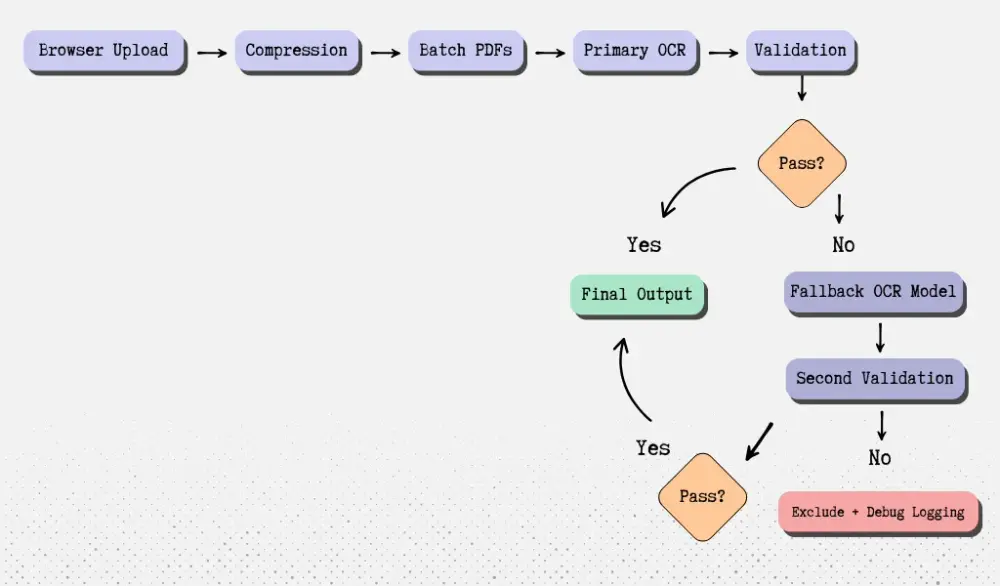
Instead of a linear pipeline, I designed what I've been calling a validation-fallback chain: a processing graph where each stage can assess its own output quality and escalate to a more capable (and more expensive) processor when confidence is low.
Here's the high-level flow:
Stage 1: Ingestion & Batching
Files come in from the browser through drag-and-drop, paste, or the file picker. They're compressed client-side using the Canvas API before they ever hit the network. This alone cuts upload time significantly for phone photos of documents, which are routinely 4 to 8MB each.
On the backend, images get bundled into PDFs. The primary OCR engine has a 30-page limit per request, so the system automatically splits large uploads into batches. Upload 75 images? That's 3 batches of 30, 30, and 15, all completely transparent to the user. No config and no "please upload fewer files" error messages.
Stage 2: Primary OCR
Each batch hits a fast, cost-effective OCR model. This handles the majority of documents well, especially clean scans, typed forms, and standard layouts. For 80%+ of files, we're done here.
Stage 3: Validation
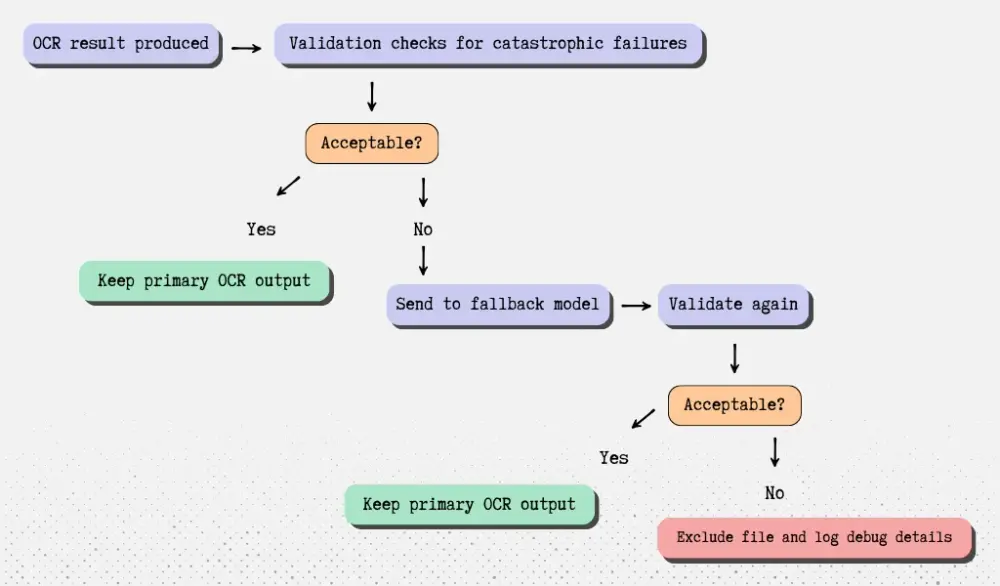
Here's where it gets interesting. Every OCR result gets passed to a lightweight vision model that looks at the original image and compares it to the extracted text. It doesn't compare character by character, because that would be brittle and expensive. Instead, it checks for catastrophic failures: garbage output, hallucinated content, completely empty results when there's clearly text in the image, or date years that got mangled (a surprisingly common OCR failure mode in medical docs).
The validation is deliberately lenient. Minor typos are fine. A garbled footer is acceptable. We're filtering for the output that would actively mislead someone downstream, not chasing perfection.
Stage 4: Fallback
Files that fail validation get escalated to a significantly more capable (and more expensive) vision model. Unlike traditional OCR, this one reads the document the way a human would, taking layout, context, and structure into account. It handles edge cases that trip up conventional OCR, including handwritten annotations, faded text, and complex multi-column layouts.
The fallback output goes through validation again. If it also fails, the file gets excluded with detailed debug information, with both outputs preserved and both failure reasons logged. No silent failures and no corrupted data sneaking through.
The Patterns That Made It Work
- Server-Sent Events for Real-time Progress: OCR processing can take minutes for large batches. Instead of showing a loading spinner and hoping for the best, the frontend gets granular events: which file is being converted, which batch is processing, when a fallback is triggered, and when rate limiting kicks in. The user sees every file tick from "pending" to "processing" to "complete" in real time. A 15-second heartbeat keeps the connection alive through aggressive proxy timeouts.
- Exponential Backoff with Countdown: Rate limiting is inevitable when you're hitting external APIs at scale. The system detects 429s, backs off (60s, 120s, 240s), and streams countdown updates to the frontend every 5 seconds. The user sees "Retrying in 47 seconds..." instead of a cryptic error.
- Concurrent Validation, Sequential OCR: Validation calls are cheap and independent; run them all in parallel. OCR API calls are expensive and rate-limited; run them sequentially. This maximizes throughput without tripping rate limits. It's a small architectural choice that has a big impact on both cost and reliability.
- Cold Start Resilience: The backend runs in a containerized environment that can cold-start. The frontend handles this transparently. If the first request fails, it waits two seconds and retries once. Combined with the SSE heartbeat, users never see cold-start errors.
- Aggressive Memory Management: Image buffers get released immediately after validation. When you're processing 75 high-resolution medical documents in a single request, holding onto raw image data will eat your memory budget fast.
What I Learned
- Pipelines aren't linear anymore: The interesting work is in decision points. When do you retry? When do you escalate? When do you give up? These are judgment calls, and encoding them well is often what separates a prototype from a production system.
- Cheap validation unlocks expensive fallbacks: The economics only work because the validation step is fast and cheap. Running every document through the expensive vision model would be prohibitive. Running a lightweight check first means you only pay the premium price for the 10-15% of documents that actually need it.
- Real-time feedback changes user behavior: When users can see exactly what's happening (including which files succeeded, which needed fallback, which failed and why), they stop treating the system as a black box. They learn which document types work well, they re-scan problem pages, they build trust in the output. The SSE streaming fundamentally changes how people interact with the system.
- Lenient validation > strict validation: My first instinct was to validate aggressively and flag anything that didn't match perfectly. This generated so many false positives that the fallback system was doing most of the work, which defeats the purpose. Dialing it back to only catch catastrophic failures felt counterintuitive, but it was the right call. In document processing, a result with minor errors is infinitely more useful than no result at all.
The Stack, Briefly
Client-side compression and state management in React. A Node.js backend orchestrating the pipeline. The primary OCR runs through a cloud AI platform. Validation and fallback leverage vision-capable language models at different cost tiers through a managed inference service. PDFs are assembled on the fly. Everything streams over SSE.
No message queues. No database writes during processing. No distributed state. The entire pipeline is stateless and ephemeral: process, validate, return, done. Sometimes the simplest architecture that handles your constraints is the right one.
Final Thought
We're entering an era where pipelines don't just transform data. They also evaluate their own work and adapt. The building blocks are there: fast-and-cheap models for validation, powerful-and-expensive models for fallback, streaming for transparency. The engineering challenge is designing the decision graph around it.
I think we're just scratching the surface of what self-aware pipelines can do. OCR was my use case, but the pattern of process, validate, escalate, and explain applies anywhere you're extracting structured information from unstructured inputs. And in a world drowning in unstructured data, that's pretty much everywhere.