
One of the most underappreciated realities of building with AI is that launching is not the finish line. AI-powered applications come with significant, ongoing post-launch considerations that can catch teams off guard if they're not planned for upfront.
The Model Deprecation Problem
A concrete example: Gemini 2.0 Flash was made generally available on February 5, 2025. Its original deprecation date was set for March 31, 2026, just 13 months after launch. That date has since been pushed back to June 1, 2026, but the underlying lesson remains the same.
Consider a realistic production timeline:
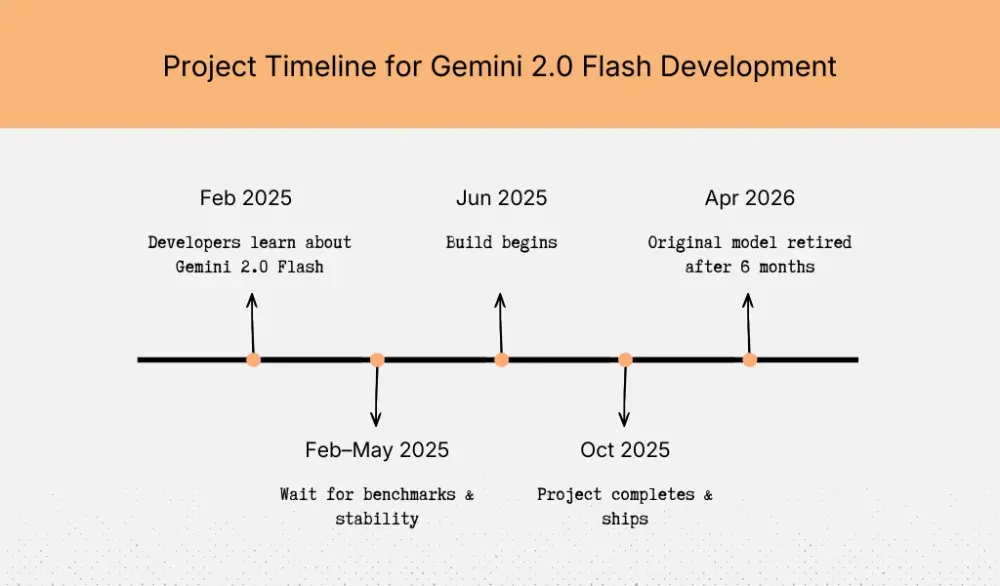
- Developers hear about Gemini 2.0 Flash at launch in February 2025
- They wait a few months for it to be benchmarked and considered stable for production use
- Development begins in June 2025
- The project takes four months to build and ships in October 2025
- Six months later, the model they built on is deprecated
It's entirely reasonable to assume there are production apps still running on Gemini 2.0 Flash today. And upgrading isn't necessarily a simple model swap. Gemini 2.0 Flash was notably stronger at instruction-following than earlier models in its lineage, so teams likely leaned on elaborate prompts and guardrails to get predictable behavior. Newer models like Gemini 2.5 Flash or Gemini 3.x handle instructions more naturally, which ironically means that over-specified prompts written for an older model can confuse a newer one, producing unintended or degraded results.
If this is your production app, you can't just swap the model string and ship. You have to run comprehensive regression testing across every user-facing flow to confirm behavior is preserved before you can safely upgrade.
Version Updates Are Costly Too, Even Within a Family
This isn't just a problem at the extreme end. We see it in more routine migrations too. Teams moving from Claude Opus 4.1 to 4.5 to 4.6 often find that some use cases carry over cleanly, while others require additional prompt tuning to restore the behavior they relied on. The delta is usually manageable, but it's never zero, and it requires discipline to catch regressions before they reach users.
Switching Model Providers Is Even More Involved
If you've been hearing about reliability concerns with a given provider, like recent reports of elevated latency and occasional downtime with Claude, the natural instinct is to evaluate a switch to GPT or Gemini. That's a sound instinct. But switching model families is a significantly larger undertaking than bumping a version number.
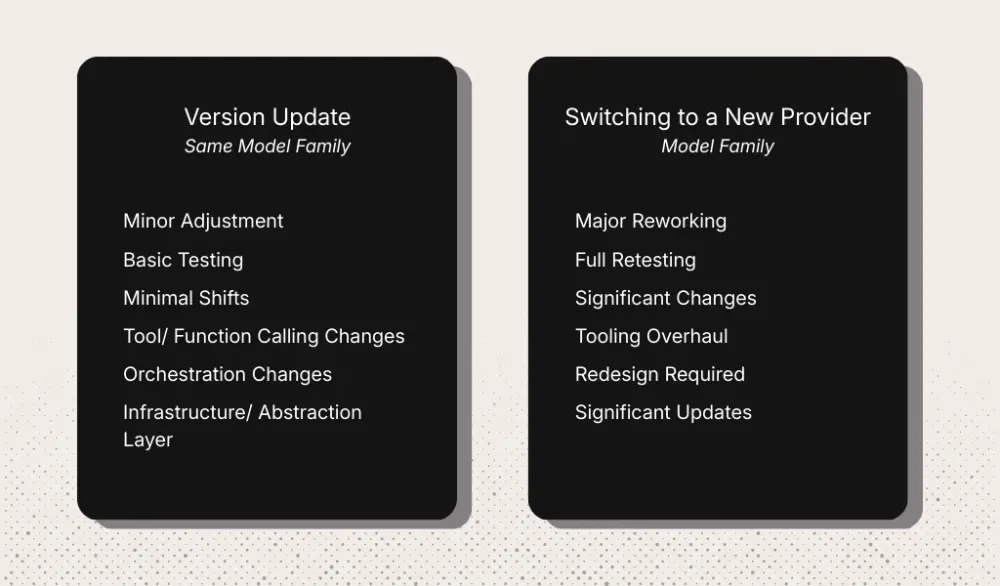
Beyond re-testing all your flows against a new model's behavior, you may also need to rework scaffolding around tool-calling loops, function definitions, and agentic orchestration, especially if you built those layers from scratch rather than using an abstraction like OpenRouter or Vercel's AI SDK. These abstractions exist precisely to insulate your application from provider-specific implementation details, and skipping them is a debt you pay later.
AI Requires a More Intensive Maintenance Contract
Normal software projects already require ongoing maintenance, including dependency updates, security patches, performance tuning. AI applications raise the stakes considerably. Model behavior can shift with a version bump. Providers can deprecate with short notice. Latency and reliability can vary across providers in ways that are hard to predict. This needs to be scoped and budgeted for at the start of any AI engagement, not treated as an afterthought.
How We're Addressing This at Aloa
Evals, Benchmarks, and Usage Analytics
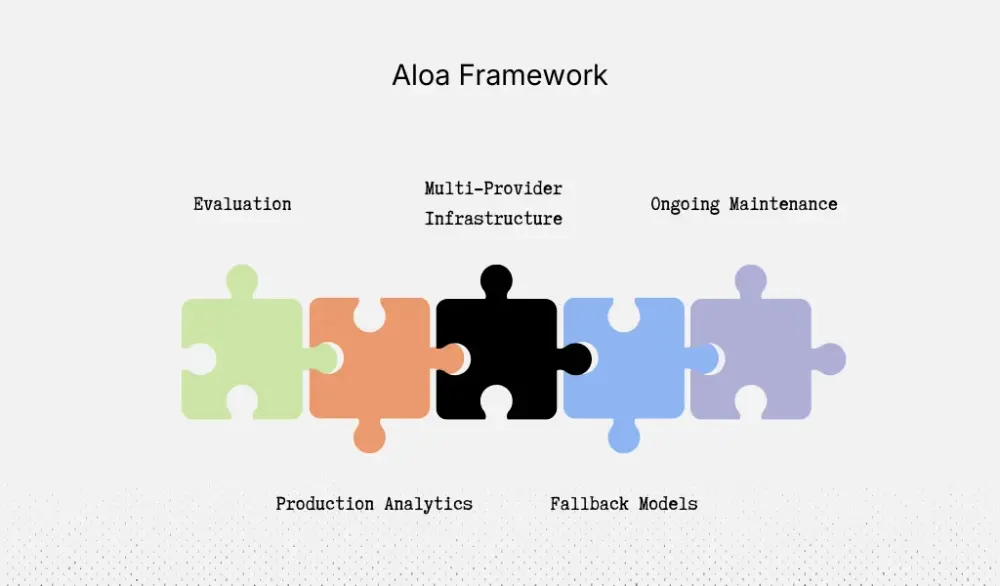
We invest heavily in AI evaluations, using structured benchmarks to establish how our current model setup performs across the use cases that matter most to our users. We also instrument production analytics to understand how users are actually interacting with AI features. Together, these tools let us quickly assess a new model's compatibility with our existing setup before committing to a migration.
Avoiding Vendor Lock-In
We have a deliberate multi-provider strategy:
- In development, we almost exclusively route through OpenRouter, except where tighter compliance requirements dictate otherwise. OpenRouter gives us access to models from many providers through a single, unified API, making experimentation and provider-switching cheap.
- In production, we prefer managed platforms like AWS Bedrock and Google Vertex AI, which aggregate models from multiple providers under a single enterprise umbrella. They’re also both HIPAA-eligible, which matters for our use cases.
We strongly recommend a similar approach for any team considering embedding AI into their applications.
Always Have a Fallback Model Ready
We maintain at least two fully tested models from different providers that we've validated across all of our application's use cases. If one provider goes down or a model is deprecated with short notice, we can fail over automatically without a customer-facing incident. You don't want your entire AI-powered product to be hostage to a single model from a single provider.
The teams that treat AI infrastructure like any other critical dependency, with versioning strategies, fallback planning, and ongoing evaluation, are the ones that avoid nasty surprises.