

Good morning,
Meta is doubling down on chips, Anthropic is pushing into finance and publishing new benchmarks, and China’s AI race is heating up despite export controls. Big Tech is spending aggressively, and model capability is becoming the new battleground.
Let’s dive in 👇
━━━
Powered by Aloa • AI Research & Education Hub
━━━
Which LLM Should You Use? - by David
I get asked all the time: what LLM should I use? I’m becoming someone that many in my network turn to for questions about AI; this question is at the top of the list.
I put together a breakdown of each LLM (ChatGPT, Claude, Gemini, Perplexity & Grok) to outline their pros, cons & pricing. If you’ve been curious about which one is best for you, feel free to check out my thoughts here.
🚀 AI Infrastructure & Global Race
🧠 Meta Expands GPU Buying Spree
Meta plans to use 6 gigawatts of AMD GPUs just days after expanding its Nvidia AI chip deal, signaling an unprecedented scale of compute demand. Six gigawatts is comparable to multiple nuclear reactors worth of power, underscoring how central AI training has become to Meta’s long term strategy. The move cements Meta as one of the largest AI infrastructure buyers globally and intensifies pressure on the chip supply chain.
🇨🇳 DeepSeek Trained on Nvidia’s Top Chips
China’s DeepSeek trained its AI model using Nvidia’s most advanced chips despite US export bans, according to a Chinese official. The disclosure raises fresh questions about enforcement of semiconductor restrictions and the effectiveness of export controls. It also highlights how critical high end GPUs remain for frontier model development, regardless of geopolitical friction.
☁️ Google’s Three Frontiers of AI
Google’s cloud AI lead outlined three major frontiers shaping model capability, including reasoning depth, multimodality, and efficiency. The company is positioning its cloud platform as the backbone for enterprises navigating these next generation models. As infrastructure, tooling, and model quality converge, Google is aiming to compete across the full stack rather than just at the API layer.

🏦 Enterprise AI & Model Governance
💼 Intuit and Anthropic Partner
Intuit and Anthropic are partnering to bring trusted AI experiences into financial workflows. The collaboration focuses on embedding Claude into products like TurboTax and QuickBooks while emphasizing reliability and compliance. It signals that major fintech platforms are prioritizing controlled, domain specific AI deployments over open ended experimentation.
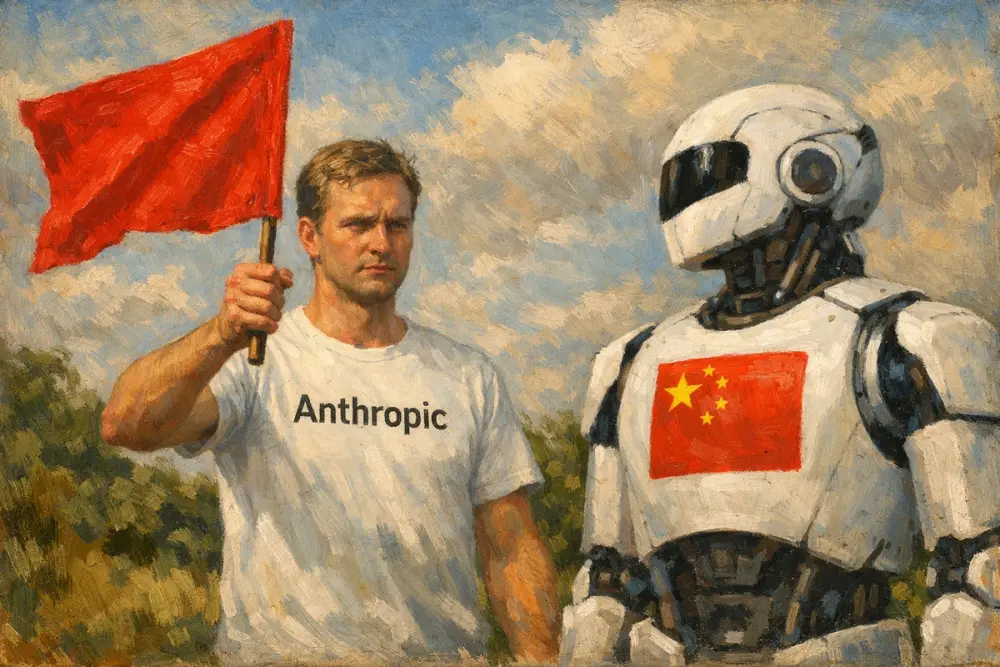
🔐 Anthropic Flags Chinese AI Activity
Anthropic says Chinese AI firms used its models in ways that triggered safety monitoring systems. The company claims it detected and disrupted activity tied to potential misuse, reinforcing concerns about cross border model access. This episode adds to the growing debate around AI governance, monitoring, and responsible deployment at scale.
📊 Introducing the AI Fluency Index
Anthropic released its AI Fluency Index, a framework for measuring how effectively individuals and organizations use AI tools. The index aims to move beyond raw model benchmarks and focus on real world capability and adoption. As AI becomes embedded in workflows, measuring human AI competence may become as important as evaluating model performance.
🛠️ Tools of the Day
→ Anima App – Convert designs into production ready code using AI driven automation.
→ Stitch by Google – AI assisted UI generation tool for faster prototyping and product iteration.
→ Liner Write – AI writing assistant focused on research backed content creation.
⚡ Quick Hits
→ Canva acquires startups to expand animation and marketing tools.
→ Meta AI researcher warns of agent misfire in inbox.
→ Particles AI news app auto extracts podcast highlights.
→ Spotify AI playlists expand to new UK markets.
🧾 TLDR
Meta is scaling compute at historic levels, China’s DeepSeek reportedly trained on restricted Nvidia chips, and Google is redefining model capability frontiers. Meanwhile, Anthropic is expanding into finance with Intuit, flagging misuse abroad, and introducing an AI Fluency Index to measure real world adoption. The race is no longer just about bigger models, it is about infrastructure, governance, and practical deployment.
Cheers,
David